
View the full issue in the Magazine Archive Cancer, the Crab, is a mid-sized constellation that lies just east of Gemini and just west of Leo. Cancer is made up solely of dim stars, and its shape is...
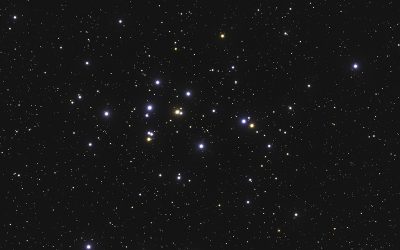

View the full issue in the Magazine Archive Cancer, the Crab, is a mid-sized constellation that lies just east of Gemini and just west of Leo. Cancer is made up solely of dim stars, and its shape is...

View the full issue in the Magazine Archive M35 and NGC 2158. Photo © Scott Rosen. Gemini, the twins, lies northeast of Orion along the band of the Milky Way. The most obvious part of Gemini is the...

View the full issue in the Magazine Archive Double Cluster, NGC 869 & NGC 884. Photo © Boris Stromar|Dreamstime.com. To the ancient Greeks, the stars of Perseus represented a hero. To me, this...

Andromeda Galaxy, M31. Photo © Shaphan Shank. Andromeda is one of those ideal constellations that is easy to find, and that contains a wide variety of outstanding telescopic targets. The main part...

M64 On May evenings, our planet is turned so that we are looking out the side of the Milky Way instead of looking edgewise through its arms. This orientation means that there are few star clusters...

Canis Major, the Great Dog, lies in the southern sky just southeast of Orion. Like Orion, many of the stars that make up Canis Major are bright. The constellation’s brightest star, Sirius, is the...

Triangulum and Aries are a pair of small constellations that lie south of Andromeda, between the Great Square of Pegasus and the Pleiades. Triangulum, the Triangle, is the more northerly of the...

Canes Venatici is a small constellation, consisting of only two stars. However, it is quite easy to find due to its location just south of the Big Dipper. Like many of the surrounding...

View the full issue in the Magazine Archive Ursa Major, the Great Bear, is a large constellation in the northern circumpolar region of the sky. Ursa Major is known best for the Big Dipper, which...