“Is it the tapioca plant?” you ask. Well, Wondernose, you are on the right track. The tiny round balls we are talking about are indeed tapioca, which certainly makes good pudding.
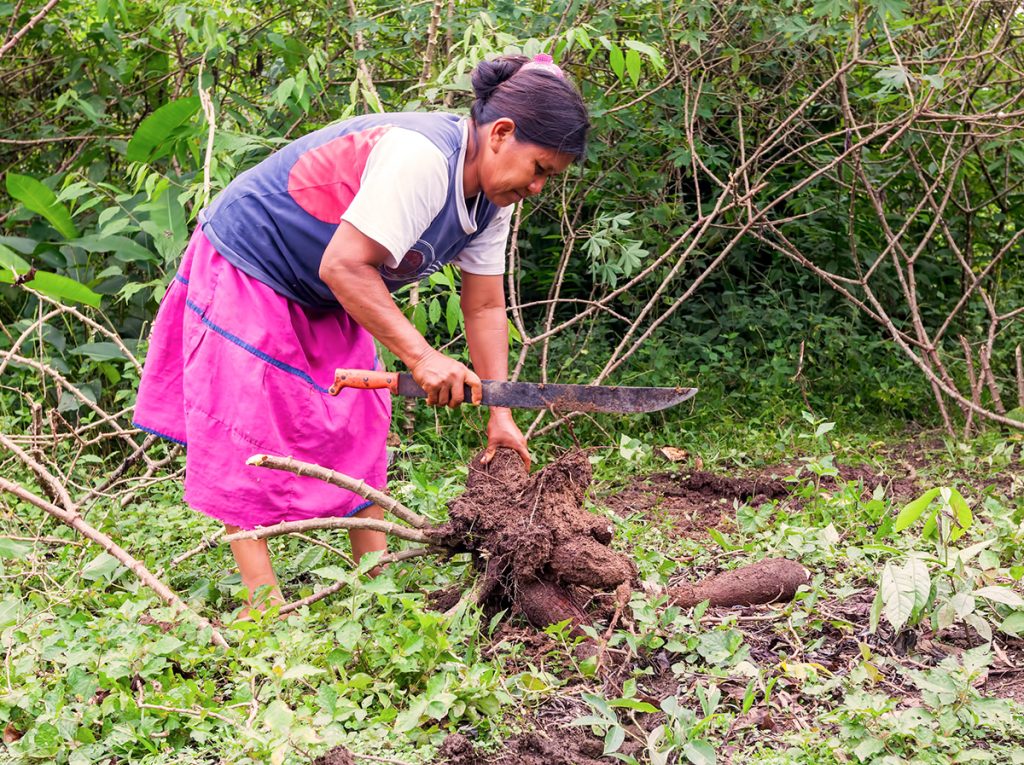
However, there is no such thing as a tapioca plant! Our mystery plant is called cassava, and it’s grown mainly in South America. That’s where it originated anyway, but other tropical countries around the world are now also cultivating cassava.
In many ways, cassava resembles potatoes. The part that’s useful for food is the tubers. Cassava tubers can grow very large, though—up to 4 feet (1+ m) long. A single cassava plant may yield 30 pounds (13 kg) of tubers. That’s more than the amount of tubers you expect to find below a potato plant.
Potatoes contain a lot of starch. So do cassava tubers. But potatoes also contain proteins and vitamins. Cassava has very little of those. It’s mainly starch! This doesn’t mean that the tapioca made from cassava isn’t healthful. Our bodies do need starch to convert into energy.
Here’s another similarity between cassava and potatoes. Potato leaves are poisonous. Cassava plants—even the tubers—also contain a certain amount of poison. There are two main types of cassava plants—the bitter and the sweet—and it’s the bitter ones that have poison. When cassava leaves are cooked, they lose their poison. As for the tubers, I understand any poisons they contain can be easily washed out. So don’t worry that tapioca may be poisonous, Wondernose.
How do plants make starch, anyway? Plants have at their disposal sunlight, water, air, and soil. How can they take those components and come up with starch? Well, the main job of green plants is to make food. This food-making process is called photosynthesis. Plants use energy from the sun to change water and carbon dioxide into glucose (sugar) and oxygen. Plant cells then quickly convert sugar into starch. In the case of the cassava plant, the starch is stored in those long tubers underground.
Supposing we had in front of us a pile of rough-looking brown cassava tubers, Wondernose, we would still be full of questions. How do these become the tiny round balls we call tapioca?
Well, the primitive method is to add lots of water till the tubers are reduced to a pulp. By straining this pulp, starch particles are separated from the root fibers. Now the starchy pellets have to be dried in the sun.
But we still haven’t gotten the little round balls! Those starchy pellets have to undergo a rotary motion. This can be done by shaking them round and round on a canvas. Thus the “pearls” of tapioca are formed! Of course, there are mechanical ways now to do each of the steps we’ve described.
The cassava plant has several different names. It’s also called manioc or yuca.
Cassava starch has numerous other uses besides tapioca-making. It’s used in cloth-making, in paper-making, and in glue-making.