Rain was in the forecast, and clouds began to creep up out of the west. But as the sun sank behind the ridge, the sky began to clear off, and what clouds were in the sky disappeared in the east. As the sky darkened and stars began to appear, I saw that tonight would be an exceptionally good viewing night.
I gathered my stargazing gear—several eyepieces, a star map, and, of course, my telescope. After collimating the scope and bidding my wife good night, I went outside. About the only good stargazing spot on this small property is the driveway. I usually spread out a carpet so I don’t get my knees chafed up while kneeling to peer through the eyepieces.
I inserted the 25mm eyepiece, which is about 50 power in my scope. I viewed bright little Jupiter and Saturn before turning to the numerous bright summer clusters and nebulae, which were now in the west. More directly overhead were the early autumn constellations Cygnus and Pegasus. Toward the south lay the sprawling constellation Aquarius.
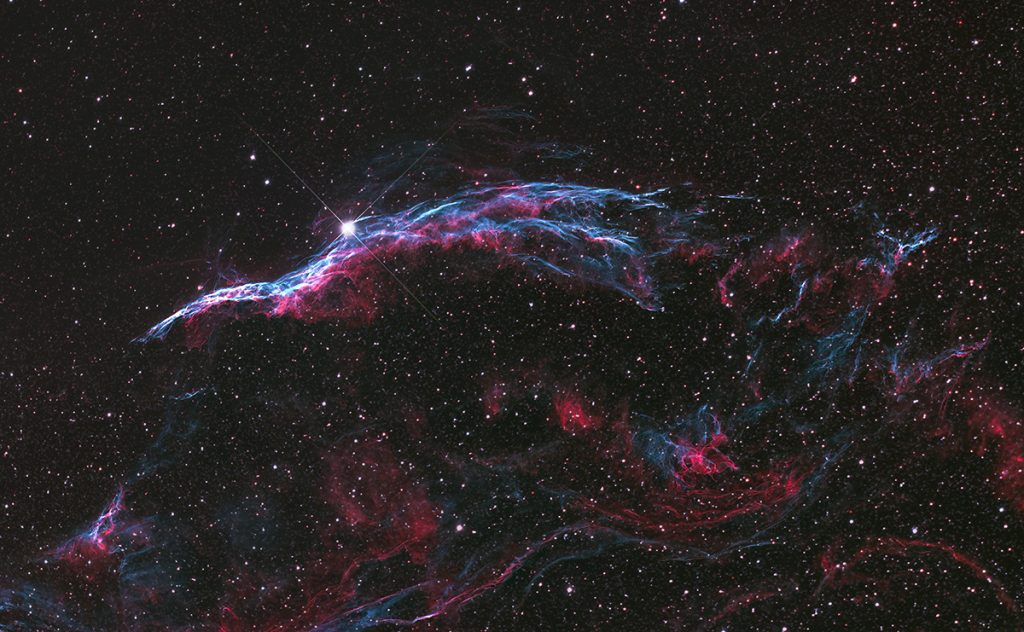
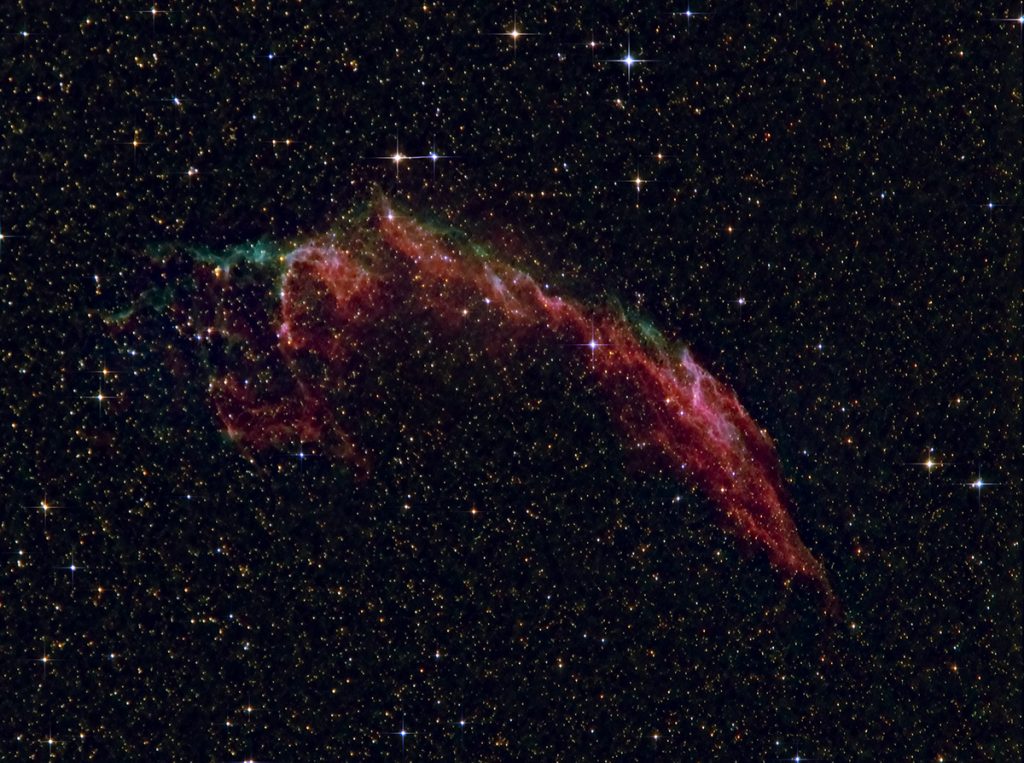
One of the most interesting objects in Cygnus is the Veil Nebula, a wispy, faint cloud that kind of looks like a smoke trail. This nebula is too large to fit in one field of view and is split into two separate sections commonly known as the Eastern and Western Veil. (An O-III filter will increase contrast for brighter viewing of emission nebulae. A UHC filter will enhance a wider range of nebula than the O-III, though for some, including the Veil, the O-III is superior.)
I viewed some more objects before switching to the 9mm eyepiece, which gives me about 130 power. Now I viewed the Helix Nebula, a planetary nebula in Aquarius. This one is truly a test of eyesight. Practically no detail is visible; it mostly looks like a faint gray round cloud.
Also in Aquarius are several globular clusters, M2 and M72. They look vastly different from each other. M2 is a nice compact ball of stars, bright and large enough for individual stars to be seen. M72 is small and faint. No individual stars are visible regardless how hard I strain my eye.
M15 is another globular a little north of M2. This one looks similar to M2, being about the same size and brightness. However, through my telescope, M15 appears to have a denser core with edges that are more scattered.
M13 in Hercules is in quite a different part of the sky, but is the best globular I have ever viewed. I studied it for a bit, then searched for and found a dim small galaxy nearby that I had discovered this summer.
Next I studied several galaxies in Pegasus—NGC 7331 and NGC 7814. NGC 7331 is the best of the two. It’s not overly large or bright, yet I always find it interesting to view, an oblong smudge of light with a brighter center.
According to the map, the galaxy NGC 7814 is the only object in the Great Square of Pegasus that is visible in telescopes the size of mine. This galaxy is quite dim, but it is not overly hard to find, being beside a star that is visible in the finderscope.
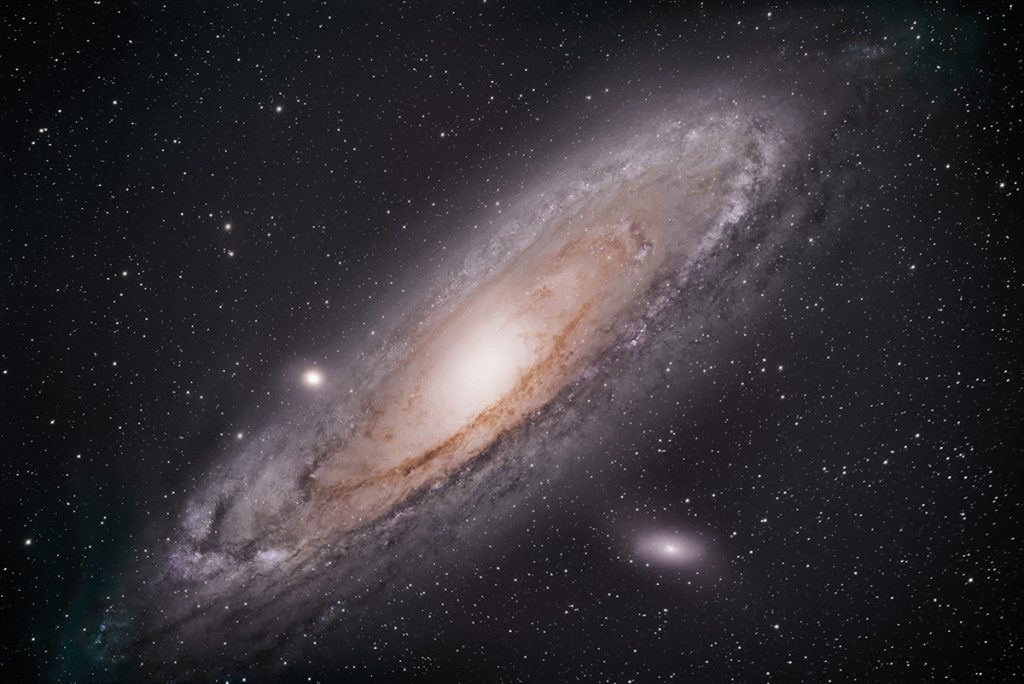
I viewed numerous other objects, including the brightest galaxy in our skies, M31 (the Andromeda Galaxy). This galaxy is easily visible in binoculars if you know where to look. Through a telescope it looks quite impressive, and I view it whenever I get a chance.
The constellation Perseus was starting to rise over the neighbor’s pine trees. This constellation holds a small nebula known as the Little Dumbbell Nebula. To me, it looks like a rectangle with the middle squashed in. Then I also viewed the “real” Dumbbell Nebula in Cygnus. This nebula is larger and brighter and looks like an apple core.
I turned the scope to the Veil Nebula again. The western section is the easiest to find. While searching for the eastern section, I came across a faint round object which I could not identify. And the star map made no mention of it. It reminded me of a dim galaxy; however, galaxies are seldom, if ever, found along the Milky Way band.
This was not the first time I had found such an object. It always makes me wish I would have some way of finding out what it is.*
Before going inside, I viewed Jupiter and Saturn again and got wonderful looks at both.
As I was about to enter the door, a Barred Owl hollered a farewell from his haunts down in the valley. Often when I’m out stargazing, he keeps me entertained with all kinds of hoots and hollers. But tonight he had been strangely silent until now.
Nights such as this make me wonder why more people don’t make time to enjoy this fascinating and worthwhile way of studying creation. Quiet nighttime out under the stars, away from the day’s hustle, bustle, and noise—such fun!
*Stellarium is a free planetarium software that gives much more information than is found on star maps. What was likely seen was NGC 6979, Fleming’s Triangular Wisp (Veil Nebula).