


Not everything that looks like a rainbow is called a rainbow. Colorful arcs close to the Sun are in the not-a-rainbow category. You can never see the Sun and a rainbow at the same time. You see, a true rainbow is always on the opposite side of the sky from the Sun. It is caused by raindrops doubly refracting sunlight back to you. If you see rainbow colors somewhere in the sky close to the Sun, you’re looking at one of many other phenomena caused by ice particles instead of raindrops. The same effect can be seen with the Moon, but it is harder to detect since it is not as bright. One of the most common displays of rainbow colors close to the Sun is called a sun dog, or moon dog when seen close to the Moon.
Sun dogs are seen 22° to the left or right of the Sun and are caused by hexagon-shaped ice crystals oriented with their flat faces pointing up and down. Sun dogs are the same distance from the Sun as 22° halos.
These halos are caused by randomly oriented ice crystals with hexagonal shapes and are relatively commonly seen. In rare cases, extra halos or arcs can be seen about twice the distance of a 22° halo from the Sun. This is what I saw in 2015 a couple of miles from our house in Georgia. I had to take three pictures and combine them to get the full view. There was a 22° halo around the Sun, a supralateral arc above the halo, and an infralateral arc below the halo.
Coronas are diffuse rings of light around the Sun or Moon. They are smaller than halos, and the entire circular area is illuminated like a disc instead of just a bright ring at the edge of the circle. Coronas are caused by water droplets instead of ice crystals and are either white or somewhat colorful.
An upper tangent sits just above a 22° halo. These formations are caused by hexagon-shaped ice columns with a horizontal orientation. They have strong curves when the Sun is low, but they flatten out the higher the Sun is in the sky.
Circumzenithal arcs bend around the point in the sky called the zenith (straight up). You are more likely to be able to see them if sun dogs are visible and the Sun is between 5° and 32° above the horizon. These are formed when light enters the top side of a hexagonal ice crystal but exits through a vertical side. The Sun is always below this type of arc.
Circumhorizontal arcs appear as bands of color parallel to the horizon. The Sun is always above this type of an arc and has to be at least 58° above the horizon.
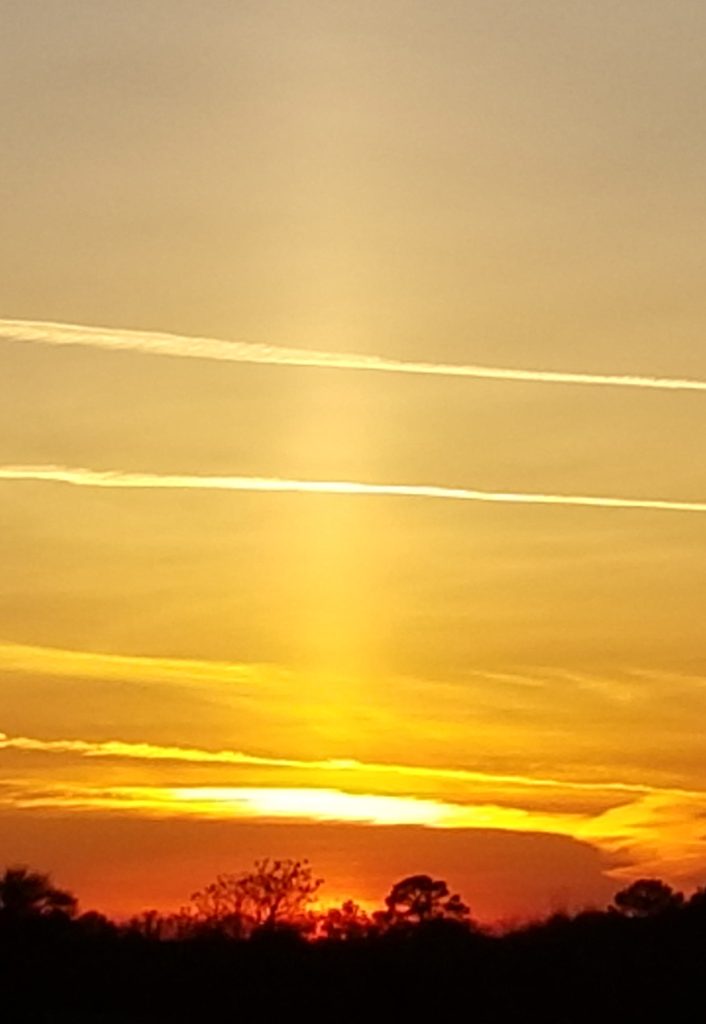
Sun pillars are bright shafts of light extending straight up from the Sun. They are seen only at sunsets and sunrises. They’re caused by ice crystals as well, but sunlight only reflects off of the crystals instead of being refracted through the crystals.
A glory is one or more colored rings of light around a shadow at the point opposite from the Sun. For a glory to be visible, an observer has to be between the Sun and a cloud of refracting water droplets. For this reason, glories are most often seen from airplanes. If you see a glory from your airplane seat, the center of it will be centered on your seat in the airplane. A friend of mine, Darryl Martin, took a photo of a glory he saw while flying. You can tell by looking at the position of the glory around the shadow of the plane, that he was sitting a little in front of center. The jet engine in front of the wing also shows that was his location.
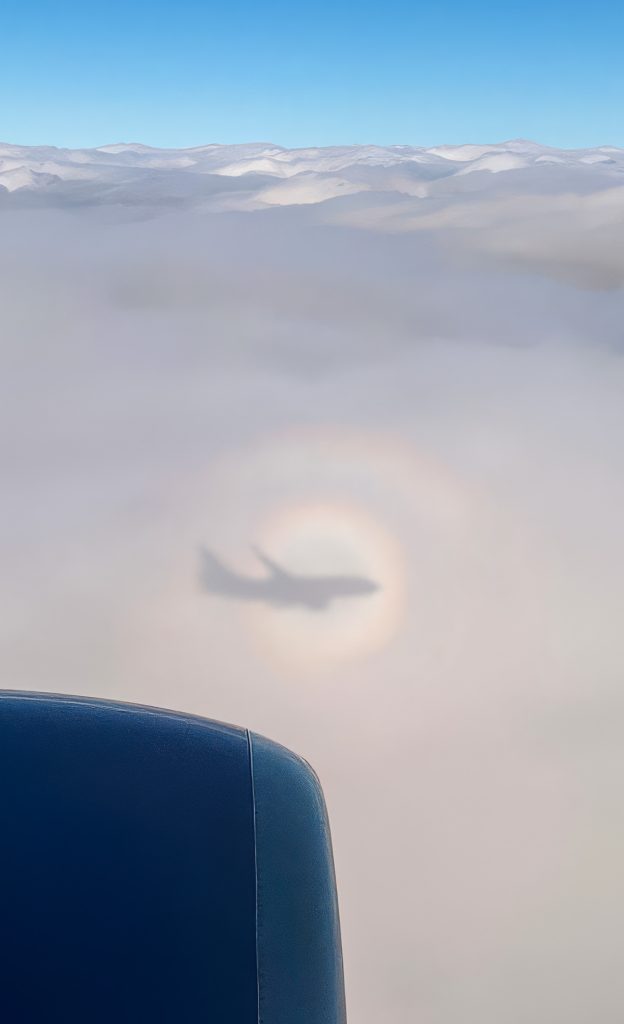
This is an example of how all rainbows, halos, arcs, and other colorful displays are unique to each observer. When you’re looking at any one of these things, your friend a few yards away may be seeing a completely different one, projected by different ice crystals or raindrops.
Every arc, halo, and bow is made by the Creator to be beautiful and unique to you personally, just as you are to Him.