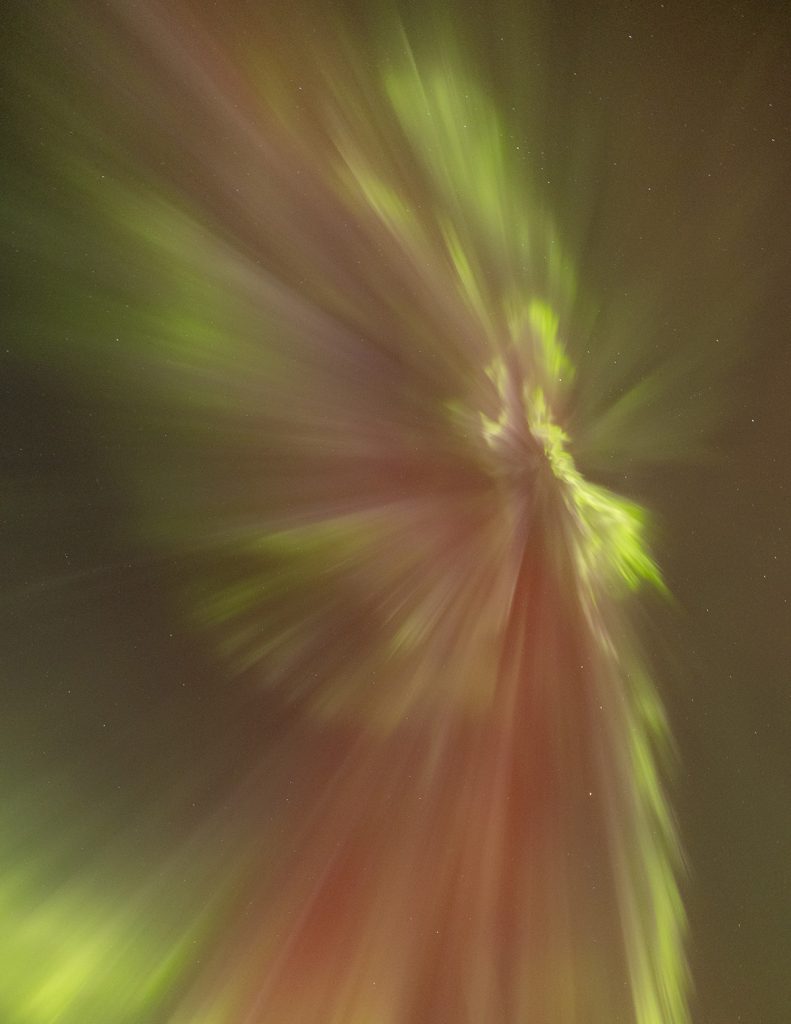
Trails and Tales Contest Honorable Mention
When I found out I would be going on a trip to Alaska, I was very excited. I would be able to enjoy several of my favorite hobbies—astronomy, birding, hiking, and especially photography. I had studied a lot about photographing northern lights, and I couldn’t wait to use what I had learned.
Dad and I had just left our hotel in Seward on New Year’s Eve, 2024, and were on our way out to photograph the early morning light on the mountains around Resurrection Bay.
“There’s an eagle!” Dad said. There, in a barren tree near the shore, sat a Bald Eagle. As soon as we could, we turned around, drove back, and I jumped out and began shooting with a Canon R6 Mark II that I had rented for the trip. The eagle was backlit, so I went to the other side of the tree. There I noticed two Pine Siskins in a bush. The light on the eagle was better, but now I was shooting almost straight up at it, so I walked toward the bush to get a better angle and kept switching between shooting the eagle and the siskins. Soon I was within 3 feet (1 m) of the siskins, and they still hadn’t moved!
Then I spied a sea otter floating a few hundred feet out in Resurrection Bay. After the otter dove, I turned my attention back to the eagle. It took off, and I thought I had gotten some great pictures. Then I realized my shutter speed had been too slow—all the pictures were blurry. Oh, well.
We stopped at a drive-thru coffee shop to get breakfast, and while we were waiting, I saw another eagle on top of a pine tree across the road. I double-checked my shutter speed, got out, and the eagle took off. I fired away, and this time the pictures weren’t blurry.
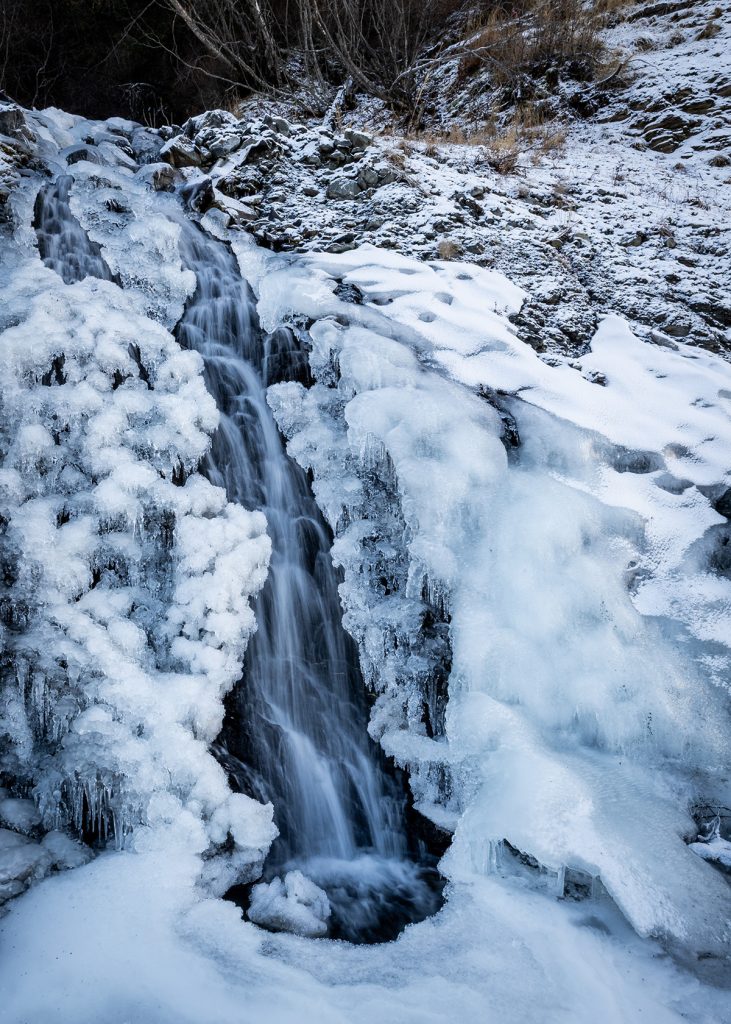
The Seward Highway goes through the Chugach Mountains and is one of the prettiest drives I have been on. On the way to Anchorage, we stopped at least ten times to take pictures of the mountains, sunrise, and frozen waterfalls. Whenever I shot toward the sun, I would use a small f/stop like f/22 to get the “starburst” effect. This works only if the sun is touching something in the frame, such as a mountain, clouds, or trees.
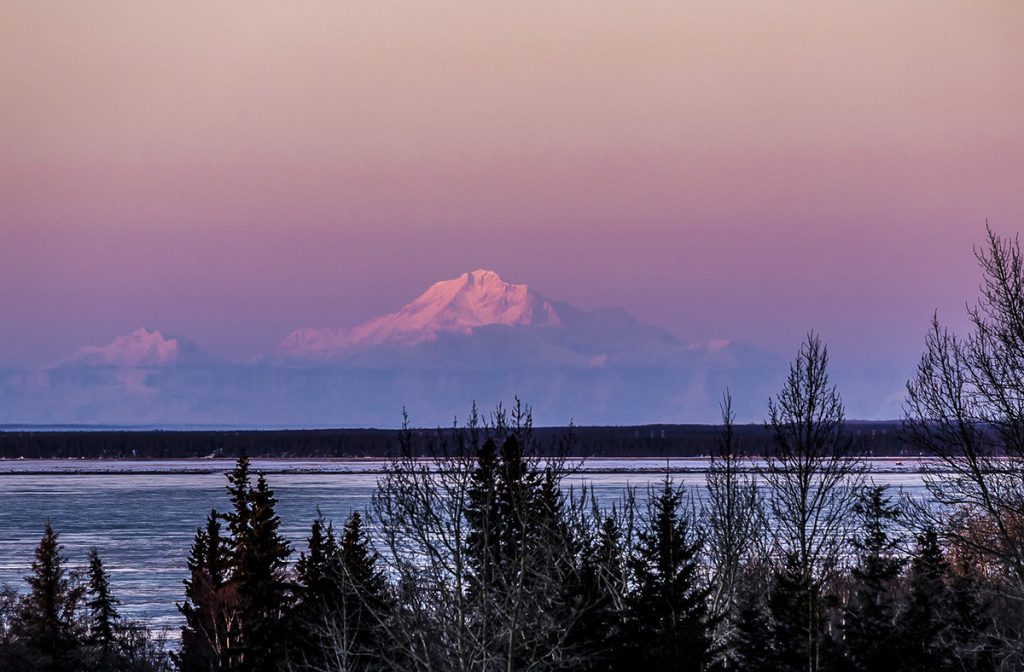
When we got to Anchorage, we went on a short hike at Kincaid Park to look for moose. The air was so clear that we could see Mt. McKinley, the tallest mountain in North America (20,310 ft./6,190 m.). Even from 130 miles (200 km) away, it looked huge!
The sun had already set at 3:55, but we were still hoping to find a moose before all the light was gone. One big advantage of a full-frame camera like the R6 Mark II is that you can shoot at a very high ISO and still get relatively clean photos without too much noise. This was very helpful, because when we finally saw a moose, there was only a little bit of blue-hour light left, forcing me to use ISO 102,400 (a horribly high ISO) to get an acceptable exposure.
We checked into our hotel, had our New Year’s Eve feast (fast food chili), and then headed out toward the Knik River, hoping to see the northern lights. We had seen them two nights before in Fairbanks, but at -32°F (-35°C), it had been so cold that we had to keep getting back in the car. With frozen toes, fingers, and noses, it was hard to enjoy it. Now at about 10°F (-12C), it was much more bearable.
Once we got out of the city and away from the fireworks, I could see a faint whitish-green glow across Orion. I took a test shot through the windshield, and on the camera screen it appeared as a bright green glow.
It seemed like a long time before we got to the Knik River. By then the aurora had gotten brighter and now stretched across almost the whole sky.
I put hand warmers into my gloves, got the tripod from the trunk, and framed up a shot with the frozen river, mountains, and aurora. To avoid shaking the camera, I plugged in a shutter release and then started shooting. There were a few people setting off fireworks on the other side of the river, and a stray firework whizzed right past us, so we decided to move to a safer spot.
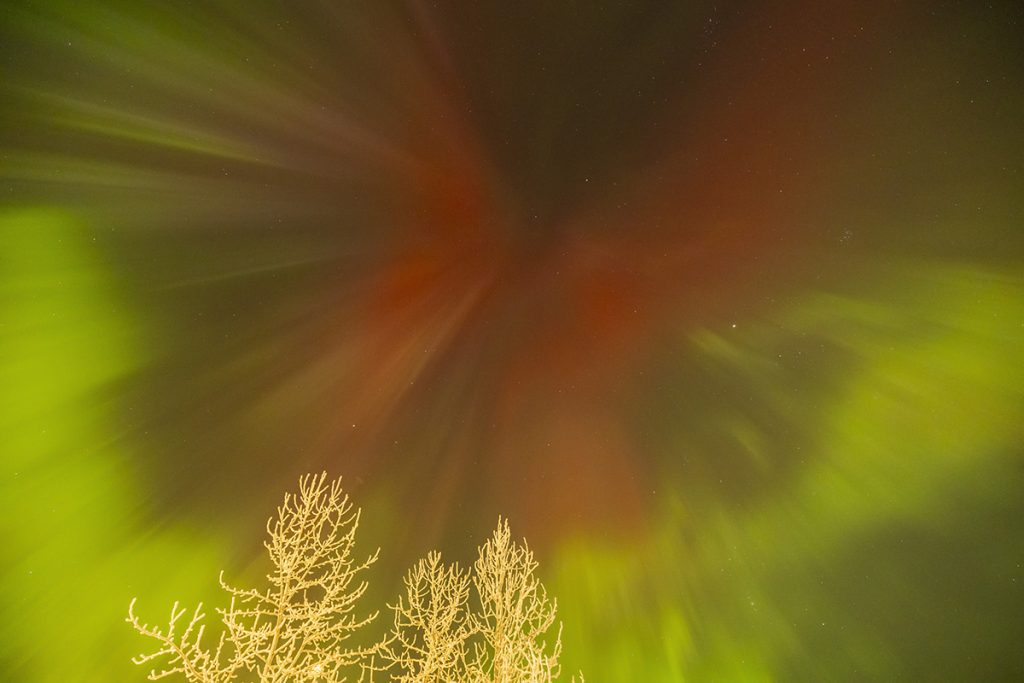
We drove a couple miles down the road to an overlook beside the river. Someone way out across the river had a campfire going, and with trees making a frame around the green-tinged mountains, it was the perfect place to photograph the aurora. Most of the time, I shot with a 5-second shutter speed, f/2.8 (wide open) and ISO 12,800-25,600, depending on how bright the aurora was. There was a red pillar in the northeast that lasted for at least forty-five minutes and slowly reached up to the green to become one bright curtain. I hated to leave, but we had a flight to catch early the next morning and needed to get some sleep.
On the way back to the hotel, I watched through the sunroof (or in this case, aurora-roof) as the aurora continued to get brighter. Finally, we decided we had to pull over and get a few more pictures of the beautiful lights that now filled the sky. We pulled over at the mouth of the Knik River. The bright green, red, and pink curtains all came together at one point directly above us. They were now moving so fast that I had to use a much faster shutter speed so I wouldn’t get any motion blur. I shot and shot as fast as I could, and Dad started singing “How Great Thou Art” as we both marveled at the display.
All my preparation paid off, and I am grateful I got to photograph so many spectacular things in Alaska.