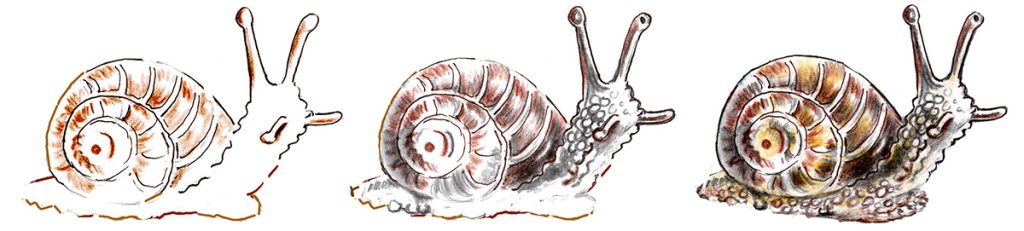
Follow a slimy trail in your garden, and you’ll likely find a snail or a slug. Along the trail, the snail, a member of the mollusk family, spreads out and draws its body together as it inches along. From its head emerge four tentacles, with eyes on the two longest ones.
Snails prefer shady, damp places. They sleep during the day and come out to feed at night on plants. A lettuce leaf attacked by a snail will not have a hunk chomped out; rather, the surface will be sanded off by the snail’s rasping tongue.
In winter, snails group under stones and leaves, where they seal their shells with layers of mucus. During the summer, a snail lays several batches of tiny pearl-like eggs. A month later, tiny transparent hatchlings emerge. If not eaten by a bird or other predator, the snail may live up to ten years.
You will need:
- Sketch paper
- Bristol paper
- Ruler
- Prismacolors
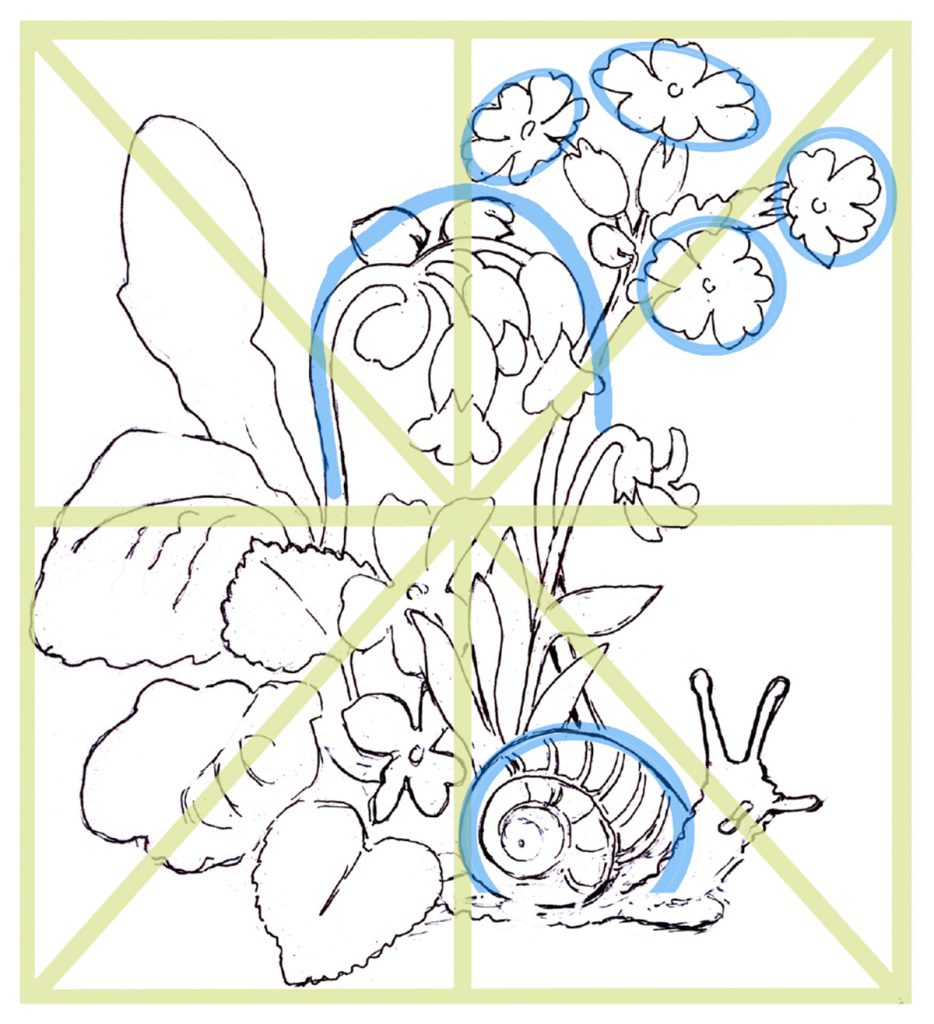
- Let’s begin with a 5 ½” x 6” rectangle divided horizontally, vertically, and diagonally. On these lines, place basic shapes and compose your sketch. Then lightly trace this onto Bristol paper.
- So that your drawing will show up well on a white background, outline with your brown Prismacolor. Outline violets with purple.
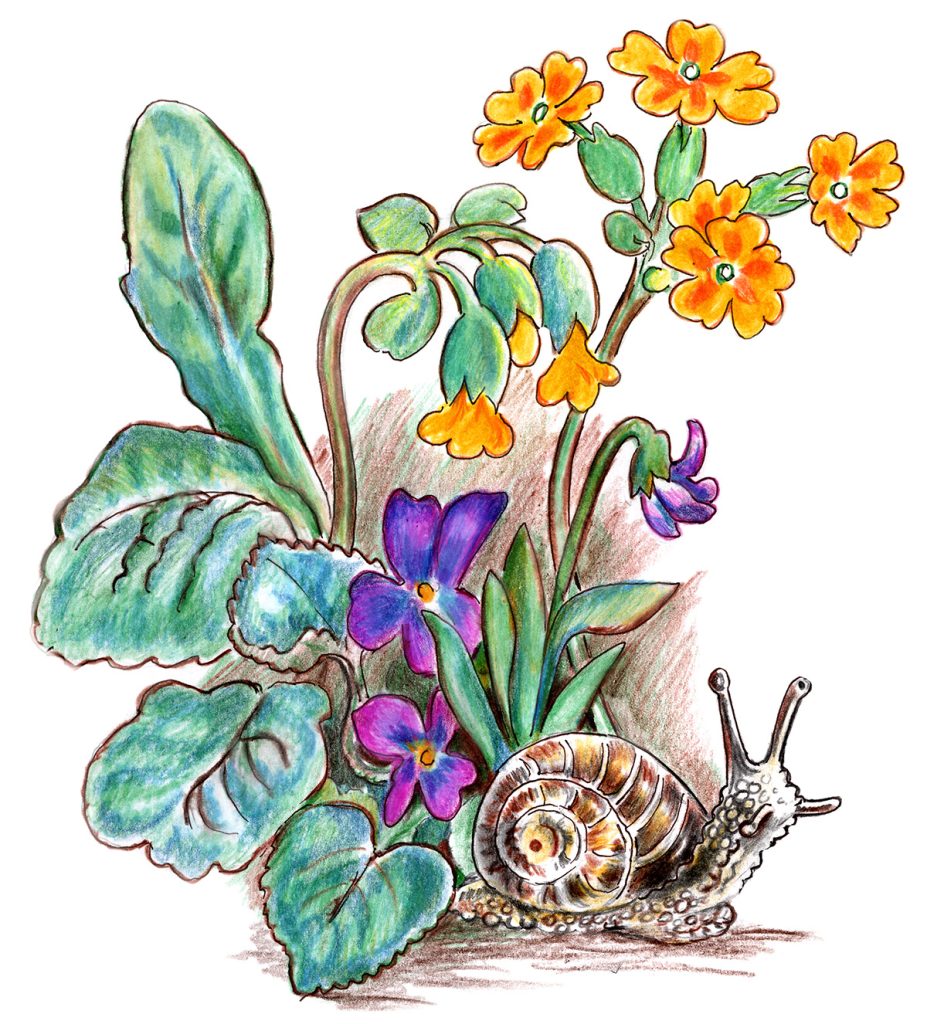
To aid in blending, go over leaves and flowers with your white Prismacolor. Add green centers to the yellow flowers followed by the orange accents. Put yellow centers in the violets. With your blue pencil, begin leaf details, leaving white highlights. - Turn the leaves green by going over them with yellow. Follow this with a layer of green. (If the leaves now look too yellow, balance the color with a little more blue.) Color the violets purple, then shade them with blue. Color the upper flowers yellow.
- Use light brown for the markings on the shell, taking care to leave white highlights that give shine to the shell.
- For darker shading and placing nodules, use either a graphite pencil or a black Prismacolor. Place a black dot for the eye.
- Shade the lower body. Then tint the shell and body with a touch of yellow.
- Finish the violets by blending purple with blue shading. Burnish with your white Prismacolor.
Color in the rest of the vegetation and burnish with white.
Begin shading the background with dark brown below the snail and behind the vegetation. Taper off at the edges of the shadow. Go over the shadow with hints of green.