

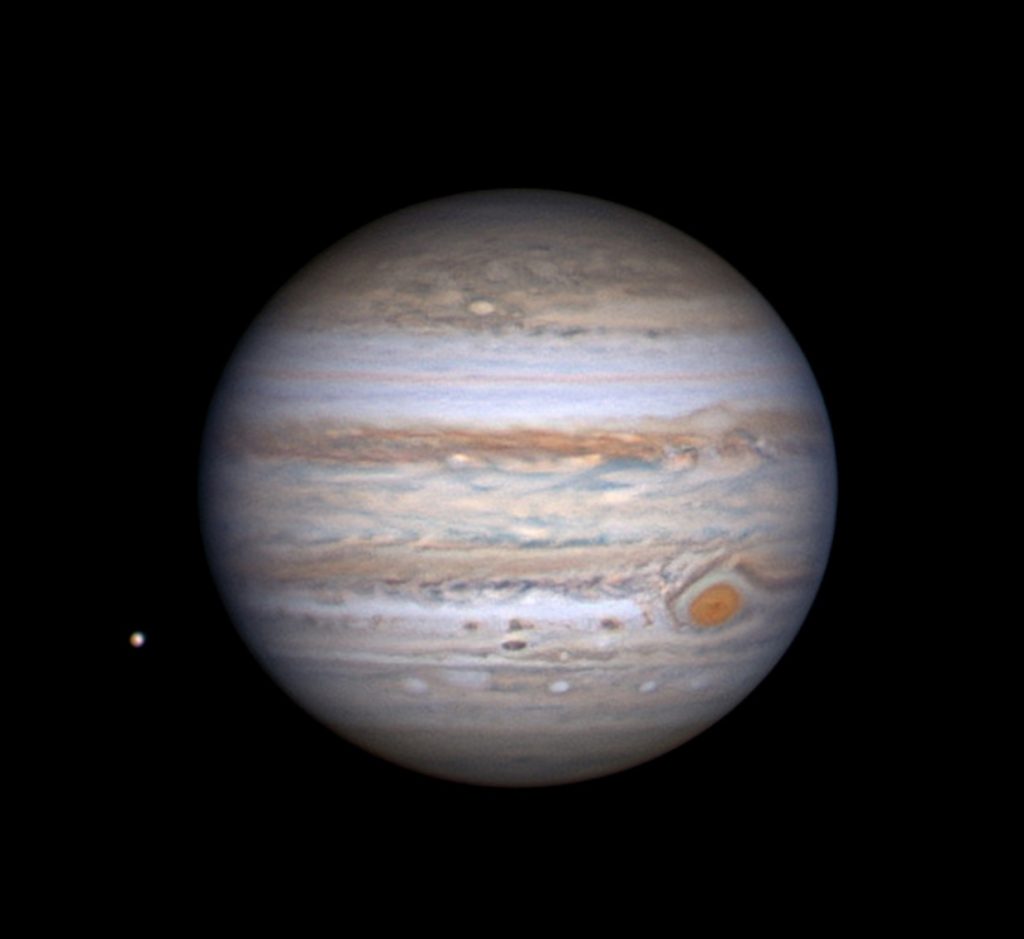
Jupiter is so big that it swings the Sun around in an enormous 920,000 mile circle, makes some of its moons spew fire and ice, and can shatter comets thousands of miles away. That may sound too far-fetched to be true, but it’s reality—and the Earth benefits. We can thank God that Jupiter is a far-out planet almost 500 million miles away, with far-out characteristics to help protect the Earth.
There are thousands of objects orbiting the Sun in our solar system that are no threat to the Earth. But some are different; they may have unstable or highly elliptical orbits and could collide with the Earth. For example, a comet exploded over Siberia, Russia, in 1908 and flattened 800 square miles of forest.
Jupiter is the biggest planet in the solar system at about 88,800 miles across. That’s big enough to create the amount of gravity needed to clean up many unstable objects that could threaten the Earth. For another example, in 1992, a comet that had been captured by Jupiter’s gravity circled in and sped over Jupiter at tens of thousands of miles per hour. A cosmic tug of war followed as Jupiter’s powerful gravity pulled back against the comet’s high-speed kinetic energy. It was enough to break the comet into twenty-one large pieces. Jupiter finished the job by swallowing all the pieces whole. Jupiter benefits us by intercepting incoming threats before they reach the Earth.
Since Jupiter’s mass is so large, it also makes the Sun wobble back and forth as Jupiter orbits the center of our solar system. Technically, it does not orbit the Sun. Instead, it orbits a point called the barycenter—the center of gravity of the Jupiter/Sun system about 460,000 miles from the center of the Sun. The Sun and Jupiter orbit around that point. Therefore, the Sun is spun by Jupiter into a 920,000-mile-wide circle every Jupiter year. Since the other planets are not as massive as Jupiter, they all orbit a point inside the Sun.
Jupiter’s extreme gravity has an even greater impact on the features of its moons orbiting close by. One of those moons is named Io. It is the most volcanically active world in the entire solar system. We’re familiar with the Moon’s gravity causing ocean tides on earth, but Jupiter’s gravity pulls on Io so hard that it causes ground tides. The ground rises and falls, generating heat. All that stress cracks open the crust, and lava pours out from hundreds of active volcanoes. Some are spewing lava up to 250 miles high, giving it the appearance of spewing fire.
Another moon, Europa, spews ice instead of fire. The tidal forces break open the icy crust, and icy water vapor blows out of the cracks, creating plumes over 100 miles high. Europa is larger than the dwarf planet Pluto but about 90% the size of our Moon. You can see it in the photo as a small disc next to Jupiter.
Since Jupiter is such a big planet, there are other dynamic forces at play that can whip up huge storms. One of them, the “Great Red Spot” visible on this picture, completely dwarfs Europa. It’s basically a giant hurricane that’s been churning for at least a couple hundred years. It gives a stark reminder of the sheer scale of the planet that functions as a guard against incoming threats, just as God created it to.