

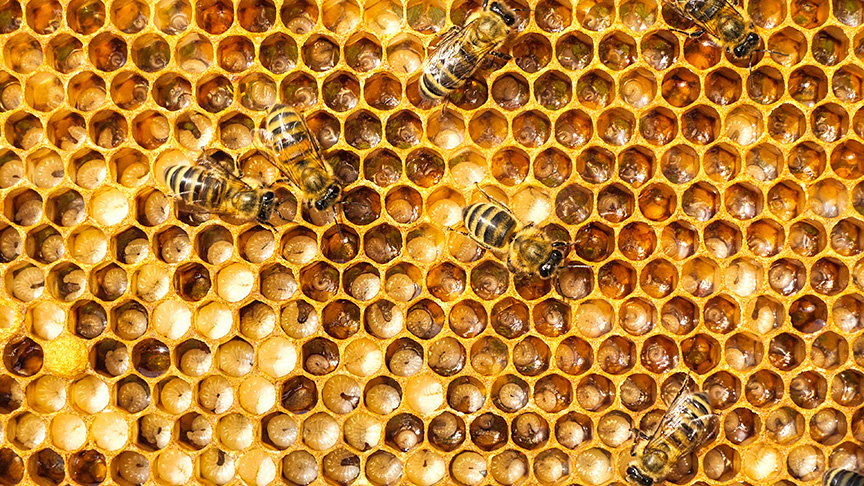
On a warm day in June, a queen bee was busy laying eggs. One of these eggs was deposited into a six-sided cell that had once been full of sweet honey. This egg was about the size of a grain of rice. After three days a small grub-like larva hatched from the egg.
For the first two days of its life, the only food it was fed was a sweet, sticky substance called royal jelly. Because this egg was destined to become a worker bee, after two days it was fed a food with a greater percentage of honey. If it would have become a queen bee, it would have been fed royal jelly for the rest of its developing time.
The nurse bees in the colony are very busy, as each larva must be fed hundreds of times daily! Bigger and bigger this larva grew. On the sixth day, it started to make a silken shell. Inside this cocoon, the larva metamorphosed into a wormlike pupa. This stage takes twelve to fifteen days.
And slowly, slowly the young bee stirred and slowly, slowly awoke to her new life. After chewing the cap off her cell, she fanned her new wings and started off on a brand-new adventure in a sunny, warm world where nectar, honey, fellow bees, and flowers awaited.

And, yes, some enemies lay in wait as well. Not far away, in a hollow under a hemlock tree, a black bear grunted and rolled over. Suddenly her eyes flew open and she sprang up. Urgently, her small black nose snuffled the wind and, with the waddling gait of a black bear, she trotted through the trees toward the open field ahead.
There she swung her small head back and forth, checking for any lurking enemies. Seeing not one dog or two-legged creature, she galumphed across the field and squirmed under an electric fence.
She licked her lips and drooled. Then, lifting a paw, the bear swept a hive off its foundation. She was about to taste the delicious sweetness of the honey bears love, when suddenly her small black ears caught a sound.
“Woof, woof, woof!” The farmer’s dog had caught her scent on the rising wind and was alerting everyone on the premises to the intruder. Fear struck the bear’s heart like an arrow hits its target, and, breaking through the fence this time, she took off for the cover of the dense forest. Maybe next time she would get honey, but, for now, the black bear would have to be content with a fresh brook trout from the stream.
As Little Bee, now three weeks old, flew out of the hive, she seemed to know exactly what to do. No one had ever told her, but somehow she knew.
Suddenly, up ahead, she spied a bright, colorful clover blossom. Zooming in for a landing, Little Bee eagerly buried into the petals, searching for the sweet nectar. When she found it, she slurped it up through her proboscis, a long tube-like tongue. As she bumbled around on the flower, the stiff bristles on the sides of her legs gathered up the fine yellow powder we know as pollen.
After visiting many other flowers in the same manner, at last, heavily laden with both nectar and pollen, she started back across the fields and hills toward the hive. Using the sun as a guide, Little Bee knew just where to find the hive that smelled and looked just like home.
Nearby a small brown house nestled in a grove of poplar trees near a small stream. In this humble abode lived a man and his wife and their three small children. The man loved honey and the good things his wife prepared using honey and all other things that could possibly be made with honey or beeswax.
So he naturally wanted to have bees on his small green farmette. Consequently, the man put five bee hives in his back field. They were close enough that he could enjoy the sight of those cute little bees flying around, manufacturing delicious honey, but far enough away that his three small girls would not be in danger of being stung by those little stinger-wearing insects.
When Little Bee arrived back at her home hive, she was flabbergasted to find it lying demolished on the ground. Anxiously, she buzzed around, trying to figure out what could have happened. You see, she had never encountered this beast that had ruined her home. She had not been there when the bear, one of the most daunting and dangerous enemies of the bee, had come.
Suddenly, she noticed a queer thing approaching on two legs through the field of waist-high grass and flowers. It carried a small object in its hand that spewed out a cloud of smoke. Never before had she seen such a thing, and she wasn’t sure if she could trust it.
The creature came and stood beside the hives, murmuring and shaking its head. It left the field and, after a long time, returned, this time with a truck. Little Bee watched as he fixed her home and repaired the electric fence. When he had gone again, Little Bee gratefully entered the hive to unload her cargo of nectar and pollen. Then she folded her wings and rested.
As this little story tells, a bee starts out as a tiny egg. It changes to a larva and then a pupa, a miniature but still not fully-formed adult. A perfect worker bee will emerge after twenty-one days in the cell. A drone bee emerges after twenty-four days.
A queen bee’s job is primarily to lay eggs. She is the “queen” of the colony.
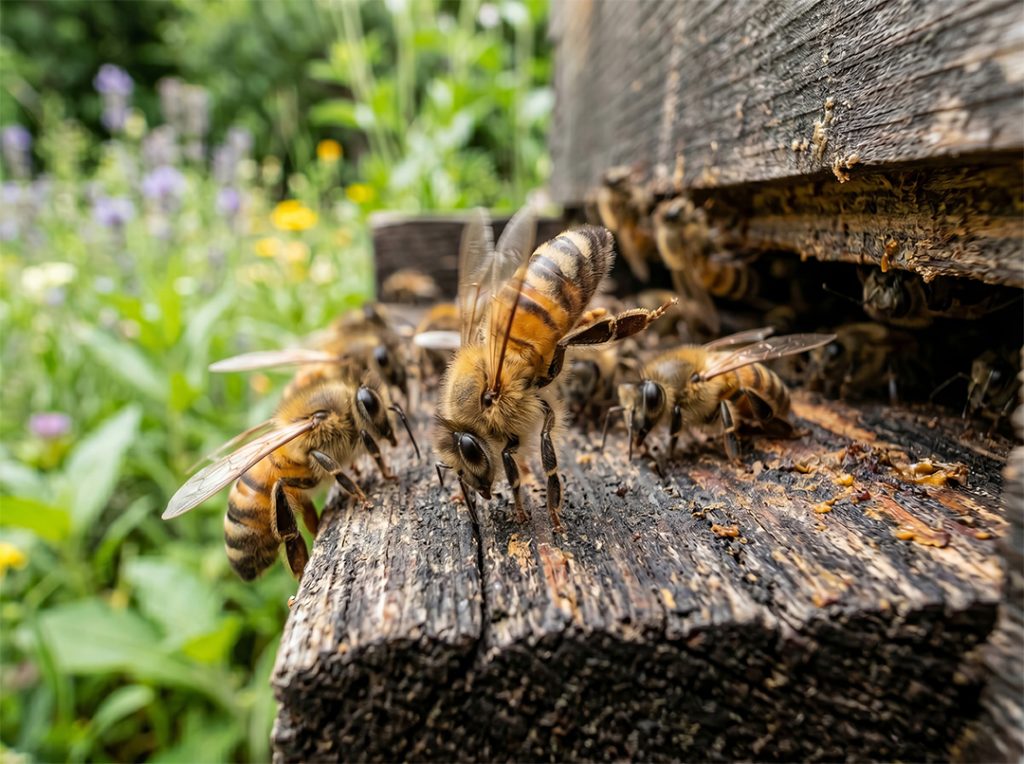
There are many different jobs for the worker bee. A nurse bee is the “nurse” for the eggs, larvae, and pupae. The forager bee goes out and searches for nectar and pollen to feed the colony and make honey. Although it seems as though one bee would have one primary job, it actually changes with her age.
After the first two or three days of cleaning brood cells in preparation for new eggs, a bee is transferred to the position of nurse bee to the older larvae. After another three days, she feeds the younger larvae. At around twelve days of age, she becomes a construction worker, repairing and building new wax cells. Several days later, she starts her new job of receiving the nectar and pollen from other bees and transferring it to cells. Around the time a bee reaches the age of twenty days old, she takes on the job of a guard at the entrance of the hive. Other jobs such as caring for the queen and cleaning the hive are usually done by bees twelve to twenty-two days old.
Then, after the third week of work in the hive, she transitions to her final and longest job, foraging for nectar and pollen. If the need arises, a bee can jump forward stages or back up stages to suit the needs of a colony.
The average lifespan of a worker bee is approximately five or six weeks in the summer.
The bees add enzymes to the nectar to break it down into simpler sugars and other substances. The extra water is allowed to evaporate. When the nectar has thickened and become the golden sticky, sweet semi-liquid we know as honey, it is sealed in cells in the honeycomb.
God created bees in many diverse and wonderful ways, giving them defense systems, instincts to know where to find food, and a very complex yet functioning colony of hundreds of bees. “And God saw every thing that He had made, and, behold, it was very good.” Genesis 1:31a