

Do buttonbushes grow near where you live? If so, perhaps you’ve found them to be butterfly magnets like I have. One sunny July day last summer, I was trying to catch a certain kind of butterfly. Since buttonbushes are butterfly magnets, I was circulating between a few buttonbushes and a patch of Joe-pye weed (also a butterfly magnet).
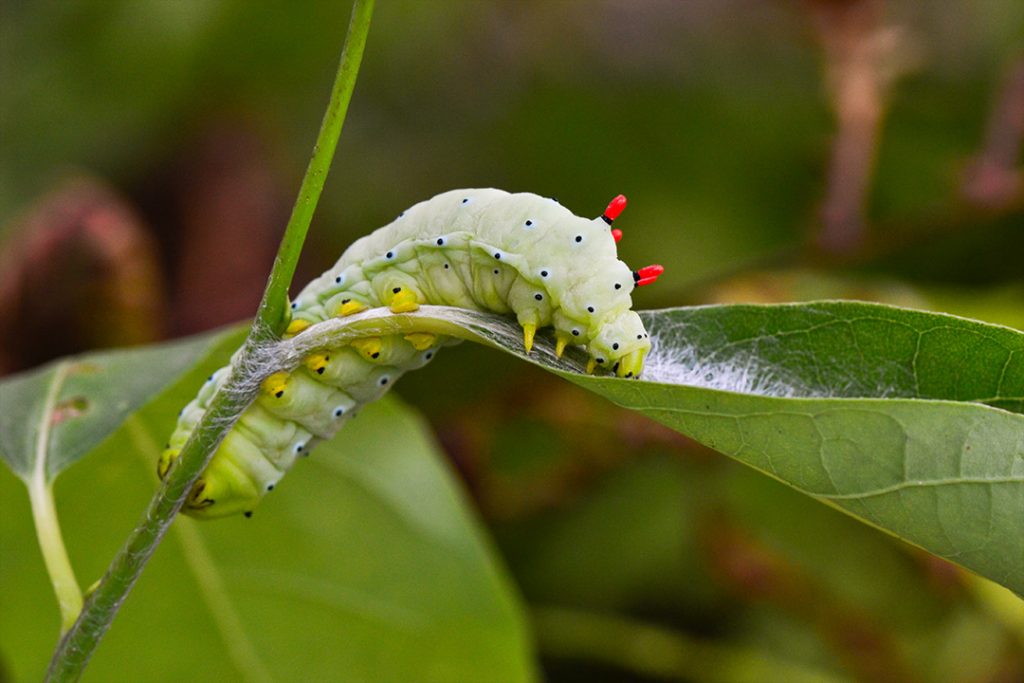
Right in the middle of it all, I noticed sunlight highlighting the brilliant white patch on a skipper’s wing. So, I whipped out my phone to snap a picture, since in my hand was a butterfly net and not my Nikon. Right about then, I was surprised by the sight of five young Promethea caterpillars (also known as spicebush silk moth) feeding on the buttonbush leaves.

Now, here’s where more scenes in the life of a Promethea silk moth flashed before my eyes.
First scene: Some years earlier, I had watched a Promethea silk moth caterpillar silking up a spicebush leaf in preparation for spinning its cocoon. I came on the scene as the caterpillar was engineering the curling of the leaf. It did this by attaching a strand of silk from point A to point B. When the strand shrank a bit, it put a little tug on the leaf. When it makes many of those attachments in the right sequence, the leaf curls around it in just the right way to be part of a comfortable, camouflaged cocoon. I saw the Creator’s genius engineering on display as the caterpillar swung its head from side to side, attaching silk strands to the side of leaf and then to the middle, then again to the side. Back-and-forth, back-and-forth just like it was slowly shaking its head NO…on and on and on as the leaf slowly curled.
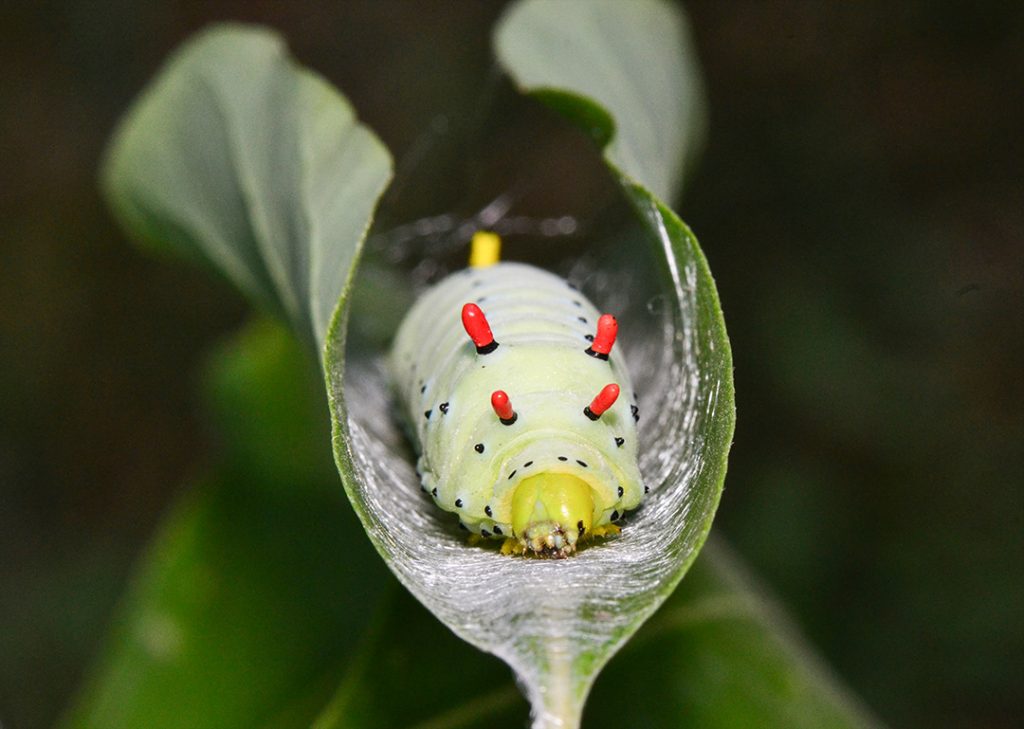
After a while the caterpillar took a break from silking up the leaf top and spent a copious amount of time placing silk all over the leaf’s stem and where the leaf was fastened to the twig. It was making sure that its leaf/cocoon was NOT going to fall off that spicebush during the winter. Watching the caterpillar’s actions amazed me that the Creator gave the caterpillar the instinct (surely it wasn’t foresight) to so thoroughly fasten its leaf/cocoon to the branch so as to withstand the coming long winter’s wind, ice, and snow.
Second scene: That silking of the stem brought to mind silk moth cocoons in the dead of winter hanging on the spicebushes like old, dried-up leaves. I’m sure I’ve missed seeing many silk moth cocoons over the years because the leaf is incorporated to provide camouflage so the cocoon looks like a dried, curled up, stubborn, old leaf. Of course, I have occasionally realized I was seeing a cocoon and have taken some home to try rearing the moths. If you’ve tried that, you know I wasn’t successful every time I tried—some cocoons never hatched. Once, a silk moth cocoon in a quart jar hatched out a whole bunch of big orange-legged parasitic wasps instead of a moth. I was successful once. I think I had it just lying on top of my fossil case on our screened-in porch.
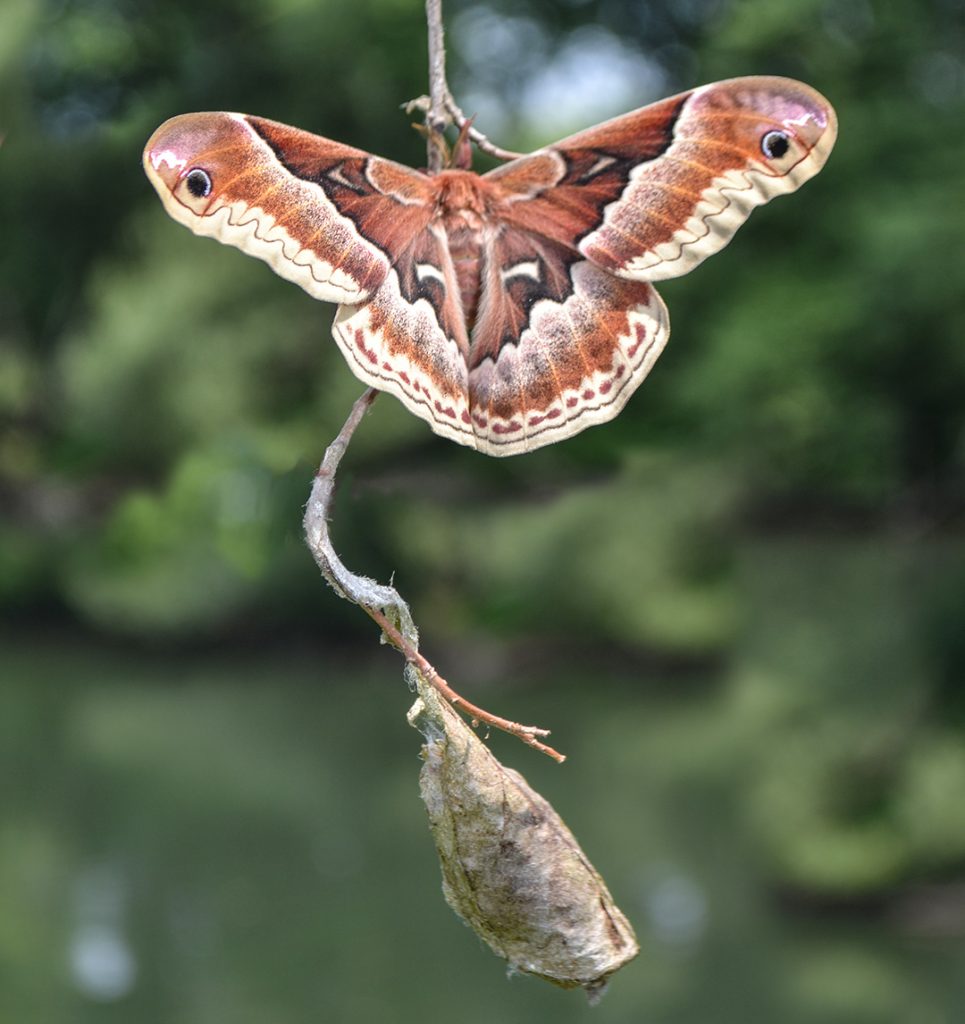
Third scene: The sight of a newly emerged silk moth is very exciting. So is the sight of one hanging around under a dusk-to-dawn light. The Promethea silk moth that emerged from my cocoon was a tan-colored female. It didn’t take long for a darker brown male to arrive. He showed up on the outside of the porch window screens.
Here are some bonus, noteworthy things about silk moths. Notice the wrinkles on the wing margins. Researchers say those wrinkles function as bat sonar reflectors. In other words, they cause the bats to attack the wrong spot, somewhat like a bull attacking the matador’s red cloth.
Also, take note of the colors (blue and black) of the wing scales in the wing’s fake eyes. I’m going to make some assumptions here as to how those colors are produced. I didn’t look closely at the adult silk moths I’ve seen, but I assume the color-producing process is similar to the butterfly wing eyes I’ve looked at under my microscope. The fake eyes have a base layer of black scales which use the pigment melanin to absorb most light waves, producing the blackness. The blue areas of the wing eyes are clear scales stacked on top of the black scales. The blue is a structural color produced by the shape of the microstructures of the scales interacting with light waves to reflect only the blue light waves. The rest of the light waves are absorbed by the black scales underneath. This scale-stacking on top of the black scales likely increases the saturation of the blue color.
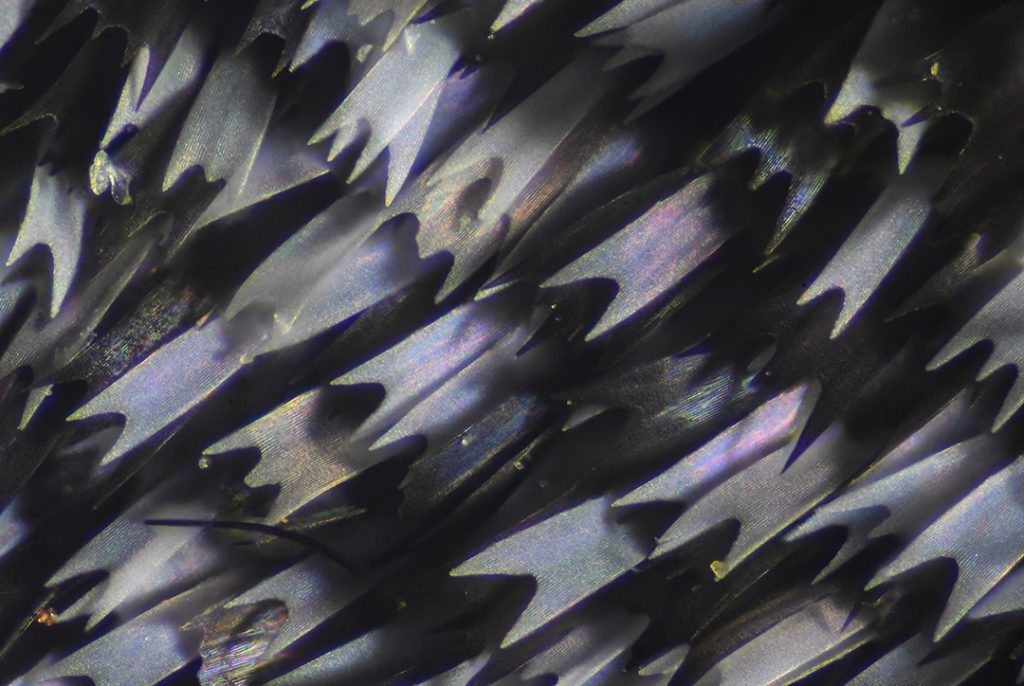
Now it is your turn. Watch for a silk moth wing to put under a microscope (or 10x loupe) to check and see if I guessed right. Maybe you’ll find a moth that beat itself to death under a streetlight or was a victim of a bat whose sonar wasn’t fooled by the silk moth wings. Perhaps you’ll even try to rear a silk moth and sneak a close-up peek at those fake wing-eyes before you let it fly away or add it to your insect collection.
Well, there you have it—a flash view of the life of a Promethea silk moth. Okay, well, I missed the egg stage. I haven’t seen the eggs yet. That makes me wish the buttonbushes were right at hand. I know what!!! Suppose I plant some buttonbushes on our riverbank!