

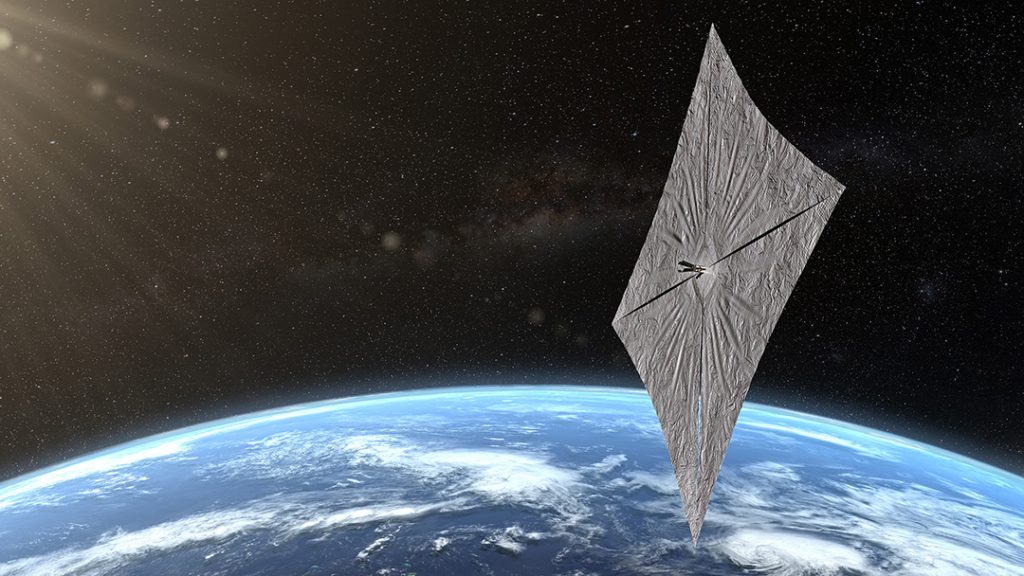
Is it possible to sail on light? This question was asked hundreds of years ago and answered relatively recently.
You may have noticed that every time you look at a comet, the tail always points away from the Sun’s location. Johannes Kepler noticed that too. He was a gifted young man who went to university and studied languages, math, astronomy, and the Bible. He concluded his time of study with the intent of becoming a minister. Yet, he still made some of the greatest contributions to science by any man through applying his knowledge of mathematics and astronomy as he formulated his “Principles of Planetary Motion.” He said that he was simply “thinking God’s thoughts after Him.”
Kepler noticed that comet tails always pointed away from the Sun regardless of the comet’s direction of travel. He reasoned that sunlight must heat the comet’s nucleus and free material from its surface, then push it in a direction away from the Sun. This clever thinking led him to believe that sunlight might be a useful method of force in space. In 1608, he wrote to Galileo, “Provide ships or sails adapted to the heavenly breezes, and there will be some who will brave even that void.”
That idea was far ahead of its time and could not be tested in space until modern times. It turns out to be true!
Light is made up of photons which have zero mass, so we don’t expect light to give a push. However, light has momentum since it travels at 186,000 miles per second. It’s a tiny amount of push—we don’t have to lean toward the Sun to stay upright when we step outside into the sunlight. The tiny push adds up to be a significant force on a large object. A conservative estimate of the amount of force that the Sun exerts on the Earth through its light pressure is a continual 130 million pounds of force. That is tiny compared to Earth’s huge mass and the Sun’s powerful gravity that locks the Earth in place. It is the perfect amount, though, to send a comet’s tail pointing away from the Sun.
Could mankind tap into this force? In 2005, the Planetary Society used a Russian rocket to launch a light sail spacecraft named Cosmos 1. Unfortunately, the rocket failed to reach orbit, and the light sail never had a chance to be tested.
Four years later, The Planetary Society started work on another light sail spacecraft named LightSail 1. It was funded by over 40,000 individual donors. LightSail 1 successfully demonstrated that sailing on sunlight was possible. Just prior to that, another Japanese spacecraft named IKAROS became the first to successfully demonstrate light sailing. Following that, LightSail 2 was launched for another test of the sailing concept.
LightSail 2 had a square-shaped sail that was a little over 18 feet (5.5 m) per side. The pressure of sunlight on that sail accelerated it at a tiny .058 mm per second, or a little over 8 inches (20 cm) per hour. This adds up to a speed of 341 mph (549 km/h) after one month of constant sunlight. That small LightSail spacecraft could be traveling at over 4,000 mph (6400 km/h) faster after one year.
This is on free energy from the Sun. It would offer continual acceleration instead of short bursts like traditional rocket engines. If larger sails would be built, spacecraft could travel even faster. Some have even considered shining large earth-based lasers onto light sails to accelerate them even more. Light sails could be useful for exploring huge distances across space.
The heavenly breezes of the Sun point comet tails away and send things sailing across space, but the orderliness of it all doesn’t just allow for space travel, it points back to the Creator of all.