Time: A sunny summer afternoon.
Place: The Red Raider Colony’s nest by the riverbank in the writer’s yard.
Occasion: One of the strangest things I have ever seen.
The Red Raiders’ nest is a somewhat ordinary-looking ant nest. It would likely appear as nothing unusual to most people—just some holes in the ground and a few ants scurrying around looking busy. By the way, the “RED RAIDERS” is my pet name for these ants. They are actually known as Shining Amazon ants (Polyergus lucidus).
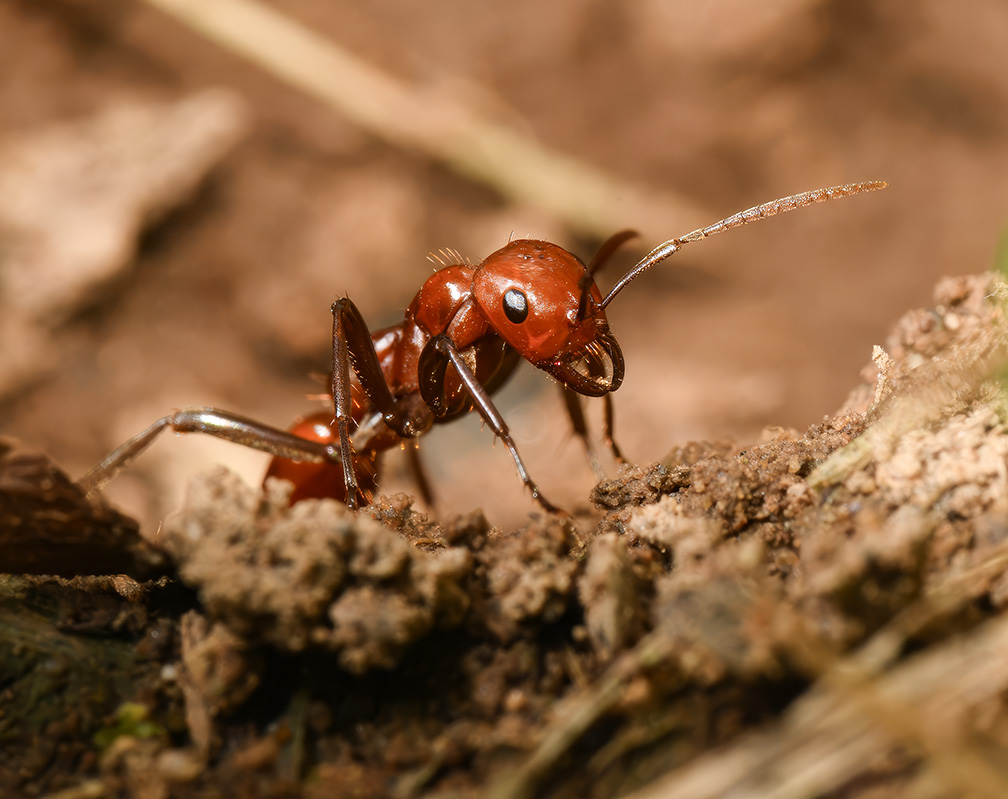
It’s late afternoon now, so anytime we’ll get to see a raid. Come, look! The ants are “beating the war drums.” That’s what I call the agitated activity around the nest now that a dozen or so ants are milling around. The ants are stroking their antennae, opening and closing their long, curved mandibles, and acting rather restless. Even the slave ants are in on the action. Well, maybe they are just wishing they could be, so they are pretending to be doing chores where all the action is.
Now, I’m guessing you might be a bit skeptical that anything spectacular is about to happen. So, let me add to the suspense by thinking out loud, “I wonder, are the ants beating a ‘March’ or a ‘Coup de Charge’ with their feet? How else could a scout ant summon such a thundering herd so suddenly?”
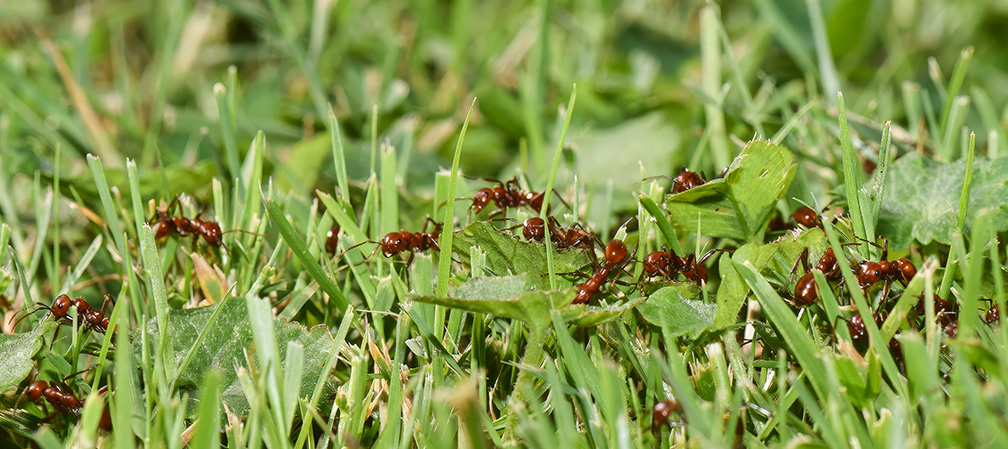
Then without warning, as if some signal went out to the whole colony of ants to “March!”, a column of ants materialized. The RED RAIDERS were out on a raid! Ants went pouring across the yard in a column 6 inches (15 cm) wide and about 6 feet (2 m) long. It was a 3D column of ants charging headlong on top of the grass, clambering pell-mell through the grass, and scrambling along under the grass. Grass blades were shaking. Clover heads were waving. Those thousands of tiny marching feet made a whispering sound which, to me, qualifies them as a “thundering herd.” It’s a pity for the ant colony where they are headed.
Imagine that you are an ant, specifically, an Uncertain Field ant (Formica incerta). Your colony’s nest is near the fence along the side of the writer’s yard about a hundred feet (30 m) from the Red Raiders’ quarters.
You are just heading out to tend your aphid herd when you get an uneasy feeling that something strange is afoot. Pausing high on a clover leaf to check out what’s going on, you sense a distant commotion. Hmmm, it’s not the lawn mower. Nor is it the landowner’s grandchildren tearing around in the yard. It seems like…like the marching of thousands of tiny feet along with the twitching of many grass blades and shaking of clover blossoms.
The commotion isn’t so distant anymore. In fact, it’s getting closer and closer…BOO! Bursting out from among the grass blades and jumping from the tops of them charges a horde of shiny reddish ants with sabre-like jaws all moving toward your home!
It all happens so fast you don’t have time to do anything to help your fellow ants. The raiders encircle your colony’s nest entrance, and there are so many of them, the ground turns a shining reddish color. Then—why, look—it seems like there aren’t as many as there had been! Now there’s only a small crowd. They seem to be disappearing. Why, of course, they’re going down into the nest! Who knows what kind of carnage they’re causing down there.
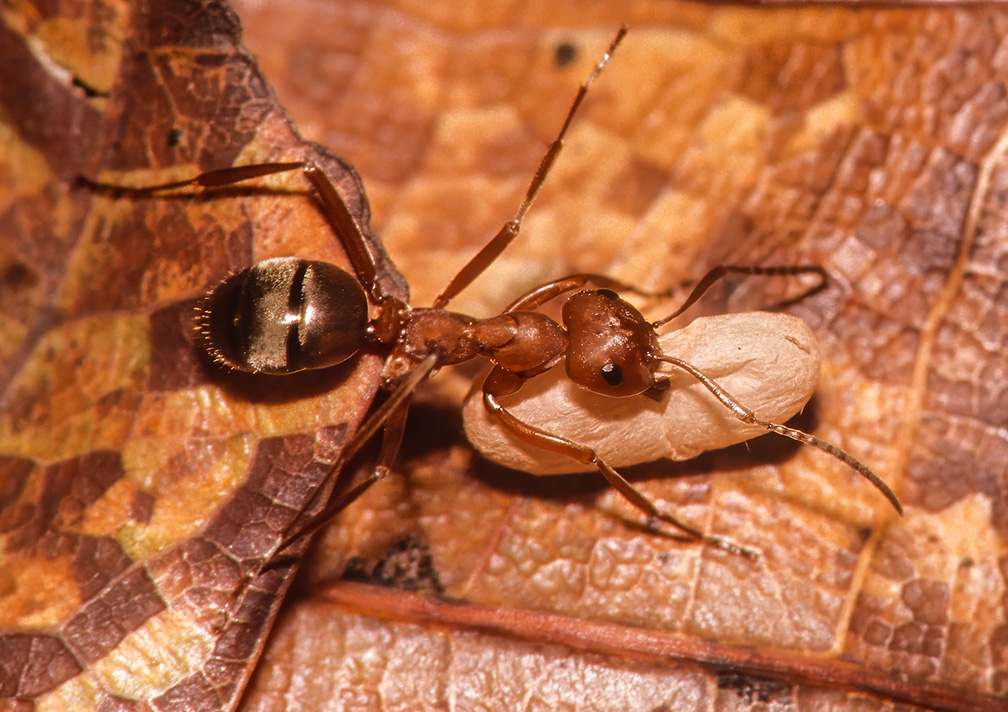
Soon the raiders start emerging from the ground. Many of them head back the way they came carrying a cocoon or larva. They’re stealing the babies! Oh, it’s awful!!! A long procession of the returning RED RAIDERS streams past, carrying the plundered brood.
The raiders’ march I just described took about half an hour from the “coup de charge” until the host nest was attacked. The raided nest was 100 feet (30 m) from the RED RAIDERS’ nest. That’s like 3 miles (5 km) on our scale. The underground raid lasted about ten minutes, and the triumphant return of the raiders with their plunder took forty-five minutes.
Polyergus ants can’t feed themselves, and they don’t do any work. All they do is go on raids to steal brood, so they enslave other ants to do their work and feed them regurgitated food. My RED RAIDERS only raid one species of ant nests, the Uncertain Field ants. Interestingly, they go on raids every summer day that is not rainy.
Editor’s note: Now I know what the ant train was that I witnessed in our driveway thirty years ago, though it appears they were a different species.