

In the beginning, God created water. He separated it from the land on the third day. Today, water covers approximately 71% of the Earth. Oceans contain about 95.6% of Earth’s total water, leaving only about 4.4% of freshwater.
Water easily changes into all three forms of matter. The water you drink is a liquid, water vapor in the air is a gas, and solid water is ice, of course. In liquids, molecules slip and slide past each other. That’s why we can drink a glass of water.
Water that evaporates into the air is a gas. Its molecules are free to bounce around. When air feels hot and muggy, it has a lot of water vapor in it, causing high humidity.
When pure water is cooled below 32°F (0° C), it freezes, becoming a solid. The molecules of hydrogen and oxygen that make up water are not as mobile anymore. You probably like solid water added to your liquid water to make it colder, especially on a hot day.
Water that contains salt or sugar or other substances dissolved in it will freeze at a lower temperature than pure water.
We’ve already done a couple of experiments with water, demonstrating its cohesion, adhesion, and capillarity. Let’s try a few other fun water projects.
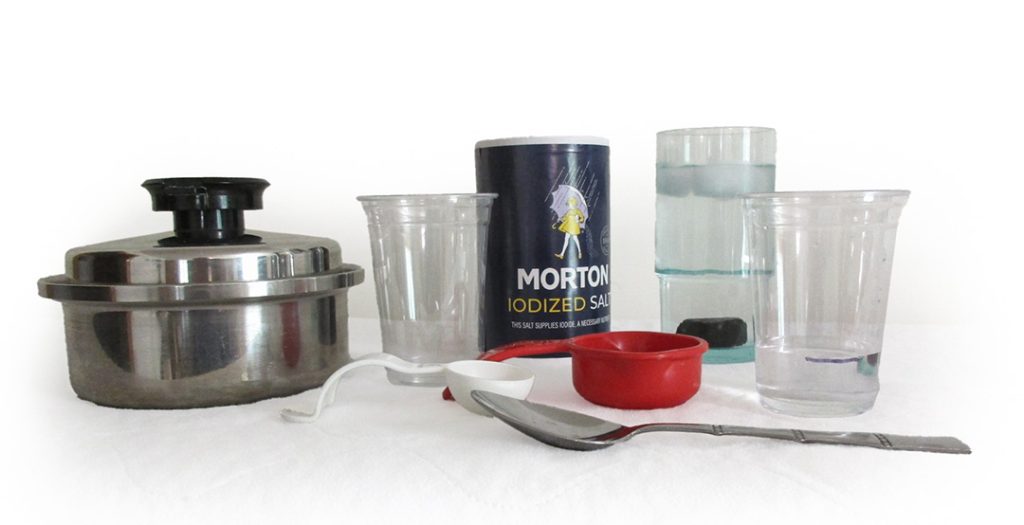
- Boil some water in a saucepan or teakettle long enough to see steam coming out of the lid or spout. The steam is water vapor going up into the air. Use a metal spoon with a handle long enough to keep you from burning your fingers on the steam. Hold the spoon in the steam for a minute or less; then pull it away from the steam. In no time at all, you’ll see water drops on your spoon. So you’ve changed liquid water into a gas and back into a liquid. Can you think of a way man uses steam to produce power?
If liquid water did not change into vapor, cool, and form clouds, we wouldn’t have rain.
But if most of the earth is salty ocean water, why doesn’t rain fall as salty water, killing your garden plants? Let’s investigate again. - Stir one tablespoon of salt into a third cup of water to make a solution of salt dissolved in the water. Pour the solution into a shallow bowl and let it sit on a windowsill in your house. Check it off and on for a few days until all the water has evaporated. Be sure to take note of what is left behind.
So now you can see why evaporated ocean water falling as rain makes the vegetables in your garden grow. It leaves the salt in the ocean behind without carrying it along into the atmosphere. - Let’s finish up with a couple of ice experiments. We already know that ice is a solid. Usually when a solid freezes, the atoms contract, making the solid denser and decreasing the volume. When water freezes, it expands and takes up more space.
Fill a plastic cup about a third full of water. Mark the water level on the cup. Place the cup in the freezer. After it is frozen solid, take another look. Is the mark you made above or below the level of the ice? If it is below, this shows that water expands when freezing, causing the molecules to be farther apart, needing more space. - One more to demonstrate that ice is less dense than other solids. This time fill a glass three-fourths full of water. Place a small stone into the water. What happened? Now put some ice into the water. Solids usually sink, but ice doesn’t. What would the poor fish do when rivers, lakes, and ponds freeze over in the winter, if ice would sink? They would all be crushed! Neither would you be able to ice skate on your farm pond.
- Before dumping out the ice water, let it sit for several minutes. Now take hold of the outside of the glass. Did your hand get wet? The water certainly didn’t come through the glass.
Once again, you’ve demonstrated experiment number one. When water vapor cools, it condenses into liquid water. Water vapor in the air near the glass was cooled by the cold glass and condensed into liquid on the outside. That explains why there is often water (dew) on your lawn in the mornings even though it hasn’t rained. The air cooled overnight, causing water vapor to condense to liquid form on the grass.
Thinking about the wonders of water causes me to marvel at the wisdom of God in creating exactly what we need.