The Blue Ridge mountain slopes and ridges gave way to pastures, houses, and woodlots as we left the larger highway. For a number of miles, we wound through somewhat familiar territory, though on roads we had not travelled before, enjoying the summer greenery of trees and lawns. Our destination was a nursery specializing in carnivorous plants.
A gentleman in a straw hat welcomed us. For the next hour and a half, he entertained us with amazing plants and their stories.
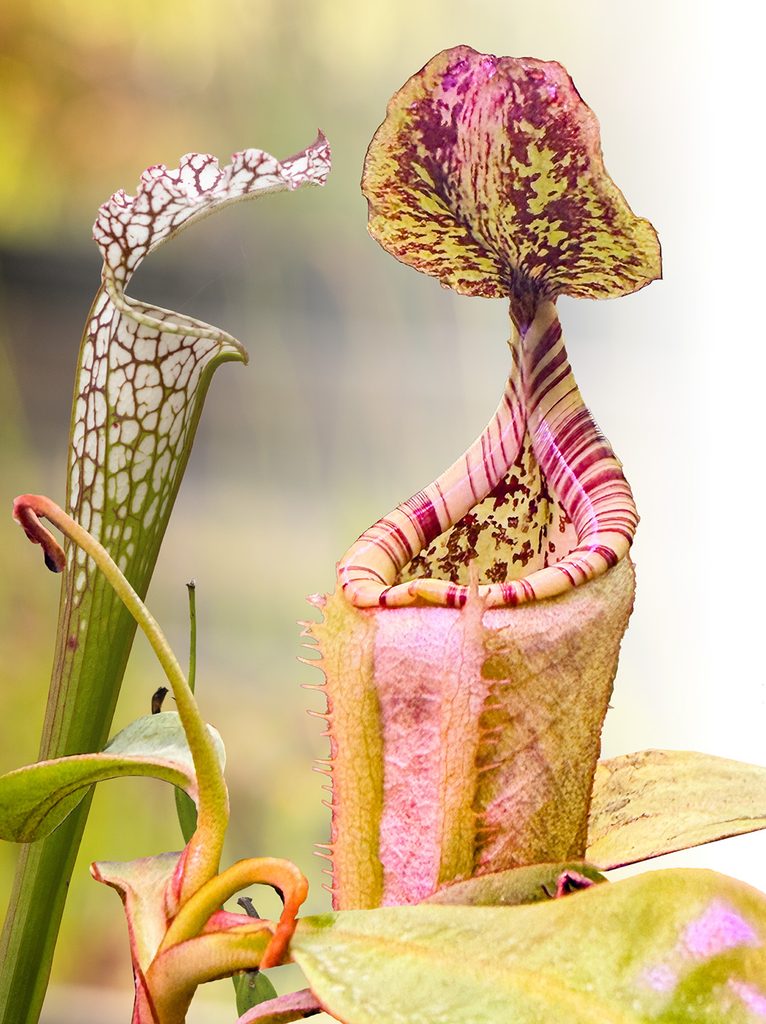
He first showed us rows and rows of potted carnivorous plants which had outgrown the original nursery area. These outdoor plants are native to the US, mostly from North Carolina to Florida and Alabama. In the 1980s, Mr. Sacilotto, and Butch Bailey (a partner and friend), visited many sites that were being drained for development or agriculture. They obtained permission and rescued many pitcher plants. They have propagated them and also hybridized and produced new varieties, including the Red Sumatra (hybrid) below.
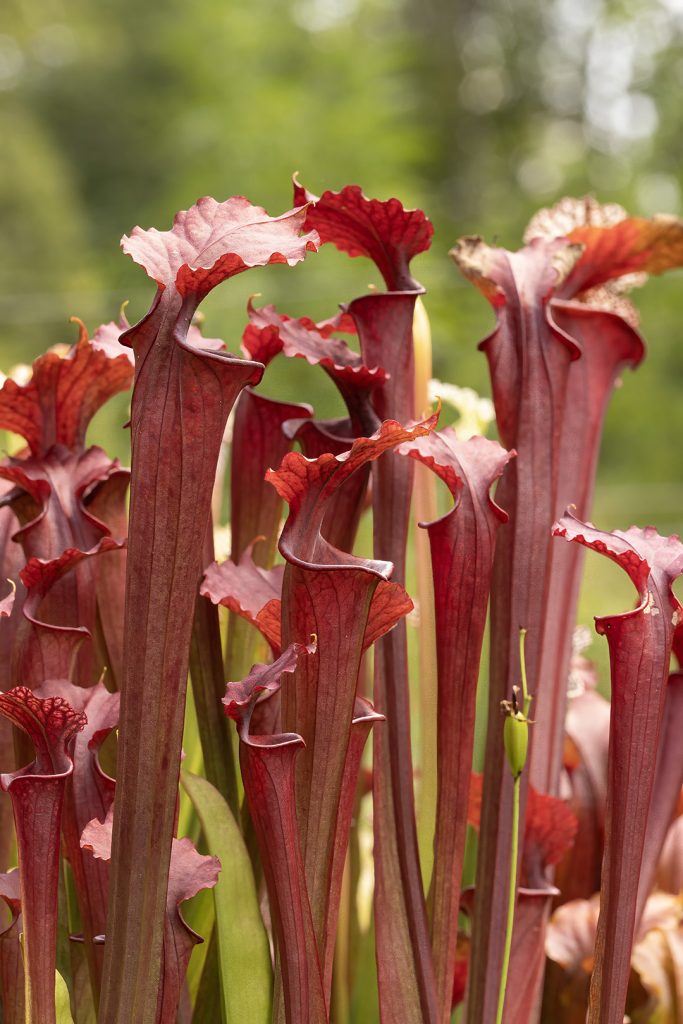
Pitcher plants grow where the soil is poor and acidic. Since they acquire nutrients by trapping and digesting small creatures, mostly insects, they do not need rich soil. In fact, they do not grow well at all in what we think of as good soil.
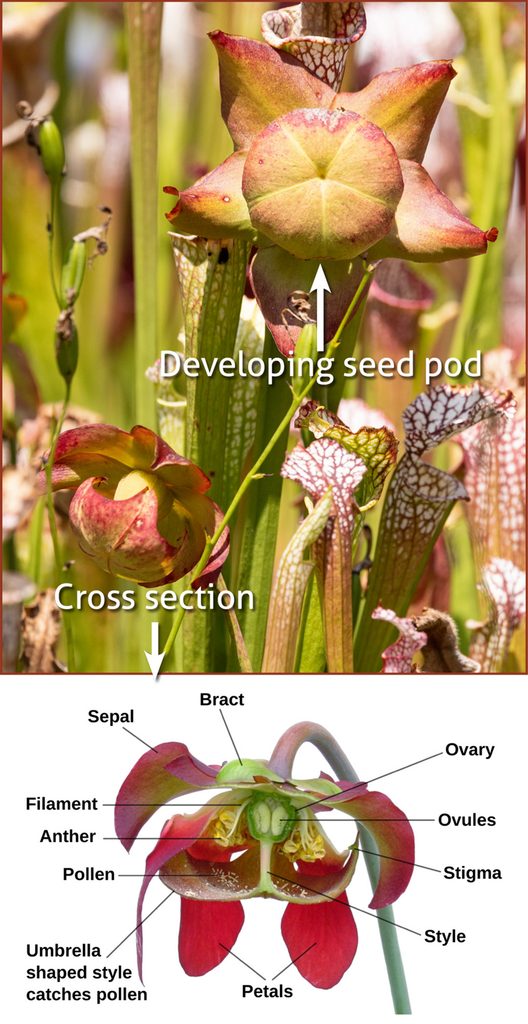
In the spring, the pitcher plants shoot up their flowers before the pitchers. The drooping flowers have a pollen bowl where pollen collects. Bees crawling around in the flower get covered with pollen. Because of the way the flower petals are locked onto the pollen bowl, bees exit the flowers differently than they enter them. As they do this, pollen rubs off onto the stigma, beginning the process of seed formation.
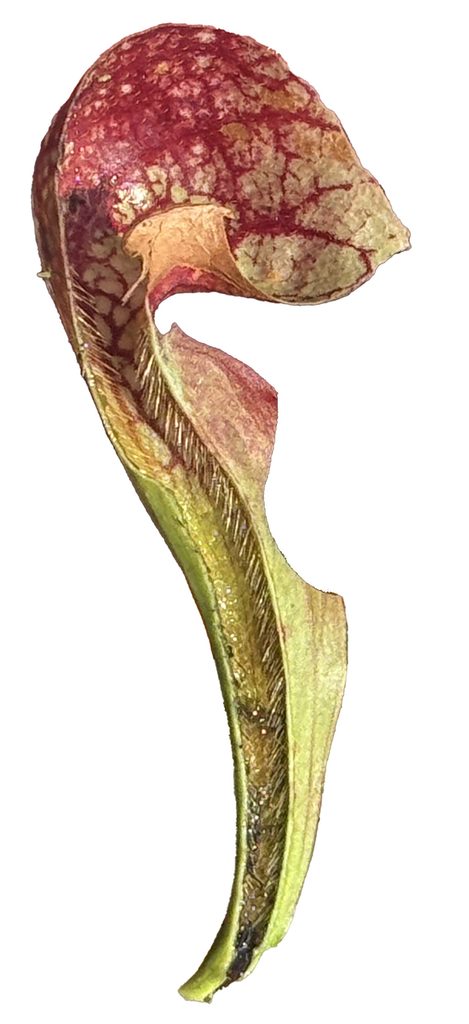
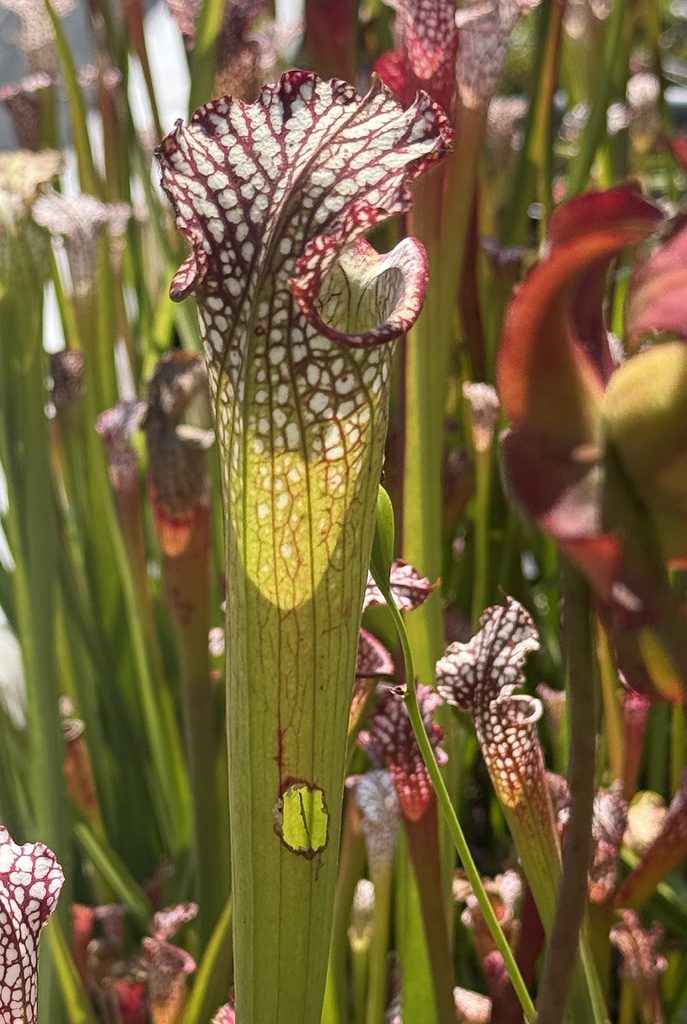
Then the pitchers come up. Depending on the variety, the pitchers vary in height from several inches to several feet. They radiate a sweet smell, attracting insects. The small pitchers hold water, which is a natural trap for unsuspecting bugs. The taller pitchers actually have a rain shield above the pitcher. The insides of these pitchers have hairs that grow backward down into the pitcher, making it easy for a bug to go down, but NOT to come back out. They also have a slippery edge or slippery area inside to keep the insects trapped. Some pitcher plants that live in areas that sometimes flood may even catch mosquito larvae or minnows!
Bumblebees, though, are too smart. Mr. Sacilotto has not found bumblebees in his pitchers. Carpenter bees, while not smart enough to stay out, will chew their way out with their strong jaws.
In the original portion of the nursery, besides hundreds more pitcher plants, grow the dramatic Venus flytraps. Using a grass blade, our guide showed us a flytrap in action. He touched the guard hairs on a leaf once, then a second time. At the second touch, the leaf snapped shut. It would stay shut for a day, he told us. However, if an insect had been trapped, it would be digested before the leaf opened again, requiring a number of days.
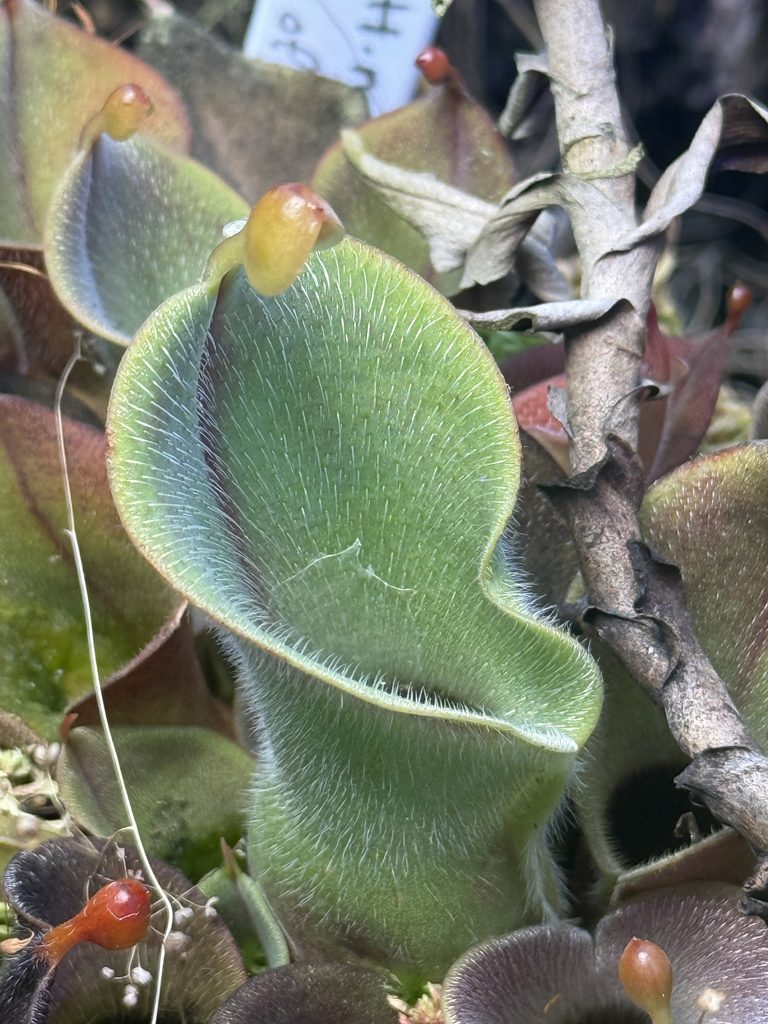
Then it was time for a tour of the greenhouse. Here grow the tropical pitcher plants of the Nepenthes genus, also called monkey cups. Most of these are natives of India and Asian countries south and east of India, such as Borneo and Sumatra. One plant with tiny pitchers (Cephalotus) is native to tropical parts of western Australia.
Here we encountered even more variety than we had seen outside. These pitchers came in a wonderful variety of colors and sizes and shapes. Some grew low to the soil, while others hung from the tips of long leaves, the central leaf vein extending beyond the leaf to support the pitcher.
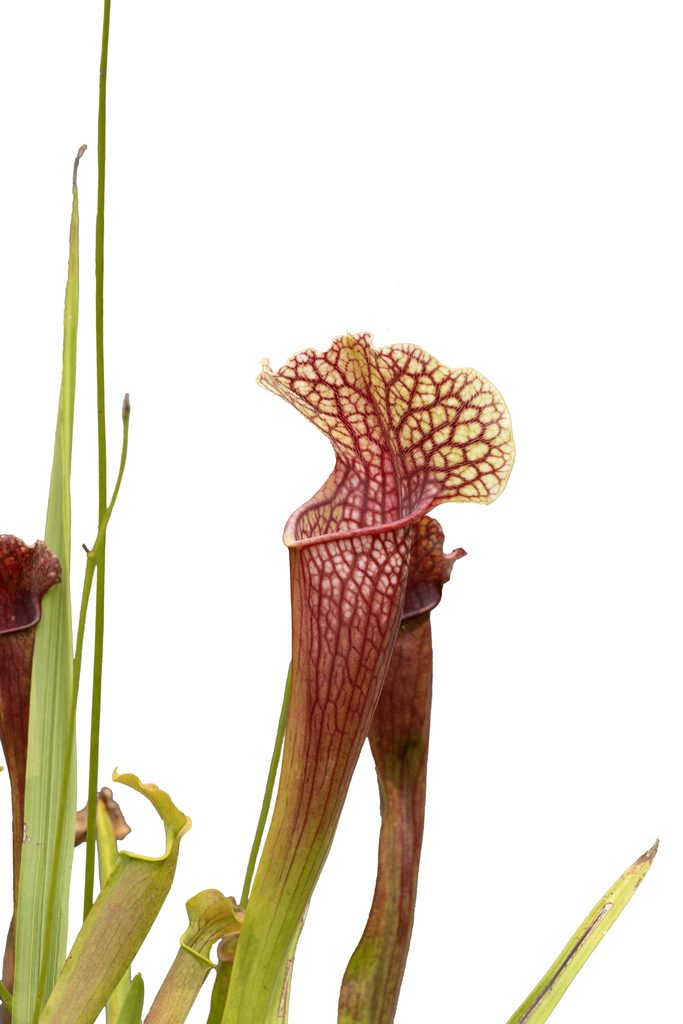
(Sarracenia rubra ssp. wherryi)
Right: Sarracenia Ruffled Sparkler (hybrid)
One plant grows large sturdy pitchers that sit on the ground. However, when the plant begins to vine and climb upward, it begins producing small lightweight pitchers that will not pull down the climbing vine! Some varieties of pitchers have stout, ringed openings on which ants can walk safely when dry. But woe to the ants when the pitcher mouth is wet! They cannot travel the extremely slick surface then.
Mr. Sacilotto told us about several more fascinating species. One has pitchers large enough to catch a large rat. Another has a large plastic-tough, oval pitcher with a lid at one end. In this lid are long hairs and a sweet, fatty, pasty substance. This Nepenthes did not appear to be a good insect-catcher. Puzzled researchers discovered that birds and shrews are strongly attracted to the substance between the hairs. As they feed on this, their droppings fall into the pitcher and nourish the plant.
A pitcher plant was recently discovered that grows its pitchers underground. A researcher recognized the leaves as looking like a Nepenthes plant, but did not see any pitchers. When he pulled up a piece of moss, there underneath were the pitchers, catching worms and centipedes and such creatures.
As we left the greenhouse, our heads and hearts full, we noticed a fig tree with numerous green figs at the edge of the woods. As an Indigo Bunting bubbled his music nearby, Mr. Sacilotto took time to tell us about his figs. Next to the greenhouse, the lacey lavender blooms of a passionflower vine native to Virginia vied for attention. As our host had mentioned earlier in our visit, he studied biology, loves to grow plants, and has worked with plants most or all of his adult life. He enjoys growing vegetables and preserving rare varieties of vegetable seeds.
The pitcher plants are beautiful in early summer and again in late September and October. We are anticipating another visit this fall. Mr. Sacilotto is ready to sell the business side of his carnivorous plants after around forty-four years, so that is likely our last opportunity to visit him and see his beautiful plants.
We left with greater awe for our Creator’s wisdom, and the distinct sense that we had acquired way too much information to retain!