

It was a fine October day, and I definitely wasn’t expecting to be shot at. You see, I was walking along the side of a forest-lined dirt road, searching for a certain kind of late-season caterpillar. I was enjoying the sunshiny fall weather, when, over the sound of trilling bush crickets I heard a “crrraaackkk,” a sound not unlike the cocking of a gun.
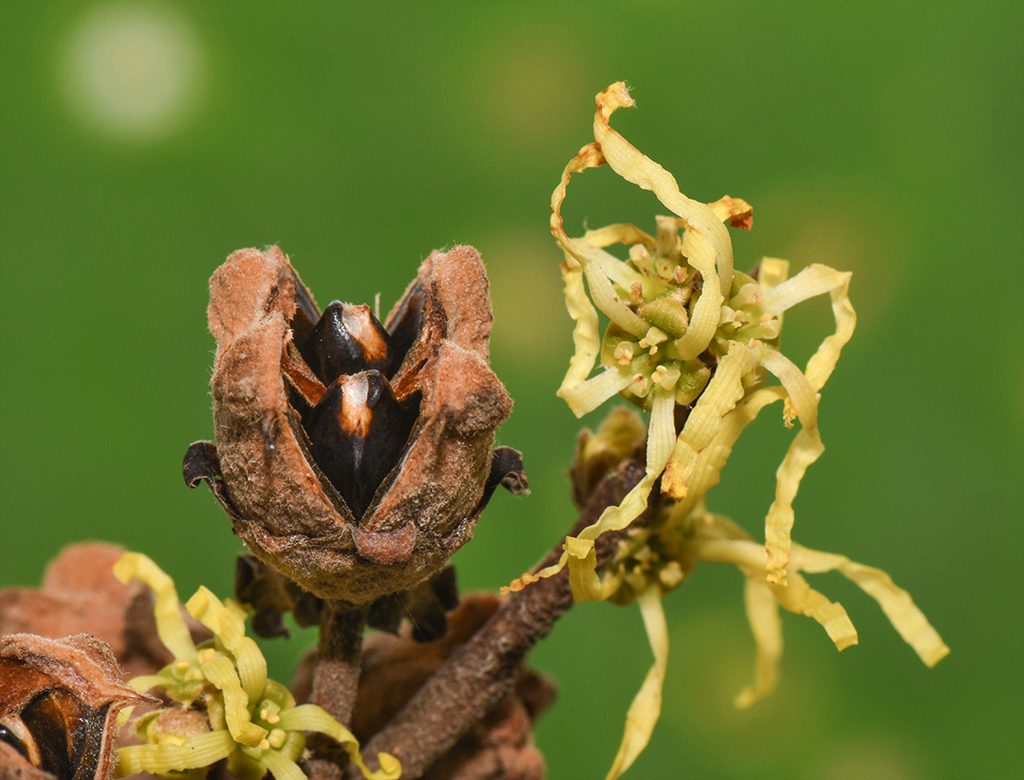
I glanced to my left, and there, at eye level and at point blank range, I was looking down both barrels of a cocked witch hazel seed shooter.
I was thrilled! I had read that witch hazels shoot their seeds like rifle bullets, but I had never before witnessed any seed shootings.
“Crrraaackkk.” There went another one! A branch shook from the recoil, and I heard the fired seed skittering on the road. I went over and found the seed at the far side of the road, about 20 feet (6 m) from the witch hazel bush.
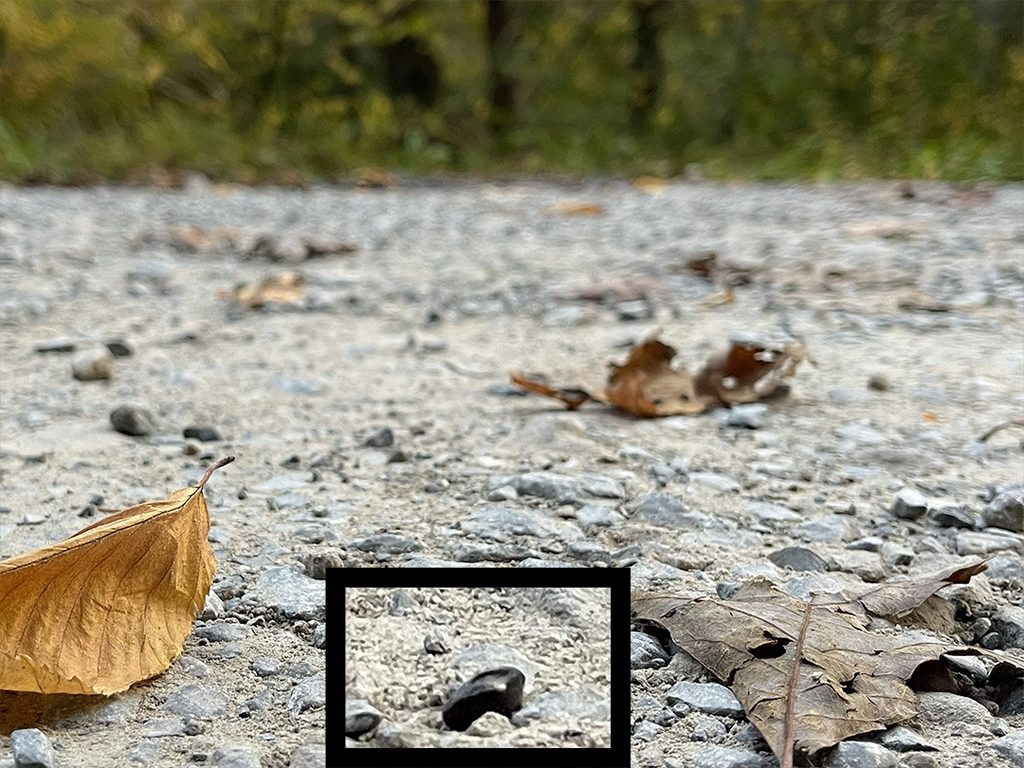
How, exactly, do they shoot seeds like that? I pondered. Naturally, I started investigating witch hazel seed launchers.
Something I soon noticed was that witch hazel bushes face numerous obstacles to the successful formation and launching of their seeds.
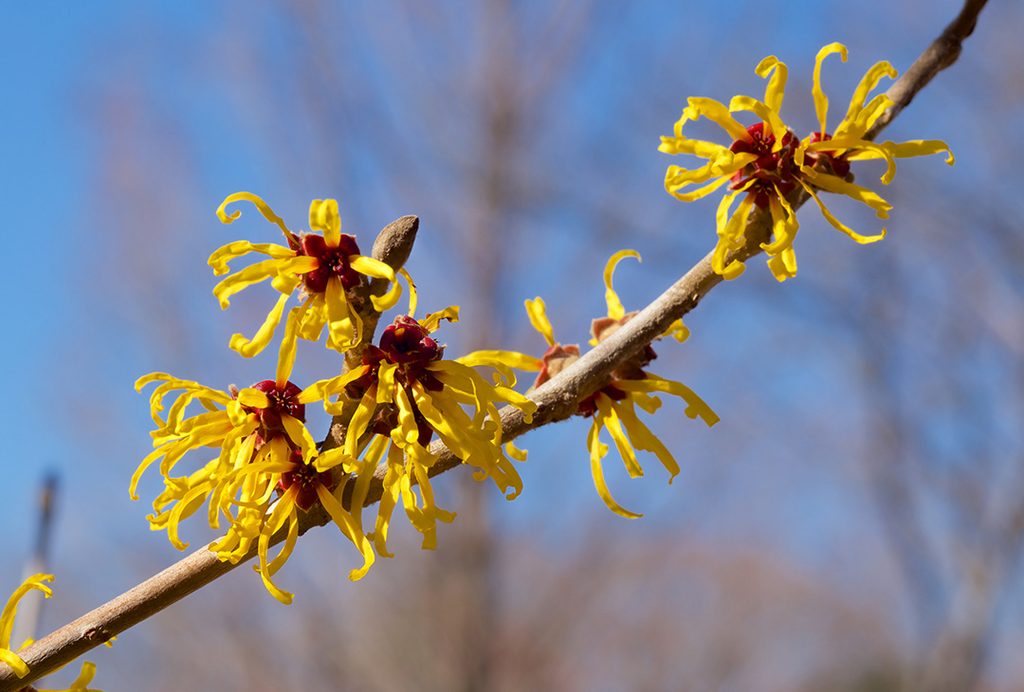
- Fruit set on witch hazel seems scarce compared to the number of their prolific flowers, especially some years. Since witch hazels are among the last flowers of the year, their pollination is likely very weather-dependent. I expect that early frosts and cool weather would really cut down on the available pollinators.
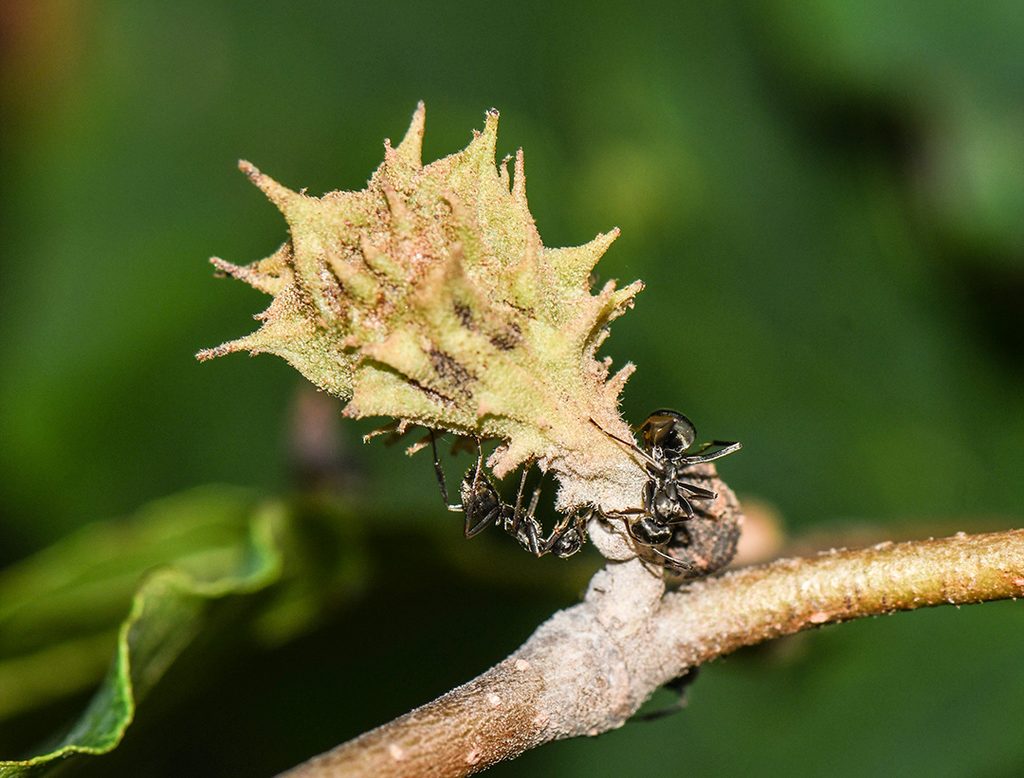
- Spiny witch hazel gall aphids hijack flower buds and cause them to grow into hollow galls instead of flowers. Interestingly, the spiny witch hazel galls have an exit hole where ants and other insects wait to catch beads of honeydew excreted by the aphids. Also noteworthy is that the aphids that cause these galls take two years to complete all the stages of their life cycle. The galls do not seem to be very abundant, so I doubt the galls are a big factor in influencing the number of seeds, but it sure is an interesting one nonetheless.
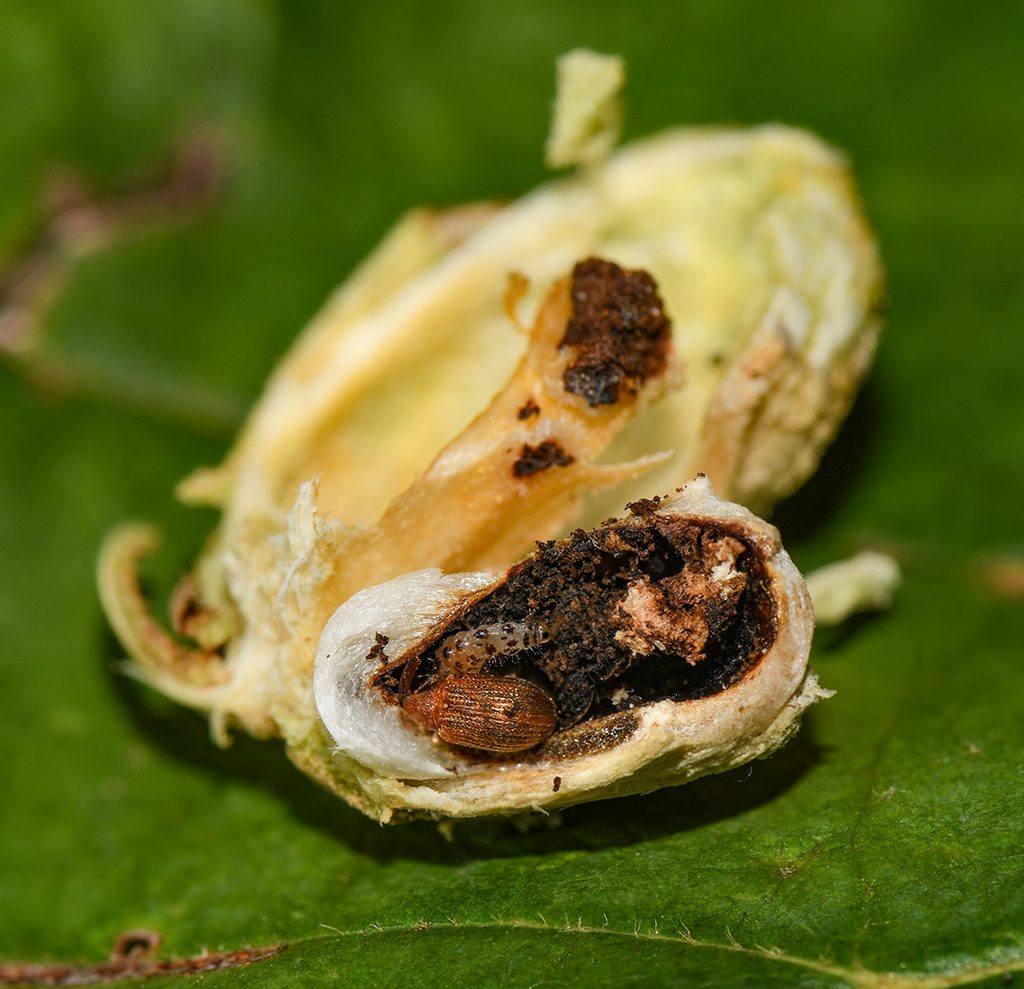
- Additionally, there is a weevil at work to keep the witch hazel from shooting a bazillion seeds everywhere. I’ve seen numerous seed pods which have a small hole bored into them. I cut one open, and, inside the pod, instead of a seed, was a tiny weevil and also a weevil larva.
Maybe you will discover other obstacles the witch hazel bush has to overcome in order to produce its seed launchers.
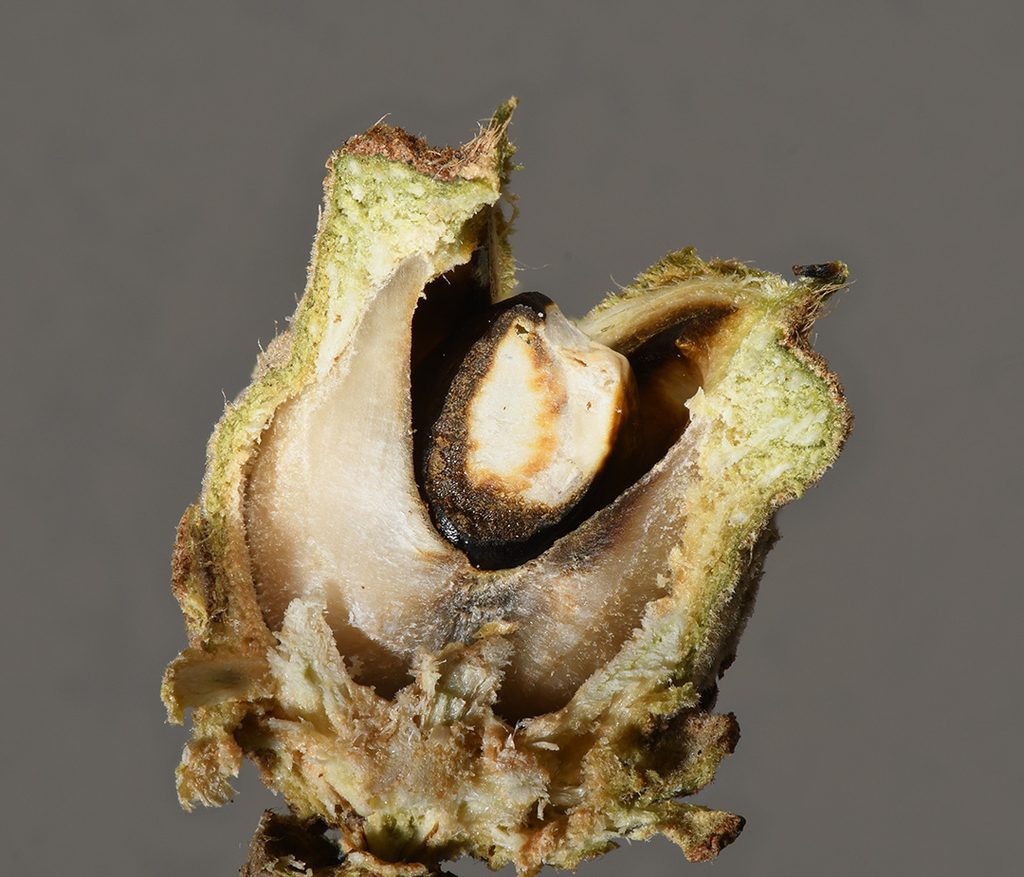
Anyway, back to recounting my methods of investigating how the seed shooters actually work, I picked some mature-looking fruits in late summer and let them dry out. In a day or two, they were shooting their seeds. Since it was obvious that drying caused the shooting, I wanted to see shape changes to the launchers during drying, so I cut into some fruits for cross-sectional views. With these cross sections I could see the shape changes from the “wet” state to the “cocked” state and then to the “shot” state of the seed.
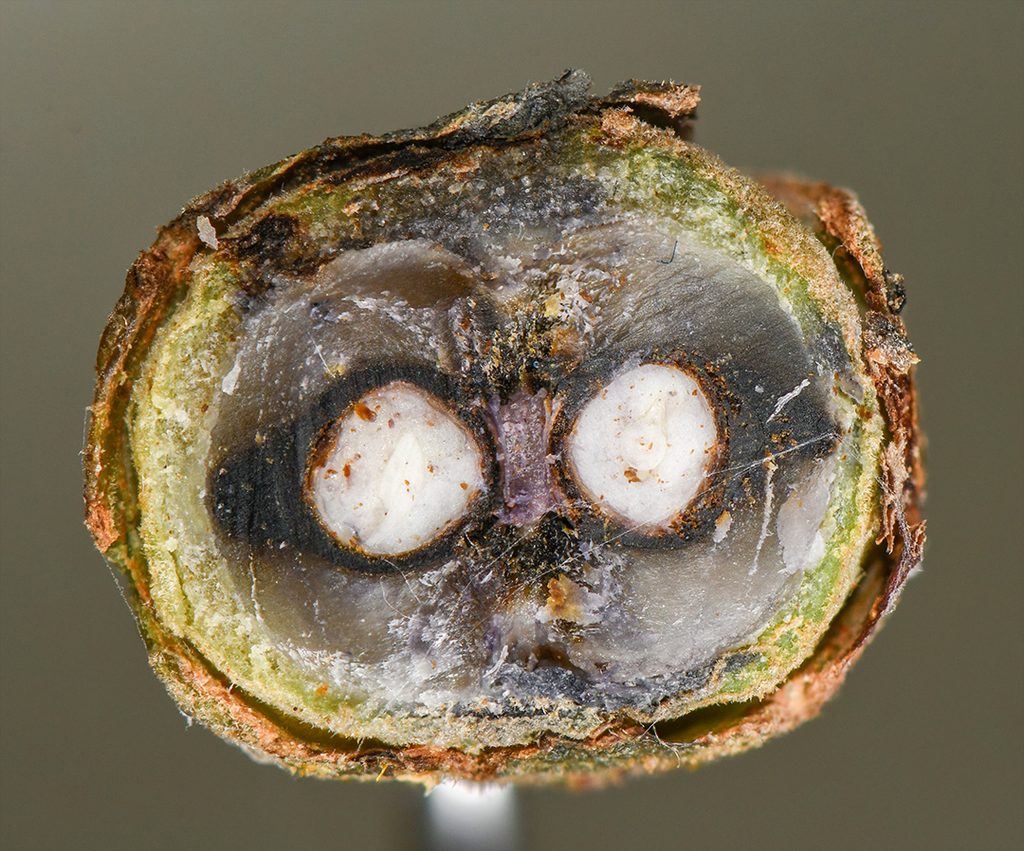
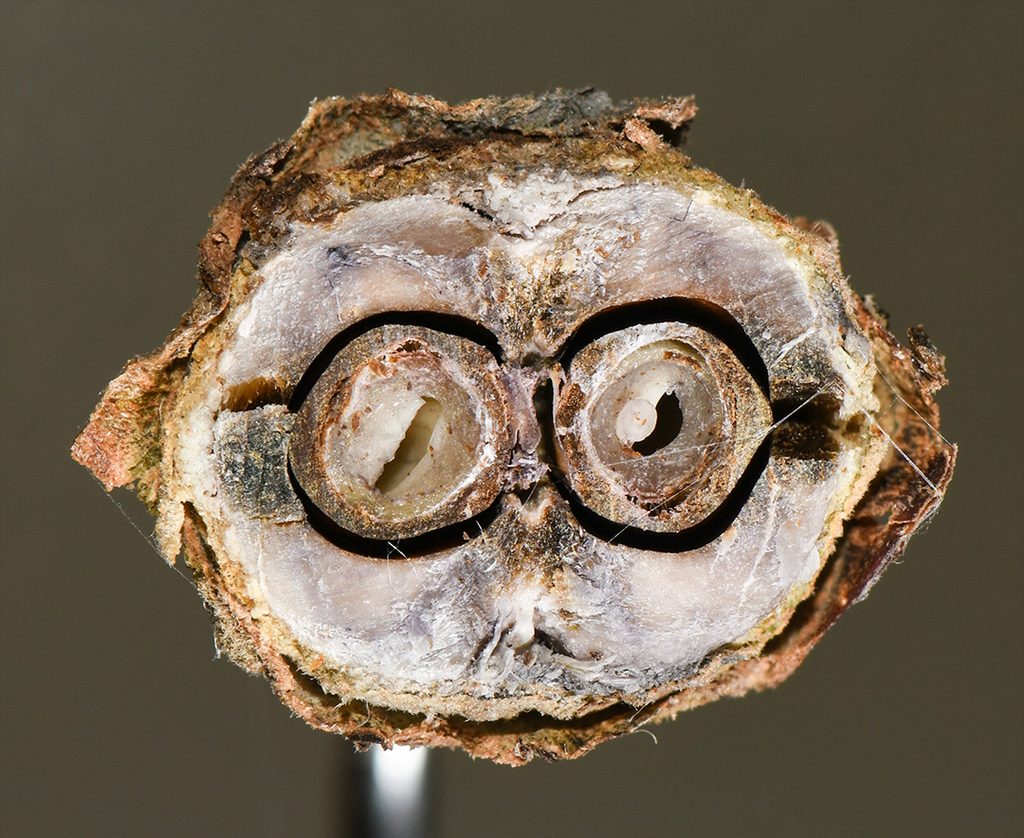
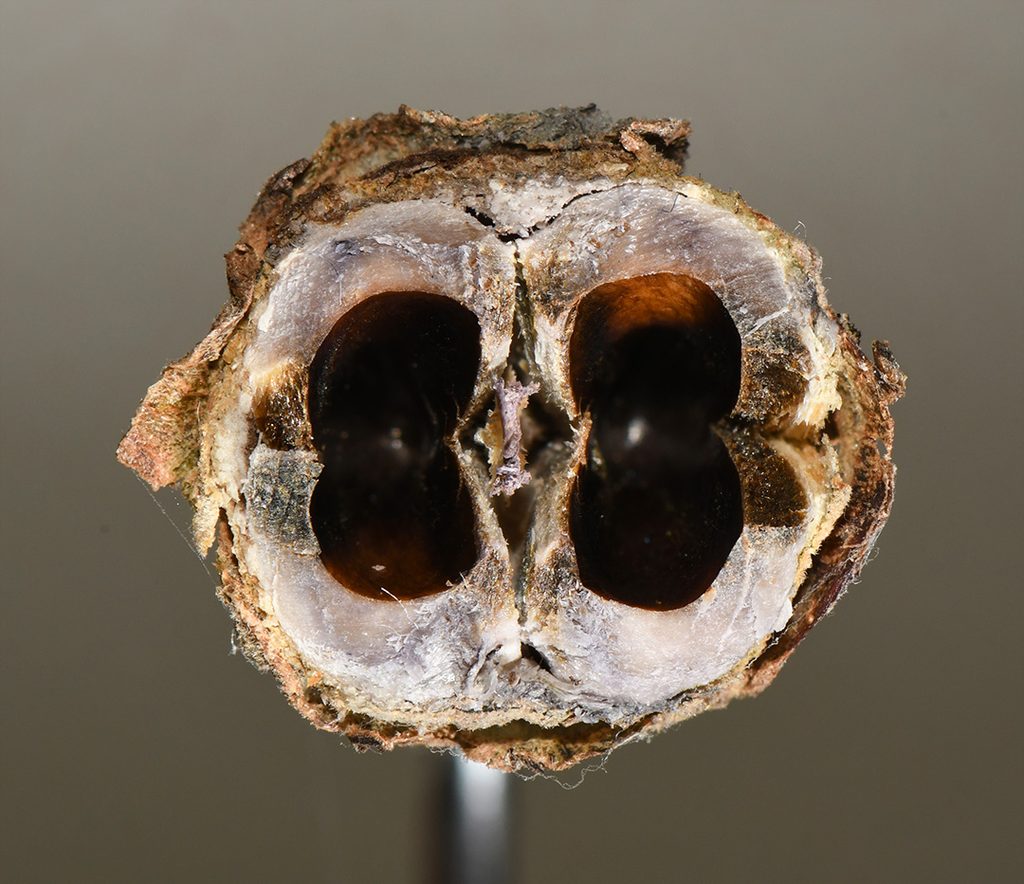
In the cross-sectional view, notice the outside layer, the exocarp, is soft and pliable. A few times it peeled off because the next layer, the endocarp, is very hard and difficult to cut. In the side view, it appears the drying endocarp is pulling away from the top two thirds of the seed as it dries and cracks open. However, the seed is still being squeezed all around the base. This is evidenced by how firmly anchored the seed is even when the seed launcher is cracked open and ready for the launch. Apparently, the “crrraaackkk” sound heard when the seed is fired results from the seed tearing away from whatever anchors it in place. The sound doesn’t come from the fruit cracking open because the seed shooter is slowly cocked open long before the seed is fired.
The top-view cross sections of seed shooters reveal a critical part of the ballistic mechanism. I made some of these cross sections by cutting around the seed about two-thirds of the way down the fruit yet leaving the seed in place. An additional way I cut top-view cross sections was by slicing clear through fruit and the seed.
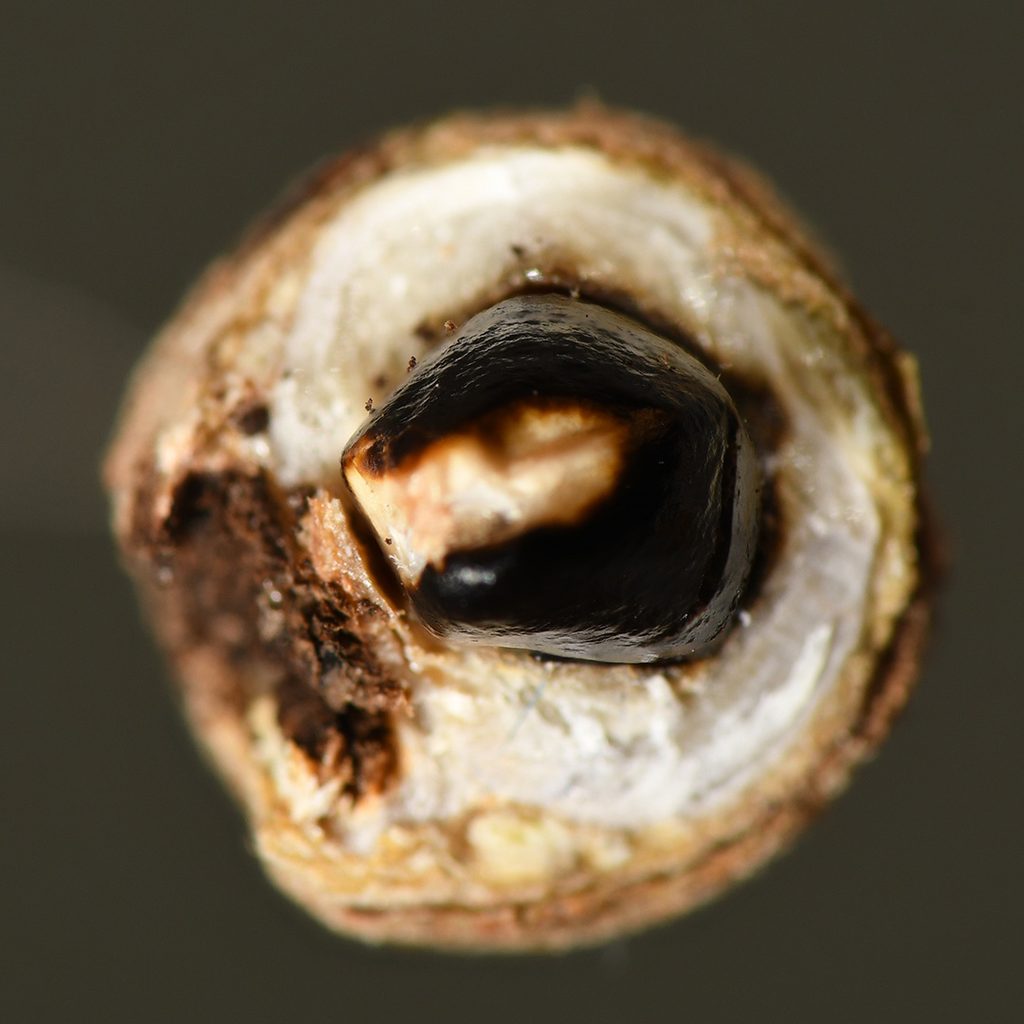
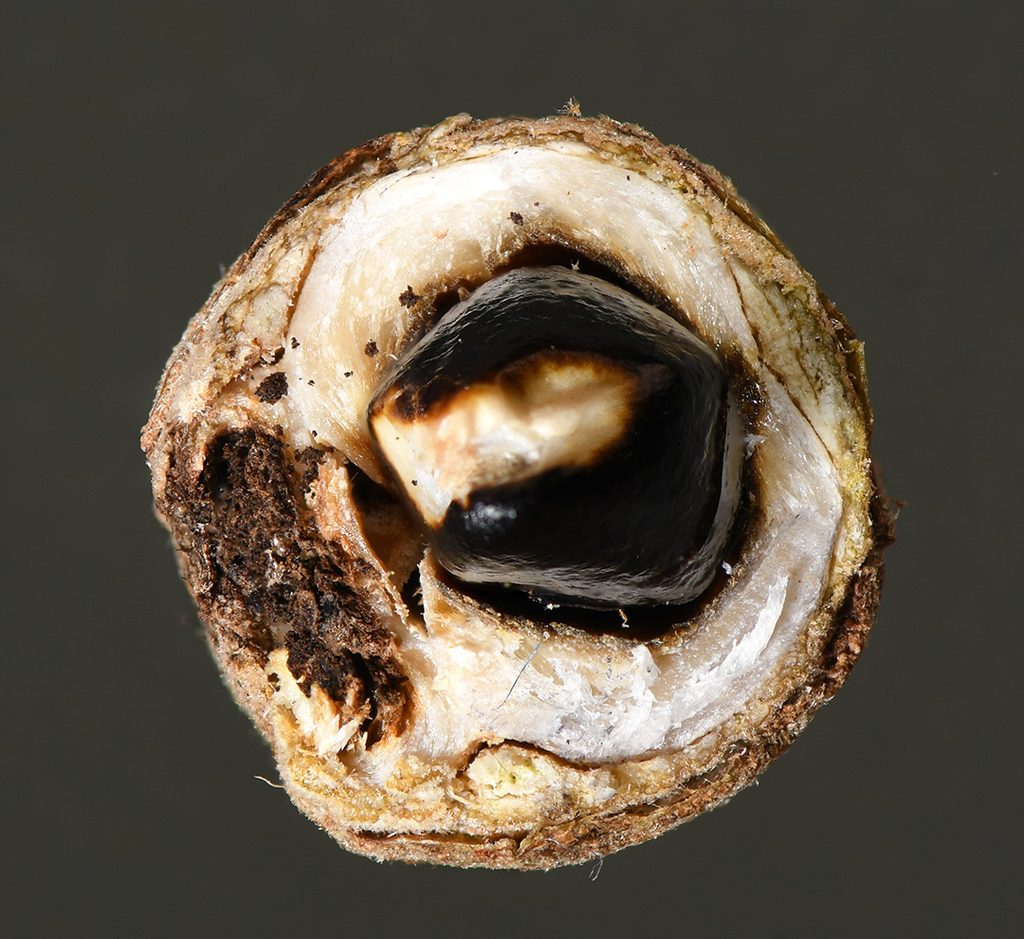
These top-view cross sections reveal the seeds are being squeezed/pinched by the edges of two halves of the endocarp. These pressure points are near the ridge that runs longways up the sides of the black football-shaped seeds. You can picture this mechanism by placing the fingertips of both your hands together and your thumb tips together forming a circle. Then, imagine squeezing a giant watermelon seed (the wide way) between your fingers and thumbs. As you squeeze, the palms af your hands arch away. When the seed shoots out, your fingers and thumbs would close the gap toward each other, and, instead of a circle, your hands would outline a figure eight or dumbbell shape.
This shape change, from circle to figure eight, can easily be seen in the top-view fruit cross sections. The figure-eight shape after the seed was fired resulted from the endocarp collapsing inward. That post-firing collapse is reportedly among the fastest plant movements.
Incidentally, the drying witch hazel fruit shoots the seed by squeezing similarly to the way we shoot a watermelon seed, but with an added twist, literally. The witch hazel seeds are put into a good spin as they are fired, not as fast as a rifle bullet, but fast enough to help stabilize the seed like a spinning bullet.
I’ve had a lot of fun investigating how witch hazel’s incredible seed shooting mechanism operates. I believe I was able to see how they shoot their seeds, but now perhaps I will always wonder, Exactly what makes that distinctive “crrraaackkk” when a seed is fired?