

I thought I could be an explorer—from my own backyard. But first, I got lost.
A long time ago, Grandma gave me an old book called The Sky Watcher’s Guide. Oh, those drawings of planets, of stars, galaxies, binoculars, telescopes, and scientists! That could be me. So, one fine October evening, I went outside to find Orion’s belt. How hard can it be to find three stars in a row? Did I ever get lost!
“Well, I couldn’t find anything,” I sighed, trudging back into the kitchen. “There’s a million stars out there.”
The next evening my father helped me. I came to find out Orion wasn’t even up in the evenings in October.
Start With One
“Let’s start with one constellation,” he said. “That will be our home base, and we can build from there. Try to find Queen Cassiopeia. She looks like a W of stars.”
Still nothing.
“Look over Harry’s house. Do you see that W rising in the sky?” He pointed.
I squinted, and then…yes! Suddenly, with one familiar shape in the sky, I could get my bearings. Every night after, I’d look for the Queen. From that one constellation, I learned the neighbors, and then their neighbors. She’s guided me all through the sky, and she might help you, too.
The ancient Greeks thought the stars traced the outline of the vain Queen of Aethiopia, sitting on her throne. To me, she looks like an M or a W, depending on the time of year. She’s a circumpolar constellation, one that appears to circle around Polaris, the pole star. If you live at latitude 34 degrees north or above (that’s Columbia, SC, or higher), you can see her all year, a steady friend in the sky.
Still, my favorite time to observe Cassiopeia is in the fall and winter when she’s well above the horizon. Starlight travels through less of our atmosphere when it’s higher in the sky, giving us a clearer view.
Out In The Field
See if you can find her. Use a red light to preserve your night vision when you look at the magazine. If you don’t have a red light, cover a white flashlight with a red bandanna.
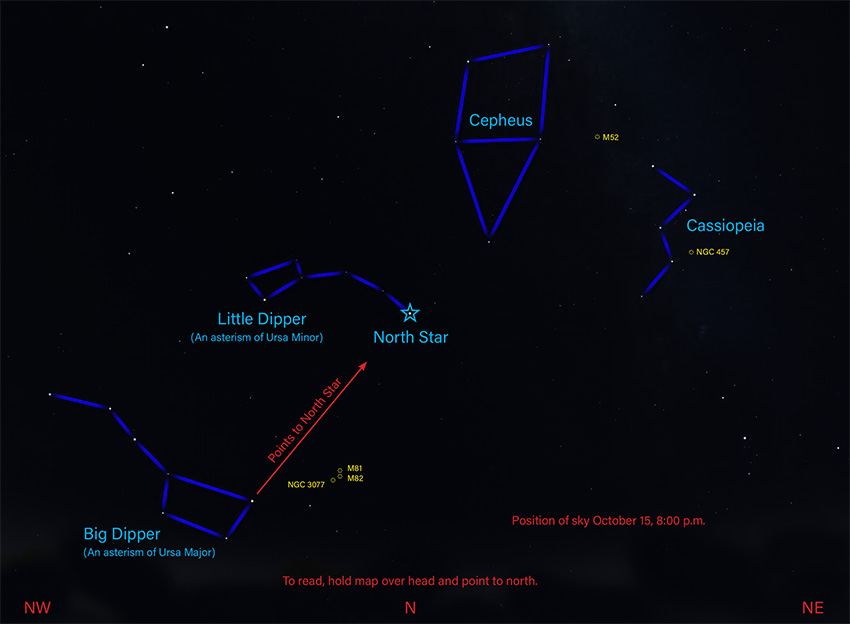
If you’re trying this in the fall or winter, look to the northeast. If you head out shortly after dark, that would be the opposite direction from the sunset. See the W?
Congratulations, you’ve met the Queen. Now you can relate a star chart to the night sky and learn more constellations if you wish, or spend some time observing her.
A Little Help: Binoculars
Using binoculars to sweep the glittering neighborhood of Cassiopeia is a treat. They unlock a new level of stars. They act like giant eyes, pulling in more starlight. The bigger the lens, the more stars you can see.
Typical binoculars are measured with names like 8×42, 10×42, 10×50, etc. The first number is the magnification; the second is the diameter of the objective lens in millimeters. Bigger isn’t always better, though. Over 12x magnification, the image gets shaky without a tripod. Over 50 millimeters, the binoculars get heavy. There are other factors you might consider too. Call Kevin at Nature Friend (540-947-1636), and he can help you. However, if there’s a pair hanging around the house already, start with those. They don’t have to be fancy.
The Deep Sky
Telescopes can open up “worlds” beyond the solar system. We call these deep sky objects. They include nebulas, galaxies, globular star clusters, and still more.
Binoculars are especially suited for observing open clusters, loose groupings of stars. There are several excellent ones near Cassiopeia.
On sky maps, you may see objects identified with numbers. There is a Messier catalog, and those objects have numbers, like M81, M82, and M52. There is also a New General Catalog of objects, and those have numbers like NGC 3077 and NGC 457.
Mr. Messier made the first catalog for an interesting reason. He wanted to find comets. So, as he discovered objects that were not comets, he gave them numbers. His numbers are still being used by astronomers today, or should I say, tonight?
On the next clear night, try sweeping your binoculars around Cassiopeia, and see what you find. Note any tiny fuzzy patches, almost like lint against empty space. With a little attention, you might be able to resolve these into small clouds of stars. This works best under darker skies (away from city lights), and when the moon isn’t spilling too much light across the sky.
Remember, if you learn one constellation, you can start to find your way around the heavens. Without a reference, the sky looks like an endless sea of diamonds. By learning one thing, you can get your bearings and get started on building a lifetime of knowledge. One day you might introduce someone to the Queen, too.