

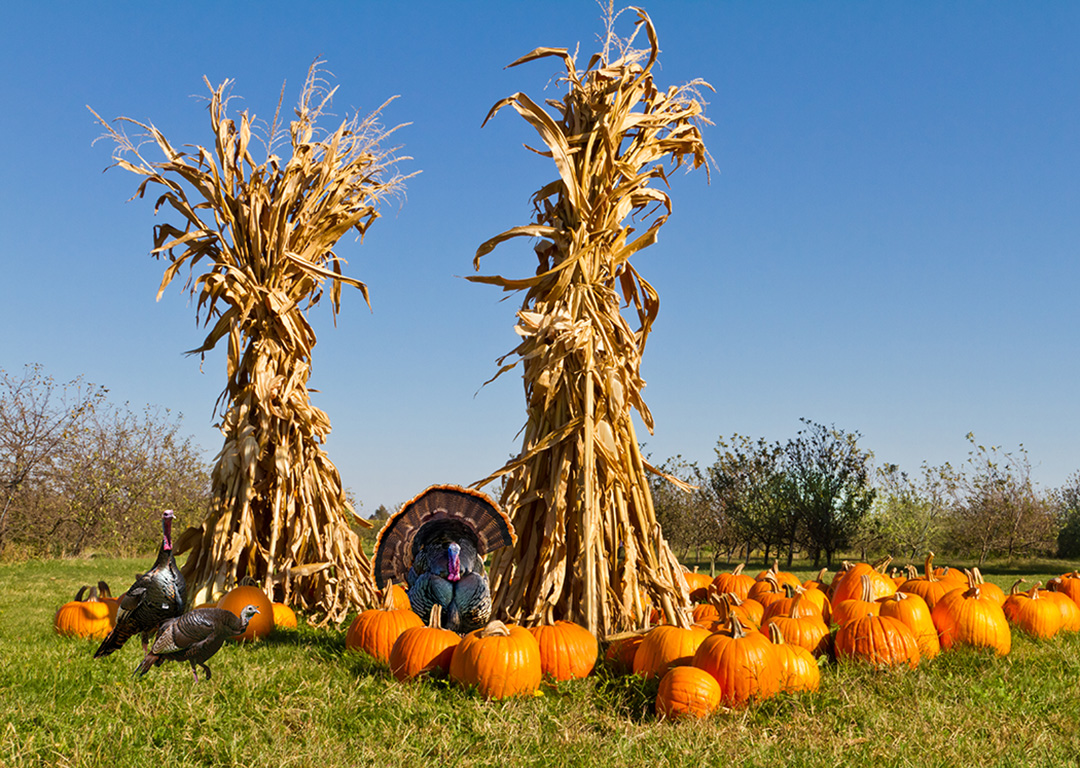
I like wild turkeys. They are beautiful birds. Their iridescent feathers shine in the sun. A strutting gobbler displaying his tail is quite the sight, and hearing a turkey’s gobble is a treat to my ears.
For those of us in the United States, before the month is over, we will celebrate Thanksgiving Day. (Canadians celebrated it in October.) How is it that Thanksgiving Day seems to be associated with pumpkins, corn shocks, Indian corn, and the beautiful wild turkey?
Pilgrims who landed in Plymouth, Massachusetts, late in the year of 1620, are credited with starting a special day to give thanks for a bountiful harvest. The Pilgrims were Englishmen who sailed to America for religious freedom.
That first winter living on board the Mayflower was very difficult. Due to sickness and lack of good food, approximately 45 of the 102 Pilgrims did not survive.
New hope was born with the coming of spring and the help of the friendly Wampanoag Indians to plant their crops. After an abundant harvest of vegetables and plenty of wild game and shellfish, they set aside a day to give thanks to their Heavenly Father. History tells us that about ninety Indians and fifty Pilgrims celebrated together.
What did they serve at their meal? The best source of information was found in historical records of Governor William Bradford and Edward Enslow. Venison (the Indians brought five deer), ducks, geese, wild turkey, and shellfish rounded out the meat.
Vegetables included cornmeal porridge (nasaump) or small corn cakes, not corn on the cob. There were also squash, beans, and pumpkins. Fruits included cranberries, blueberries, plums, and grapes.
There were no potatoes, no cranberry sauce (due to lack of sugar), no bread stuffing, and no pies.
Now let me guess—most of you have turkey at your Thanksgiving dinners. Am I right?
So how has the turkey become a symbol of Thanksgiving, if it wasn’t the main meat or dish at the Pilgrims’ thanksgiving feast?
Although venison was the main meat for the Pilgrims’ celebration, wild turkeys were in abundance. They would sometimes wander into the village. In 1621, William Bradford wrote that colonists were able to catch wild turkeys around their settlement.
Turkeys were easy to domesticate, and supplied eggs as well as meat. They were larger than chickens and easier to raise than beef or hogs. So they became the preferred meat for larger gatherings.
In the 1800’s, a prominent writer, Sarah Hale, wanted President Abraham Lincoln to set aside a special Thanksgiving Day. She promoted turkey for the main dish. Turkeys had become a symbol of gratitude and bounty in the New World.
Before President Lincoln declared Thanksgiving a national holiday in 1863, turkeys had already become the traditional main dish on Thanksgiving Day. Hunters enjoyed going out to harvest a wild turkey for the occasion.
Today large poultry farms raise turkeys, fattening them up to serve larger gatherings. Most weigh 20-30 pounds (9-14 kg); some have been known to weigh 35 pounds (16 kg) or more.
I like having a special day set aside by our government for giving thanks. Yet the Apostle Paul in his letter to the Ephesians encouraged them to “give thanks always.” And I’m sure that means every day.
Happy Thanksgiving.