Have you seen the giant flying horse lately? No? Start by looking for the Great Square of Pegasus.
Lines, squiggles, even triangles—you’ll find the night sky spangled with these shapes. A square is a bit more rare. It takes a little squinting to see how it’s a flying horse, but walk with me, and we’ll use our imagination.
Although dim, the Great Square of Pegasus dominates autumn and early winter skies. Look toward the east this time of year, and the first thing you’ll notice is how dim the sky looks. The splendor of the Summer Triangle marches west, bisected by the soft glow of the Milky Way. As we look away from the “downtown” part of our own galaxy (overhead in summer and winter), we see fewer stars, just as the lights get fewer the farther we travel from a city.
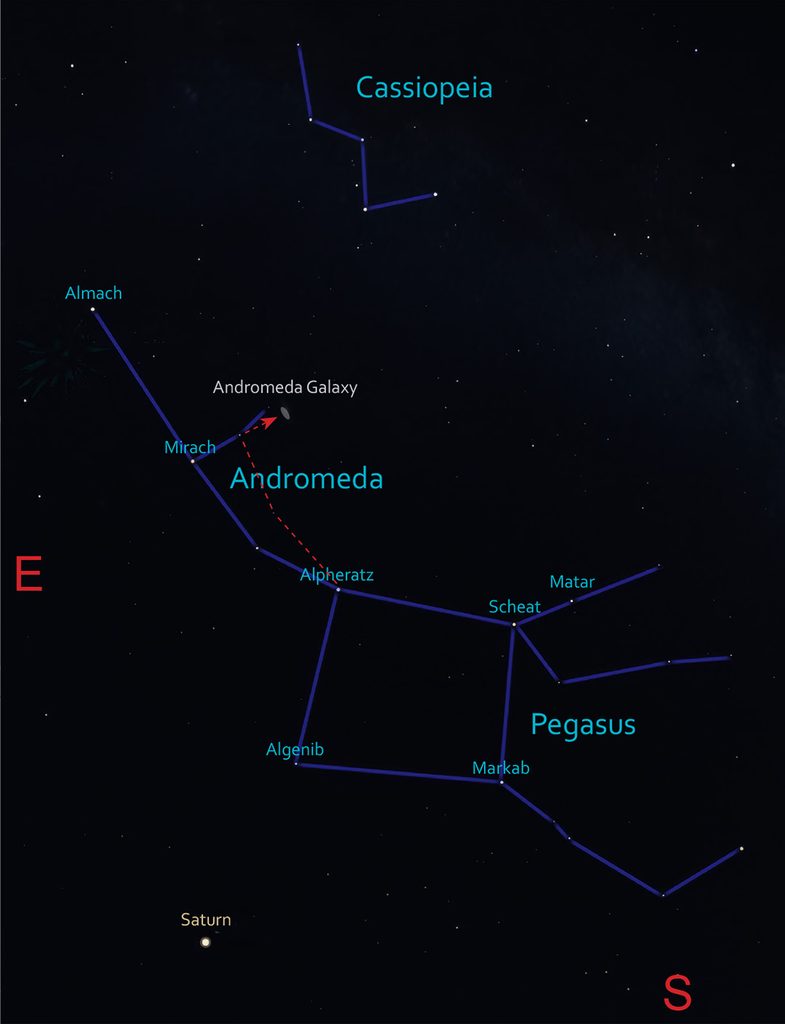
If you read the article in last month’s Nature Friend, you might be good at finding the landmark W (or M) of Queen Cassiopeia. Put her on your left hand side, and move to the right to sail to Pegasus. As your eyes adjust to the dark, find the square or diamond, depending on how you tilt your head.
Pegasus is drawn upside down, with its head extending from alpha (brightest) star Markab on the lower right, and its legs from beta star Scheat on the upper right.
If you were near Markab, you’d see it shining 150-200 times brighter than the Sun. Since it’s far away—130 light years or more—it looks dim.
Scheat is a “cool” red giant star almost 200 light years distant. It shines with a total luminosity of 340 times the Sun, and over 1,500 times if you count infrared radiation. These “little” stars twinkling away in the night surely are mighty furnaces!
Turning to the lower left corner of the square, we find Algenib cooking almost four times hotter than the Sun and shining over 4,000 times brighter. Again, since it’s far away (at least 333 light years), it looks relatively dim.
Finally, the upper left corner of the square doesn’t belong to Pegasus at all. It’s the alpha star in Andromeda, and it is called Alpheratz. It’s the closest of the square, at “only” 97 light years away. Remember, a light year is equal to 5.88 trillion miles. It’s actually two stars (a binary, or double star). The bigger member is 3 times the size of the Sun and shines 200 times brighter. The smaller is 1½ times the size of the Sun and shines about 10 times brighter.
Pegasus points us to a neighbor worth meeting, the Andromeda Galaxy. Starting with Alpheratz, “turn” left and note two lines of three stars each.
Counting Alpheratz as one, count down the lower line to star three. Jump up to the upper line. Double that distance, plus a bit more. If you have binoculars handy, give the sky a sweep, and boom! See the fuzzy blur? It almost looks like a wet cotton ball. Any size telescope will show it, and if your sky is dark enough, you might even spy it with your unaided eye.
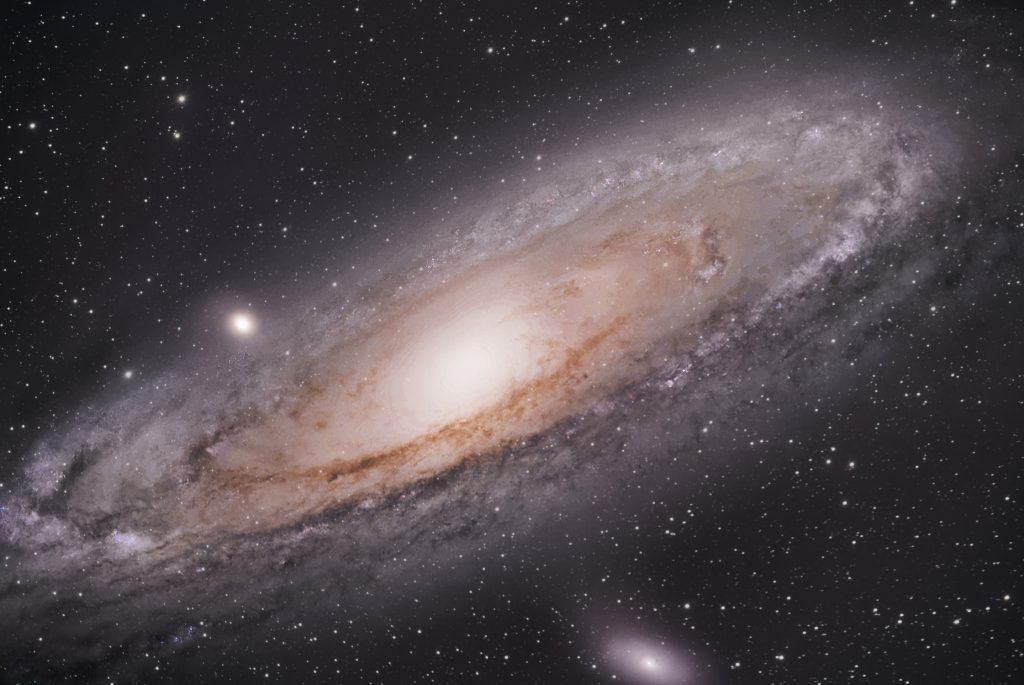
That’s the Andromeda Galaxy, our closest spiral neighbor, “only” 2.5 million light years away. It’s the combined light of a trillion stars in another galaxy.