

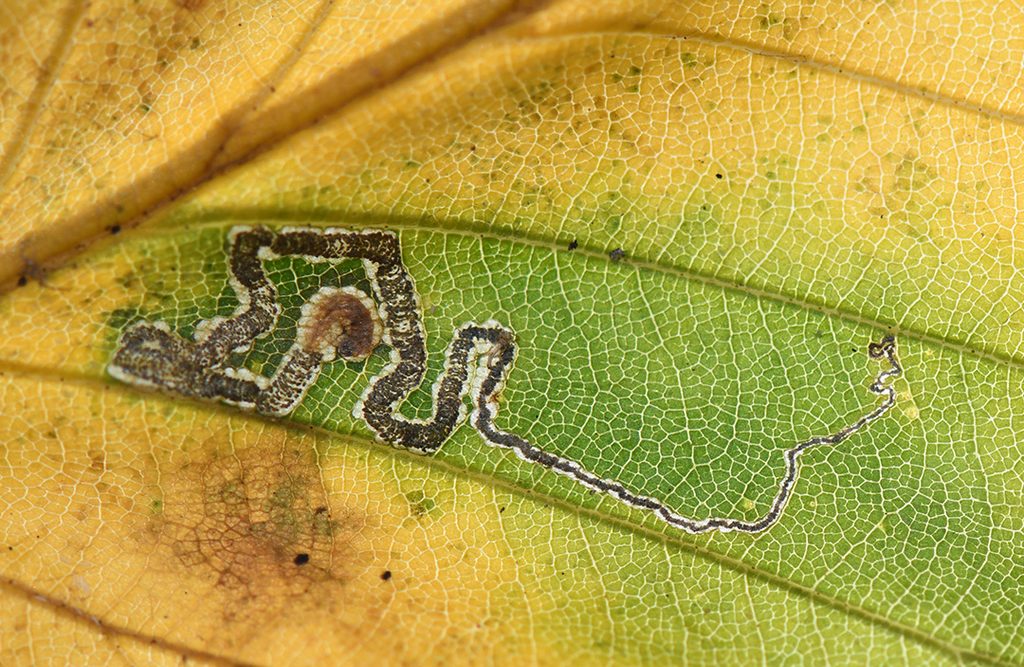
Ah-ha! Green islands! I thought. I’m sure Wyatt, and all the other Nature Friend readers, would enjoy seeing something odd that is probably happening right in their yards. Perhaps they will never look at fallen leaves the same way again. This was right after I learned that Wyatt is a recent subscriber to Nature Friend magazine. I was walking through his yard and spied some green spots on a few yellowed, fallen leaves.
Now then, if you are game for a mini adventure, head outside and try hunting for those green spots on the fallen leaves—little green islands in a sea of brown, red, and yellow leaves. Once you see a few, you’ll likely see them everywhere. I’ve seen green islands on birch, maple, oak, black gum, pear, as well as other kinds of leaves. Take a Ziploc bag or two along to put the leaves into so they won’t shrivel up right away.
Okay, here’s the curious part. As you were picking up the leaves with green islands, you might have been wondering, What causes the leaves to stay green in those spots? Did you happen to notice little squiggly lines in any of the green islands? Those are leafmines. You might find it easier to see them if you hold the leaf up toward the sky. Then, if you haven’t had a killing frost yet, you might even see a leafminer larva munching away on its green island surround by a sea of yellow.
Some, but not all green islands are associated with leafmines. Green islands are also associated with galls, rust spots (fungal infections), and even aphid damage. Some green spots are simply areas where the chlorophyll wasn’t recycled for some reason.
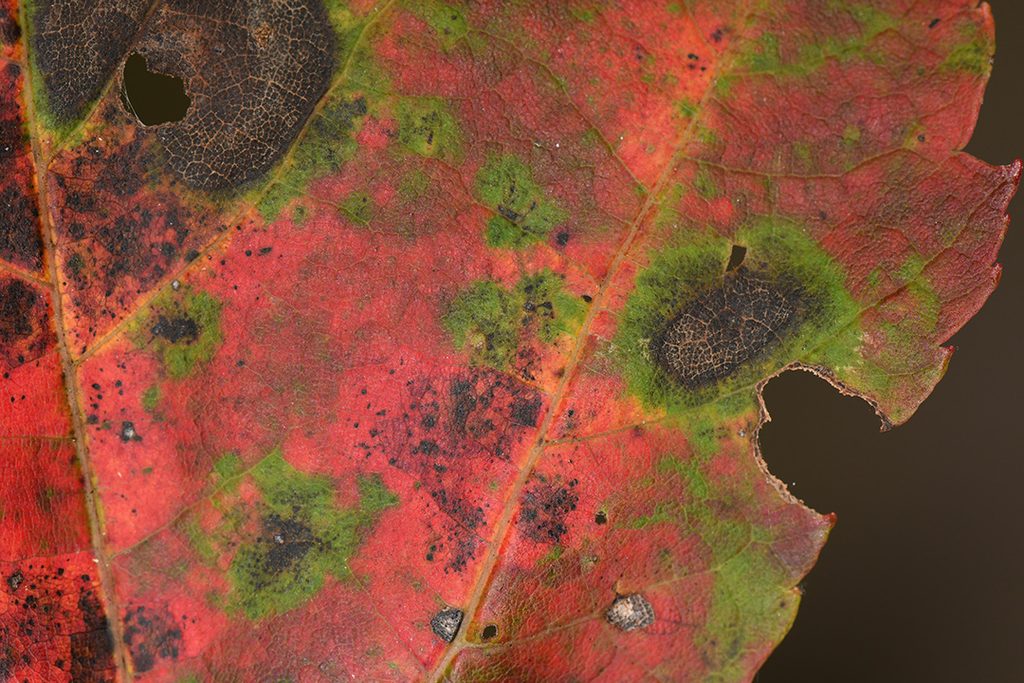
The cause of our classic green islands, according to some researchers, is the leafminers’ symbiotic bacteria. These bacteria are thought to produce cytokinins, which are plant growth hormones that induce the stay-green effect. Some researchers say the fungi in the leafminer’s frass causes the green island. Other researchers say the leafminers themselves produce the cytokinins.
Regardless of what causes the increased cytokinins in the green island area, the chemistry of the leaves is modified and the host cell death is delayed. This could extend the food supply for the pathogen or insect. Just think of that leafminer larva we saw feeding happily in its green island while the rest of the leaf was basically dead. Additionally, consider how most other leaf feeders have already finished feeding on leaves, and many of the larva’s potential enemies are also gone for the year.
That’s a real oddity.
Well, green islands get even stranger. Green islands might have a cascading effect. For example; years ago, I think I read somewhere that leaves with green islands take longer to decompose. Unfortunately, I wasn’t able to relocate that research. Oh well, what difference does it make anyway whether some leaves decompose faster than others?
Wait! If green islands do in some way affect decomposition rates, that’s really fantastic! Why not try to see for ourselves whether that happens? Let’s set up experiments with some green island leaves and compare what happens with them versus regular leaves. Maybe they’ll take longer to rot, or maybe they’ll decompose faster.
Here’s one way to do a green island leaf experiment. Gather some fallen leaves, some with green islands and some without any. Let’s say you have three birch leaves with green islands and three birch without. Duct tape the stems of the three green-island leaves onto another piece of duct tape, and the other three (same species, similar size) without green islands to another strip of tape. Since the leaves should be subject to the same conditions, notch the tape of one group of leaves so you can tell the leaf sets apart later on.
Place the two sets of leaves in a mesh bag (like an onion bag) and put it out on the ground with other leaves where the worms won’t get them and where they won’t blow away. After a good while, compare them and see if there’s any noticeable difference in the decomposition rate between the green-island set and the regular-leaf set.
Green islands become even odder if you think about this. When leaves fall to the ground, worms get some of the leaves and pull them down into their burrows to eat. But generally, most of the leaves that fall to the ground get decomposed by bacteria and fungi and a whole assortment of leaf litter/soil animals—the leaf-litter processing zoo.
However, lots of the leaves get blown away and fall into streams. There they get water-logged and sink. The leaves then get caught in clumps on sticks and rocks. There in those leaf packs, a whole processing system kicks in, similar to what happens to the leaves in the leaf litter.
So, what happens to our green-island leaves if they end up underwater in a leaf pack? Is it possible that the green-island leaves have a different decomposition rate then? Are they preferentially colonized and fed on by the aquatic leaf-processing zoo, or are they avoided?
Hmmmm, I’m about to find out! Aren’t you?
You could make your own leaf packs by putting green-island leaves with the same number of regular leaves into mesh onion bags and fastening the bags among the rocks in a stream riffle. The stream’s leaf-processing system will take it from there. Just check on them once in awhile to see what happens.
Fallen leaves are fantastic, aren’t they?