

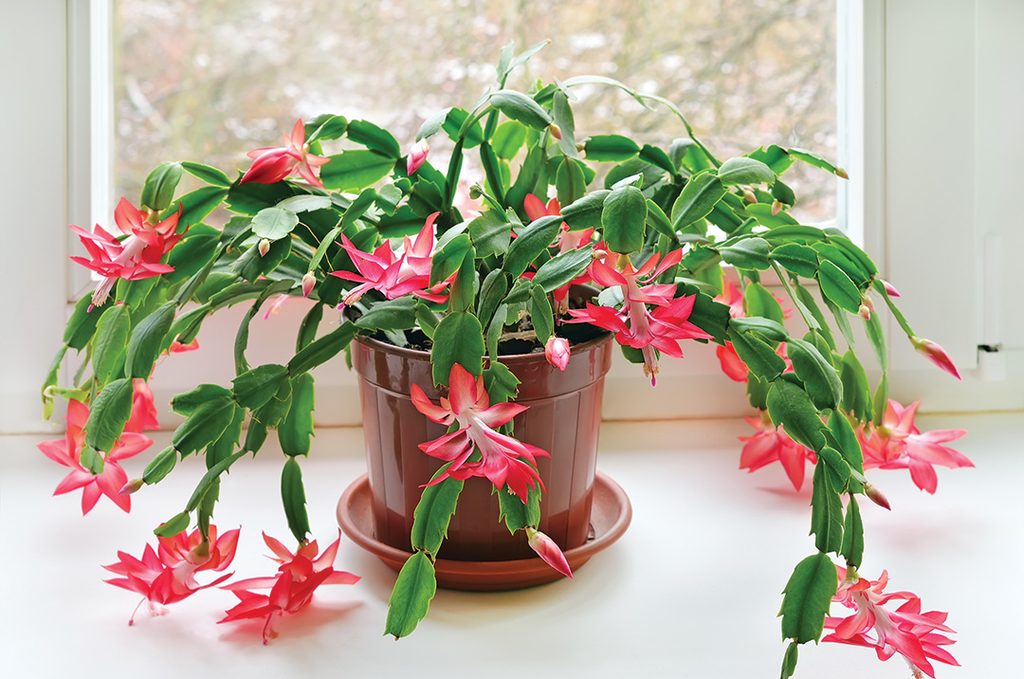
Looking around the living room from my comfortable seat on the couch, I see a rubber plant, a spider plant, a split-leaf philodendron, two palms, a dracenea, a Norfolk Island pine, another dracenea, a white rabbit’s foot fern, a maidenhair fern, two African violets, and the most beautiful flower of all, my wife.
Houseplants add texture and character to any room of your house. Even the bathroom! And they do more than add beauty to your home. They even help purify the air. NASA reportedly did extensive studies showing that the right density of houseplants can remove more than 80% of toxins in an airspace within twenty-four hours.
Studies show that houseplants can improve your mood, help your concentration, and reduce stress. An indoor garden can be a refuge from the outside world, a tropical “escape.”
Certain houseplants can even help you sleep better. Most houseplants release oxygen during the day. At night, when photosynthesis stops, they switch and release carbon dioxide. But orchids, succulents, bromeliads, and snake plants release oxygen at night, which is why you might consider having an orchid or two drooping down over your pillow while you sleep.
So it’s November. How should you care for that fig tree (Ficus benjimina), umbrella plant (Schefflera), or grape ivy (Cissus rhombifolia)?
Here are a few general rules for keeping your houseplants thriving during the winter.
- Provide adequate light. Remember, the days are getting shorter, and the sun is lower on the horizon. This means light levels inside your house are much lower and less intense. Moving your houseplants nearer the south or west windows would likely be a good idea. Be careful about drafty windows, however. Rotate your plants when you water them to keep one side from stretching toward the sun.
- Put your houseplants on a diet. Since your houseplants are growing very slowly in the wintertime, they need very little food. You can hold off on fertilizer entirely until spring, or until you see new growth.
- Watch for temperature fluctuations. Most houseplants are like people. They like daytime temperatures from 60°-80° F, and can stay comfortable down to 50° F at night. Be careful about cold drafts near doors and windows. And while woodstoves are a wonderful way to heat your house, the dry air created by wood heat is not great for your plants. Be careful not to place houseplants too close to a woodstove or a hot air register.
- Don’t overwater. This might well be the most important consideration in keeping your houseplants healthy this winter. Since there’s less light, your houseplants will need up to 50% less water. Check moisture by sticking your finger a half inch or more into the soil. If you don’t feel moisture, it’s likely time to go for your watering can. Of course, if your plants are drooping, that could be a sign they need water. Let’s hope it’s not plant wilt caused by root rot due to overwatering!
- Humidify. Because of forced air or wood heat, the humidity level inside your house in the wintertime might be as low as 10-20%. Many of your houseplants originate from tropical forests, and should have at least 50% humidity. Raise humidity by running a humidifier or by keeping a pan of water on your wood stove. Another way to create a high humidity microclimate for your houseplants is to place them in saucers or pans with a layer of pebbles on the bottom of the saucer. Keep a little water at the bottom of each saucer. (Make sure the pot stays above the water.)
Keeping a collection of houseplants thriving indoors all winter means you can garden all winter long, even when your outdoor garden is covered with 3 feet (1 m) of snow.
As for me, it’s time I finish this article, make two cups of tea, and sit beside the flower of my life—on the loveseat.