A magnifying glass does its job by the curvature of its lens. Light passing through a curved lens will be redirected. A magnifying glass can be used to make things appear bigger and to intensely focus light in a small spot. You can even use it in the sunshine to burn dry leaves and paper. The bigger the magnifying glass, the bigger the effect.
There are some natural magnifying glasses of huge cosmic scale. To understand how they work, we need to understand how gravity works. Gravity works by warping what seems to be the emptiness of space. A big object puts a big dent in space, which causes other objects to move toward it. A heavy ball on a trampoline illustrates this warping of space. Other objects on the trampoline want to roll toward the heavy ball, not because they are attracted to the ball itself, but because the trampoline fabric is tilted toward it. In the same way, objects in space and on the Earth are attracted to each other. It’s not because of some attractive force between each object, but because space itself, like the trampoline, is curved toward massive objects.
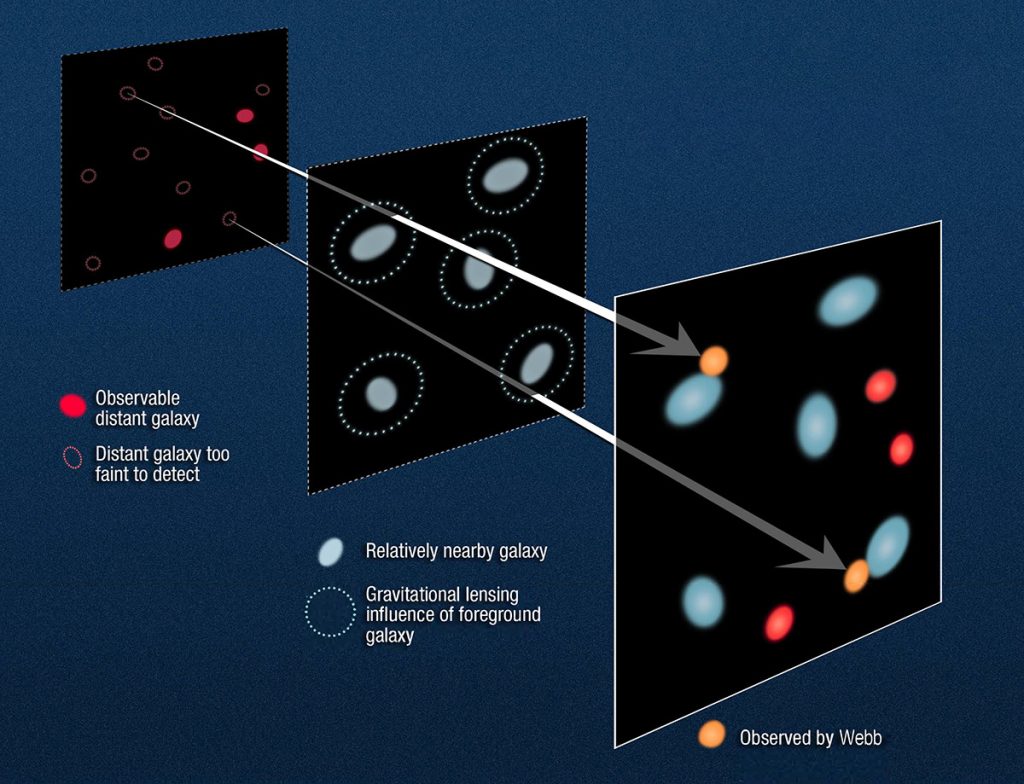
We can look at certain areas in space where there are massive galaxy clusters with trillions of enormous stars—stars that can be hundreds of times larger than the Sun. All this mass in one area causes space to be warped inward, in effect, creating a giant magnifying glass. In the same way that a magnifying glass can magnify the Sun’s brightness dramatically, a massive galaxy or galaxy cluster can magnify and brighten distant galaxies. In some cases, galaxies that are too far away to see with our biggest telescopes are brought into view by this lensing effect. It’s like being at the bright focal point of a magnifying glass held in sunlight.
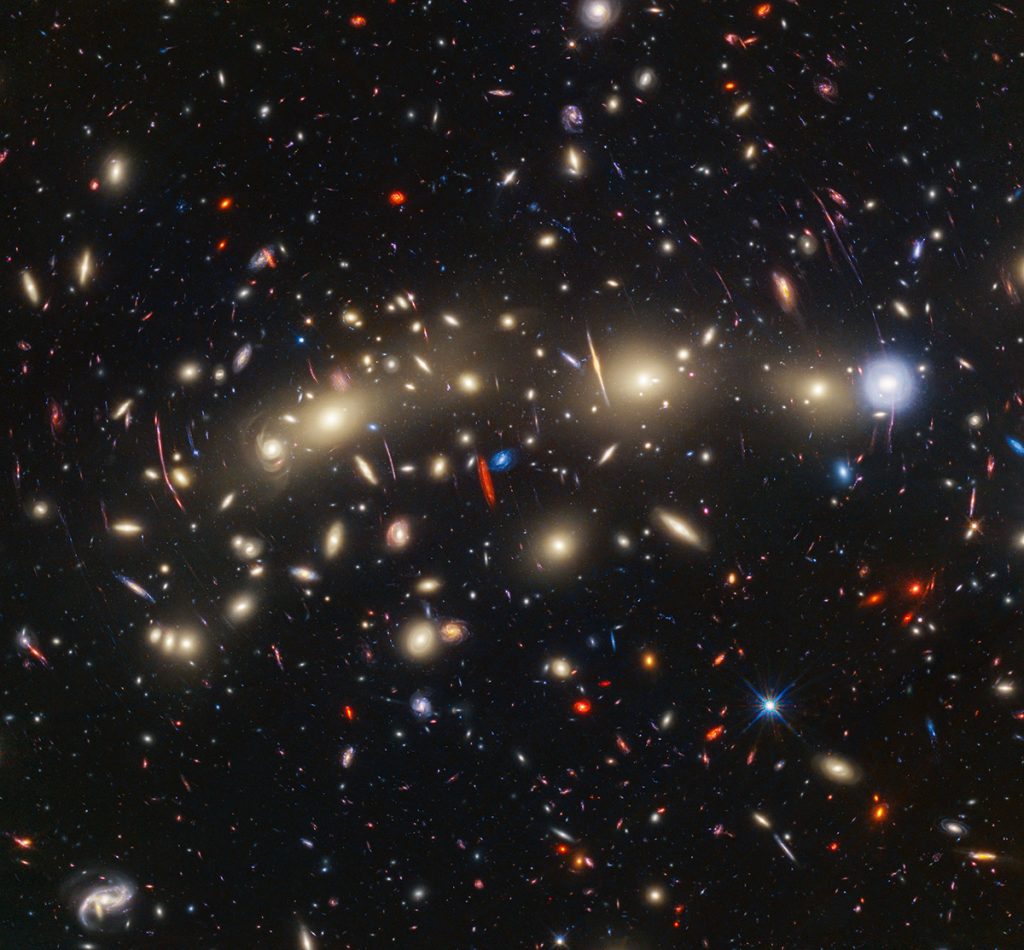
If the distant galaxy isn’t perfectly lined up with the lensing galaxy, then the image it projects will be projected off to the side of the lensing galaxy and distorted into a long thin line that’s often curved. If the distant galaxy is perfectly lined up with the lensing galaxy and the Earth, it will form an Einstein ring—a perfect, circular image of itself wrapped around the lensing galaxy.
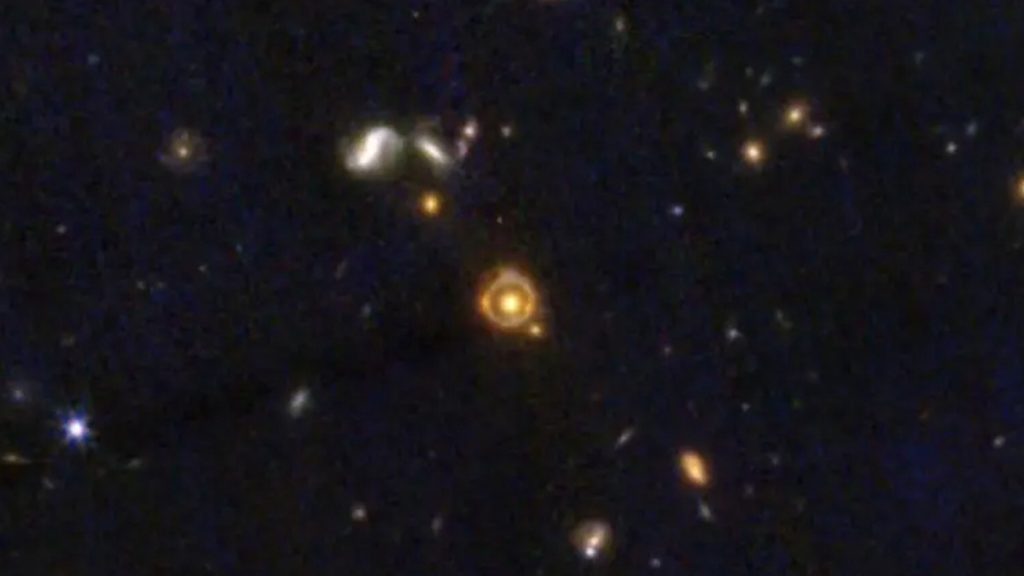
It’s called an Einstein ring because it was Einstein who first proposed that the warping of space happens.
In 1915, Einstein proposed his general theory of relativity. Many scientists remained skeptical of the claims he made. They found it difficult to understand how objects could warp space. About four years later, a group of scientists tested his idea by traveling to a total solar eclipse site and measuring the positions of stars close to the Sun. The stars appeared to be deflected away from their normal positions. Suddenly, Einstein’s mind-bending claims about the bending of space weren’t so far out after all. That experiment was the best early confirmation of his theory of relativity.
Interestingly, sometimes God’s creation magnifies itself. When that happens, He is exalted. “O magnify the Lord with me, and let us exalt his name together.” Psalm 34:3