

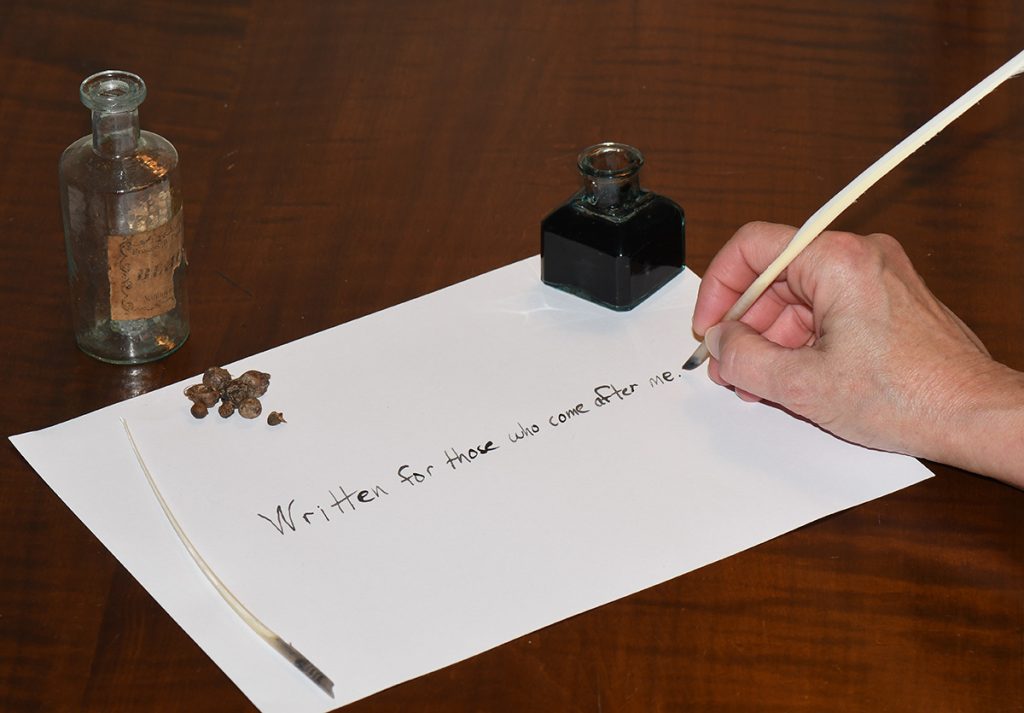
Tiny wasps help tell a story of George Washington and Samuel Pannebecker “for those who come after….”
The little fellow came tearing out of the woods and running up to me, happily holding up his find. “Look! I found a turkey feather!”
He was really excited about simply finding something just lying out in the woods. I’m sure he wasn’t thinking about Thanksgiving turkey, and I wasn’t either. What I thought about when I saw that large flight feather was how it would make a nice quill pen. Then I thought about an old ink bottle I had recently bought at a yard sale. That bottle would have contained oak gall ink, or wasp ink, as I like to call it. The old bottle has a story that includes tiny wasps, oak trees, George Washington, and turkey or goose quill pens.
Not long ago and not very far away, while I was at a yard sale, I picked up a small pontiled bottle made with greenish bubble glass. It is a very old bottle, likely from the early 1800’s, and does it have a story connected to it!
Its paper label reads:
From S. B. Pannebakers’ Drug Store
BLACK INK
Mifflintown

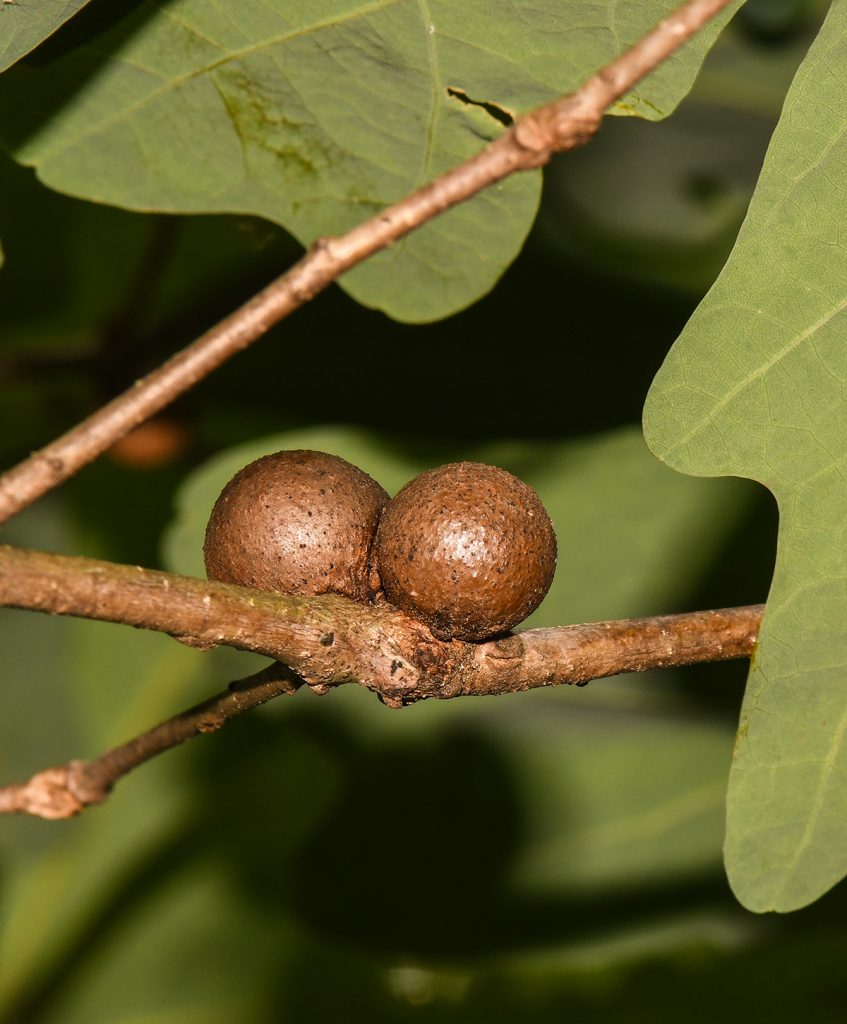
Back then when the bottle was sold, it would have held “wasp ink” or oak gall ink because ink has, for thousands of years (traceable to ancient Roman times), been made from oak galls. Oak galls are caused by gall wasps.
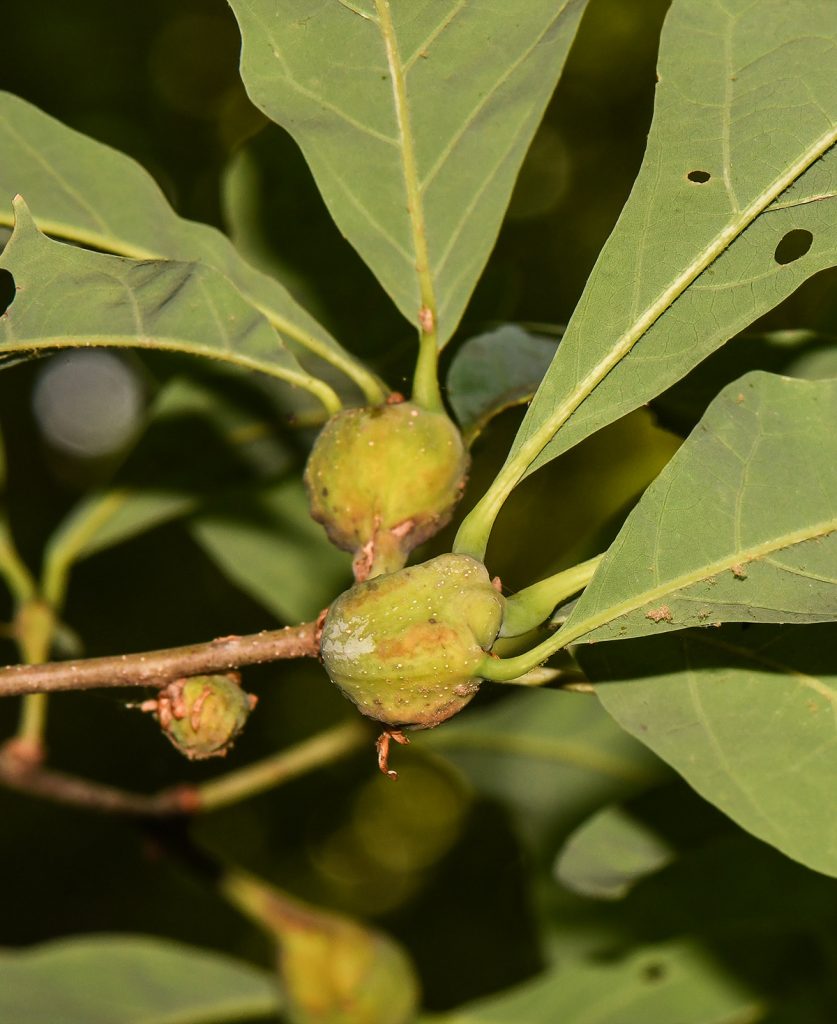
Gall ink starts with tiny wasps laying eggs in the spring when the oak leaves or stems are developing. The gall wasp larvae hijack the oaks’ genetic information and cause the oak trees to grow those abnormal growths (galls) on the leaves, stems, or branches. These galls feed the developing larvae and also afford the larvae a measure of protection from predation. I often illustrate the phenomenon of insects causing galls to form by saying, “It’s like you going out to an oak tree, giving it a shot, and it grows you a house and feeds you.”
By the way, if you try rearing a gall wasp, there’s a good chance that whatever emerges may not be the galling insect but a parasitoid wasp. There are many parasitic wasps and also inquilines that can be found living in galls instead of the gall-inducing wasps.
Galls concentrate the plant’s resources and also the plant’s chemical defenses which, in the case of oaks, are tannins. Those tannins are the ingredient that produces black ink. Try it for yourself using this 1500’s-era recipe for gall ink that I modified into modern English and smaller amounts.
Here is the original recipe I found:
To make gode blak yngk as ony ys in Ynglond. Take an vnce of gallys, an vnce of gume, and an vnce of grene coperose, brose all thyse togeder almost to pouder and put hit in a pott…than put therto a pynte of rayne water or of stondyng water that rynneth nott, than stere hyt euery daye and within iii. Dayis ye schall have gode yngk.
Cambridge University Library CUL Ee. 1.15 (32) IMEP VOL. 19
Here is a gall ink recipe I based on the above medieval recipe:
3.5 grams crushed oak wasp galls
3.5 grams gum arabic
3.5 grams ferrous sulfate
¼ cup distilled or rain water (approx. 60ml)
Mix well and stir daily. In a few days, filter out the gall pieces. Add a whole clove (or keep refrigerated) to help keep the ink from getting moldy.
Historical connection:
Samuel B. Pannebaker (Last name spellings vary.)
His father was William Pannebecker and his grandfather Samuel Pannebecker, who wrote in his Bible (in German) with a quill pen and gall ink (most likely):
On the 26th day of September 1777, an army of thirty thousand men encamped in Skippack Township, burned all the fences, carried away all the fodder, hay, oat and wheat, and took their departure the 8th day of October 1777. Written for those who come after me, by Samuel Pannebecker.
Grandfather Samuel Pannebecker’s farm and home were taken over by the Continental army during the Battle of Germantown. All his crops were gone in a day. That would have been a real hardship for the Pannebeckers, especially during the upcoming winter. The fence rails he split were burned up in the soldiers’ campfires. I suppose Samuel Pannebecker didn’t even have a goose or turkey left in case he needed a new quill to write with. His son William, Samuel B. Pannebaker’s father, remembered wounded soldiers being brought into the Pannebeckers’ kitchen.
George Washington had made the Pannebecker house (Pennypacker Mills present spelling) his headquarters during the Battle of Germantown. While he was there, he wrote letters to his generals, etc. That’s right! You’re onto it! You know what he used to write those letters—wasp ink and a quill pen.
If you are raising a turkey for Thanksgiving, perhaps you can pick up some of its flight feathers and use them for making quills. I use goose feathers purchased from a craft store.
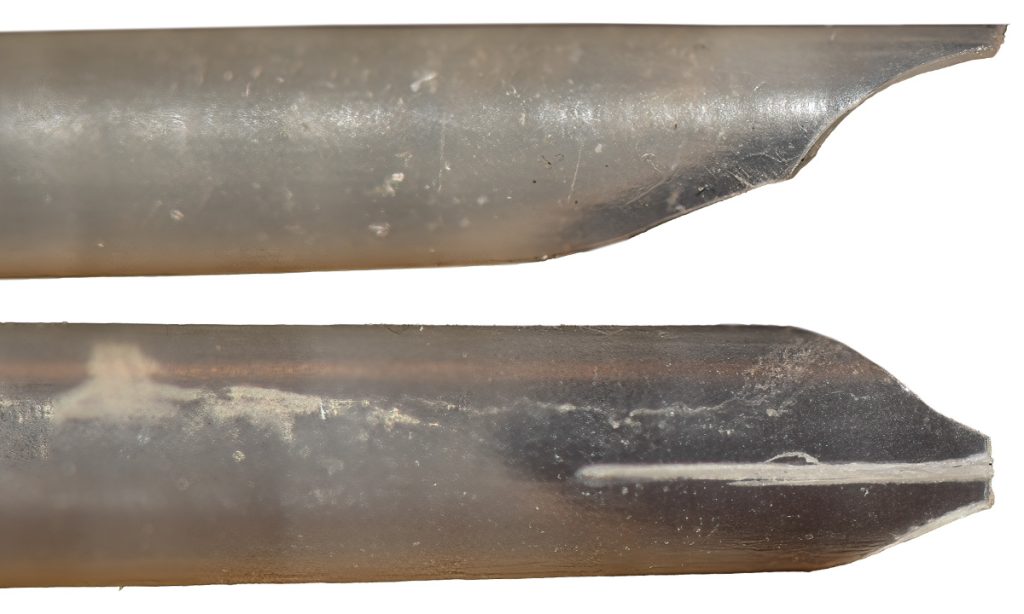
Just a few cuts are required for cutting a quill nib. Cut the tapered end off. Cut a long angle off the lower side. Trim the tip narrower on both sides. Cut off the tippy-tip. Then score or cut a slot from the center of the reservoir area to the tip. This will help the ink flow.
Historically, quill pens were just that, a quill with no barbs. A feather pen is apparently a modern thing. So, cut off the barbs if you’d like to be historically accurate. Then go ahead and try writing with the gall ink. Dip the quill into the ink, wipe the tip off on the rim of the inkwell, touch it on a scrap piece of paper to test for excess ink, and try writing some things you are thankful for. Perhaps that will include tiny gall wasps and oak trees in addition to Thanksgiving turkey.
If you don’t have oak trees from which to gather galls, you can use maple leaves. Maple leaves work because both oaks and maples have tannins for chemical defense against herbivory.
Maple Ink
15 maple leaves
3.5 grams ferrous sulfate
3.5 grams gum arabic
Tear leaves into small pieces. Place in kettle and cover with distilled (or rain) water. Simmer until ¼ cup of liquid remains. Discard leaves. Add ferrous sulfate and gum arabic, and stir well.
Add a whole clove or keep refrigerated for preservation.