

Even though outer space is mostly clear and empty, there are lots of areas that contain huge clouds of gas and dust.
The largest clouds in space are usually called diffuse nebulae. They can be divided into two main types: reflection and emission nebulae. Emission nebulae have that name because gases within the nebulae are energized by intense UV radiation from nearby stars. As a result, the gas molecules emit photons of light. Hydrogen, the most abundant element in the universe, emits red light. Other elements can create blue, green, or other colors.
Reflection nebulae are clouds of gas and dust that do not emit their own light, but instead reflect light from nearby stars. They can appear as dull gray or brown clouds in space. Often times nearby blue stars shine on a reflection nebula and light up the dust with the same blue color.

This photo of LBN 534 is an example of that happening. Most of the dust in this picture appears brown, but the upper portion has dust with a bluish color. So, why is one part of the dust cloud blue while the rest of it is brown?
The parts of the nebula that are brown appear that way because light seen from those areas has passed through the dust cloud. As that happens, blue light is scattered out, and redder longer wavelengths of light pass through and continue on to us. The blue areas only appear that way because of the brilliant blue starlight reflecting off the surface instead of passing through it.
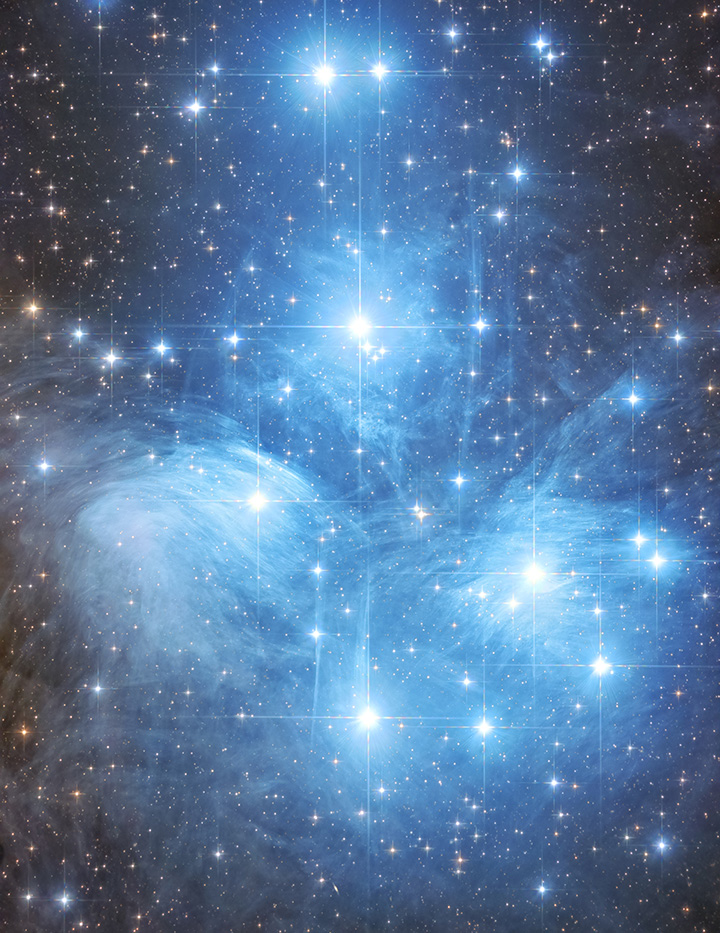
The bright blue nebulosity around the Pleiades star cluster is an example of colorless dust being lit up by blue starlight. Dust in reflection nebulae primarily appears brown or blue because of the way light interacts with it.
The same principle explains what we see in the Earth’s atmosphere. When the sun is low in the east or west, and shining through lots of dust and air, red light is much more prominent.
Clouds in our atmosphere also manipulate light and appear with a variety of colors. For example, the tops of puffy white cumulus clouds usually appear white during the middle of the day. They are white because sunlight is reflecting off the surface of the cloud where water droplets reflect all wavelengths of light equally. However, thick clouds often appear dark blue, especially near the bottom. The reason is that light emanating from the blue-colored bottom has passed through the cloud instead of simply reflecting off its surface. When light passes through water or water droplets, long wavelengths of light such as red are absorbed whereas blue light more easily passes through. Therefore, when white sunlight passes down through a cloud, it exits the other side as a darkened blue light. The thicker or denser a cloud is, the darker or bluer color it will have.
All of these natural laws come together to add variety and beauty in both the heavens nearby and the heavens afar.