

Gravity seems fairly straightforward and predictable. If you throw a ball up and then catch it, the speed at which it falls back into your hand will be the same speed as when it was launched. If you ate too many cookies at Christmas, depend on it, your bathroom scales will give you the bad news. There are some little-noticed effects of gravity that are surprising though. We’ll look at three of them here.
Tidal force
When we see illustrations of how the Moon creates tides on the Earth, it’s easy to understand why there is a bulge of water on the side of the Earth facing the Moon. Have you ever wondered, though, why there is a bulge of water on the opposite side of Earth from the Moon? It’s not that the water rises on that opposite side, but rather, it’s that the Earth is pulled away from the water on the far side.

Here’s how it works. Gravitational strength follows the inverse square law. Each time you halve the distance between two objects, the gravitational pull increases by four times. This causes the Moon to pull on the water closest to itself more powerfully than it pulls on the Earth under it. Yet, it pulls harder on the Earth itself than it does on the water on the other, far side of the Earth. This makes for an interesting situation. If you were standing at the rising tide opposite from the Moon, the Moon would be beneath the Earth and you. Although the water would appear to rise around you, you could think of it as the ground around you sinking toward the Moon while the water lags behind!
Barycenters
Objects in our solar system appear to orbit the Sun. But things aren’t always as they seem. One object doesn’t necessarily orbit another stationary object. Instead, two objects orbit each other. For example, we could imagine connecting the Earth and the Sun with a long pole, then finding the balance point on that rod. Since the Sun is so massive, the point of balance would be inside the Sun but not at the center of the Sun. It would be offset toward the Earth. This is called the barycenter. It is the point around which the two objects revolve.

Jupiter is much more massive than the Earth, which makes for an interesting result. The point where you could balance Jupiter and the Sun is between Jupiter and the Sun. So, technically, Jupiter doesn’t orbit the Sun; instead, it orbits an empty point in space beside the Sun. As Jupiter orbits the Sun, it also slings the whole massive Sun around that point once every twelve years. At the same time, the perfectly choreographed orbits of the other planets also pull the Sun to and fro with a lesser effect.
Orbital speeds
Many comet orbits are highly elliptical. At aphelion, the comet is at its farthest point from the Sun, which can be hundreds of times farther away than it is at its closest point, called the perihelion. Although the Sun can exert thousands of times more force on periodic comets at perihelion, they don’t get sucked into the Sun. Why? They speed up tremendously. Imagine the comet’s orbit as a sliced pie and the center of all the slices being at the Sun. In order for all of the slices to have an equal area, the slices at perihelion would need to be much broader than the slices at the aphelion end. The fascinating thing is that the comet spends an equal amount of time traversing each of the segments of the pie. A comet encompasses the same amount of area of its orbital plane in any given time regardless of its speed.
As a comet approaches the Sun, it speeds up and dives to the Sun at the same speed that it was “thrown” up from the Sun earlier. It’s almost as if the Sun threw it up like a ball, and it returned at the same speed.
Gravity’s quirky surprises aren’t such a surprise after all. Instead, they’re a showcase of the predictable regularity of God’s creation.
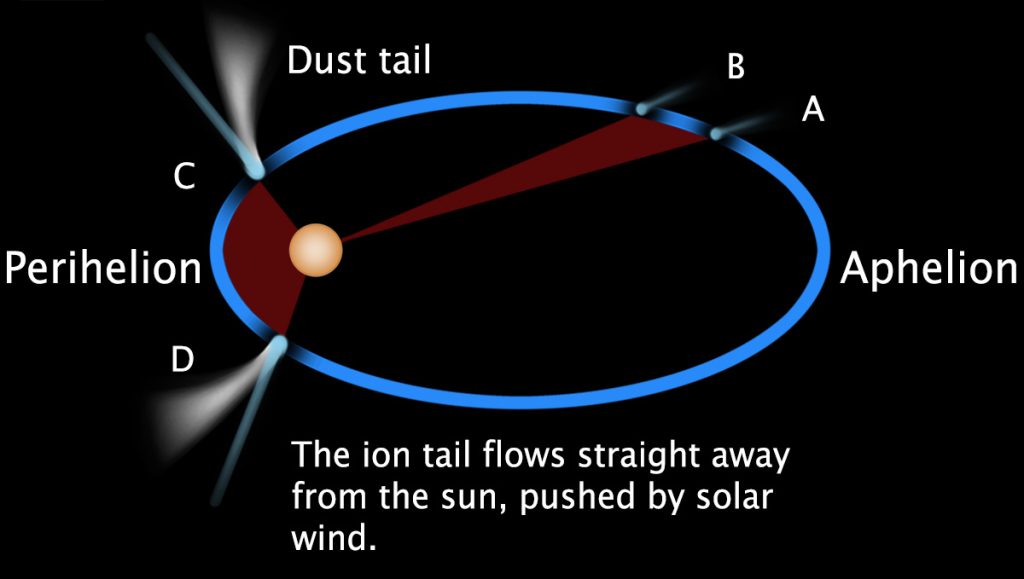
As the comet nears the sun, the tail grows longer. There may be both an ion tail and a dust tail visible. The dust tail may curve due to the comet’s speed, similarly to how a water stream from a hose can curve as the hose is swung in an arc.