“Would you go on a bird walk with me if I wash the dishes for you?” wondered my husband one January day.
How could I say no to an offer like that? Actually, that was exactly what I had planned on doing. It had been one of those clear, cold mornings with only a light breeze teasing the laundry on the line. The sunshine and bird songs beckoned me. Now my husband was offering to do the dishes so I could go. What a coincidence!
“All morning while we trimmed grapes, the birds have been singing, and I need you to tell me what birds I’m hearing,” he continued.
Lunch and dishes were finished in record time. Slinging binoculars around our necks, we headed for the swamp trails. Downy Woodpeckers and nuthatches flew from tree to tree, busily pecking. Chickadees, those small bundles of large enthusiasm, as Aldo Leopald said in Sand County Almanac, flitted about energetically, bubbling over with song. A Northern Flicker added his “Flick, flick, flick” to the melody. Oh, what a lovely day to be outside! Even though these were just the regular winter birds, their music held the promise of spring.
The flutter of wings caught our attention, and we stopped to search for its owner. Out of the corner of my eye, I noticed a large seemingly headless bird taking off from one of the neighboring pines.
“Owl!” I yelped as I quickly swung my binoculars around. We got just a glimpse of the disappearing bird.
Certain it had landed in another patch of pines along the trail, we cautiously edged closer, keeping our eyes riveted on the pines. Arriving at the pine grove, we stopped and scanned the trees methodically.
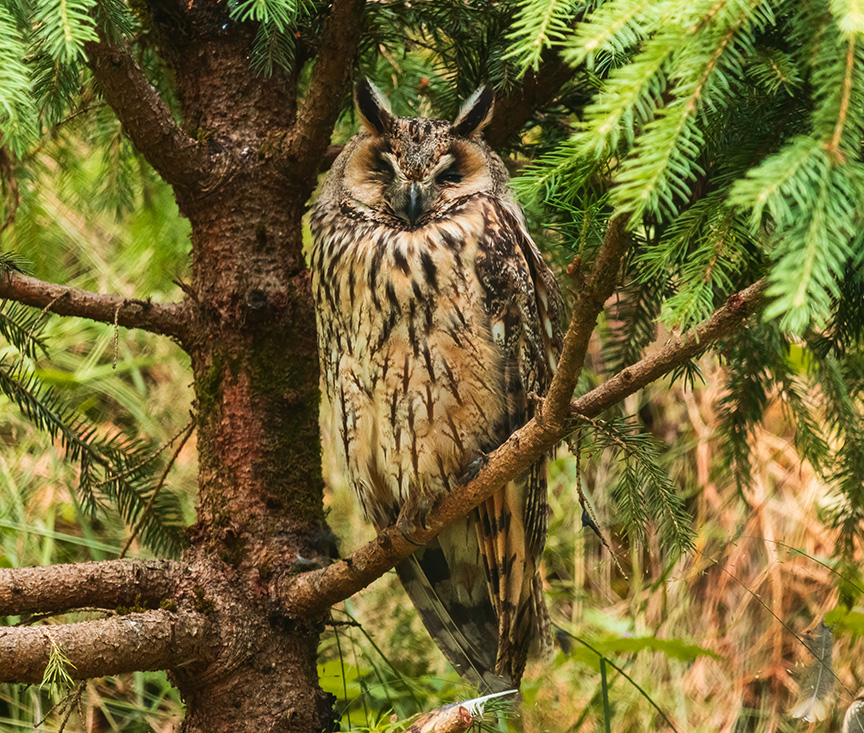
Suddenly I paused. Was that…could that be an owl? Carefully I moved the focus wheel and stared. That shape, right against the trunk—it WAS an owl! His camouflaged posture and color made him nearly invisible.
Keeping the owl in my sights, I described his location. My husband soon spied him too.
“This is not a Great Horned Owl. What is it?” I wondered. “Extremely large ear tufts, orange face with a black vertical line and some white.” I tried to memorize all the markings. The breast pattern of streaks and bars was distinctive.
Suddenly, on silent wings, the owl was off. We watched him go until he disappeared among the trees.
Back in the house, I quickly flipped to the owls in the bird book.
Barred Owl? No.
Short-Eared Owl? No.
“There he is!” I exclaimed to my empty kitchen when I paged to the Long-Eared Owl. Carefully I checked all the markings and the size. They all matched. I paged on, checking the other owls to make sure, but nothing else was right.
My excitement mounted. In all my twenty-five years of birding, I had never before seen a Long-Eared Owl. Now we had one on our own property!
Out of curiosity, I played his song. No, I had never heard one. Then came his alarm call. Wait! That’s what we heard last summer and fall, coming from the swamp after dark. How many times we had walked down there, trying to find the elusive bird! First we’d hear it on one side of the road, then on the other, but never found its source. Confused, we had decided it could be a frog. Now the mystery was solved.
I did quick research on our newly discovered feathered friend. Long-Eared Owls are nearly crow-sized, with long close-set tufts. They are nocturnal hunters, and roost by day close to tree trunks, compressing their feathers to appear slender, which is an effective camouflage. How many times have I walked close to one, unaware of its presence?
A new bird for my life list on our own property—wasn’t that a good way to start the year?