

Did you know there are two dates for the beginning of summer, depending on whether you are an astronomer or a meteorologist?
Meteorologists consider the beginning of summer to be the first day of June.
According to my calendar, June 20th is the beginning of summer this year. Astronomers refer to that date as the summer solstice. Solstice comes from the Latin words sol, meaning sun, and sistere, standing still.
This is the date when the sun shines directly over the Tropic of Cancer, which is as far north as its direct rays hit the earth. Where I live at a latitude of 38.9° N, there are about fifteen hours of daylight on the first day of summer. Those of you living in higher latitudes have even more hours of daylight due to the northern part of the earth tilting toward the sun in summer.
Perhaps you’re not interested in the science behind summer; you’re just happy to be out of school if you’re a student or a teacher, and ready to enjoy vacation.
So come along with me on a summer outing. We’ll drive up to our mountain forest and pasture land.
See the lovely white and pink blossoms on those shrubs? That’s mountain laurel; its flowers are in the shape of little cups. These shrubs often grow closely together making laurel thickets, good deer cover. Some might confuse laurel with rhododendron, but rhododendron is taller and has longer leaves and larger blossoms. They bloom later than mountain laurel, here in West Virginia around July 4th.

Over there is a wild azalea bush; they may be pink or orange in our area. Locals inaccurately call them honeysuckle. Wild azaleas aren’t as plentiful as they were a number of years ago. I think it’s because the deer population has increased, and they browse on azalea bushes, especially during the winter.
We’ll go left here and drive back to that large hay field. Let’s look for red berries growing low to the ground. Yes, they are wild strawberries, similar to domesticated ones, but smaller and, I think, sweeter. Try some. One year my mother made wild strawberry preserves. They were delicious on bread and ice cream. Strawberries are our first berries of summer.
Let’s drive back to my cabin where we will begin our hike. Grab a water bottle from the fridge, if you wish.
OK, lets go. We’ll walk down to our old farmhouse.
Look up there on the top of the mountain where you can see spruce trees growing. Elevation there is around 4,000 feet (1200 m) or more. We won’t go there today, but a popular berry that grows in these higher elevations is the huckleberry. Huckleberries begin ripening the middle of July, but may not reach peak season until late July into August. Huckleberries may be red, black, or blue.
They are very nutritious, being high in antioxidants and vitamin C. They are pretty small, so it takes a long time to fill your bucket.
Huckleberry vines are very resilient, with shallow roots and underground stems. They were among the few types of vegetation that survived after Mount St. Helen’s erupted in the state of Washington way back in 1980. Old timers in our area used to set some of these high plateaus on fire periodically to get rid of brush and increase the habitat for huckleberries.
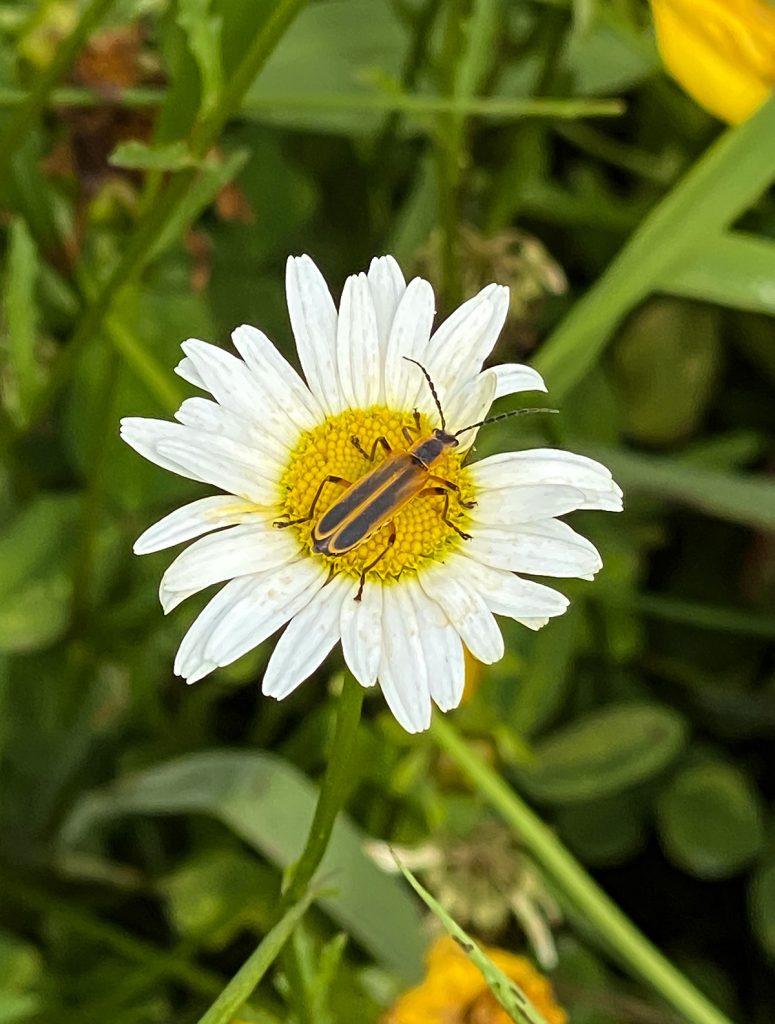
I see you’ve picked an oxeye daisy. These are very common, blooming throughout the summer. When weed eating at the cabin, I like to let them grow.
These are likely not your favorites, but thistles are considered wildflowers. There is no lack of them. God didn’t make thistles on the third day of creation as He did other plants. They appeared after the Fall of man, recorded in Genesis 3. I am sure Adam was not happy about thistles; they kept reminding him that he had disobeyed God.
But thistles do have a beauty and value of their own. Bull thistles, like you see here, are pink, lavender, or red. They provide food for bees, butterflies, and birds. Goldfinches especially like thistle seeds. Do you put thistle seeds in your bird feeders at home?
Well, here we are at the old house. My grandfather got tired of the prevailing winds. He kept the property, but moved to the lowlands. What a view he left behind!
Yes, here are some tame flowers that Grandmother might have planted. This beautiful flower is called a bleeding heart. Up on the huckleberry plains are wild bleeding hearts which aren’t as large as this one. They grow on rocky ridges and ledges. Their deep pink-to-reddish-purple flowers are heart-shaped too. See the “drop of blood” at the bottom of the heart?
Be on the lookout for rattlesnakes. My dad said one year they killed thirteen around this house and the barn. He said later there was a fire on the plains—the highlands I pointed out earlier. He thinks many of the rattlers had already hibernated up there, and the fire got too hot for them. Whatever the case, there weren’t as many snakes around after that.
Right over there, I almost stepped on one once. It was coiled up, and I had already started putting my foot down beside it before I saw it. I couldn’t stop, but quickly hurried on. Thankfully, the snake never moved. He was apparently taking an after-dinner nap.
“What’s that mouse doing above the 2 x 4 under the porch roof?”
Oh, that’s just a bat waiting until dusk to begin catching insects out of the air. Most people don’t care for bats, and I don’t think they are beautiful either. But, in addition to getting rid of insects, some species, like the fruit bat, are also good pollinators.

Bats are mammals that give live birth and feed their pups milk. Don’t try to catch it; bats will bite, and some carry rabies.
Bats hibernate during the winter, often sleeping together in caves or other places of refuge.
My favorite nighttime flying insect is the firefly; we call them lightning bugs. They aren’t wearing headlamps to see where they’re going; the male’s abdomen lights up at frequent intervals to attract a mate. This emitted light is a result of the chemical process of bioluminescence.
OK, time to head back up to the cabin. Take a look here on my porch at these slender coils of mud. There are three of them hooked together like pipes on an organ. These were made by mud daubers, a type of wasp. I’m sure they are finding mud on the edges of my pond. They capture and paralyze prey, pushing them up into the “pipes” to save them for meals for their “babies”—growing larvae.
“Why do you have a tennis racket in your cabin?”
See those carpenter bees hovering outside? They are actually drilling holes in my rafters to make their homes. When they hover in midair like that, they’re pretty easy prey to a tennis racket. These bees aren’t usually aggressive either, so it’s not too scary playing tennis with them. If left alone, they can actually weaken the rafters with all the holes they bore. Carpenter bees also make holes in trees, damaging timber. Woodpeckers, one of their enemies, like pecking into trees, looking for a meal of carpenter bees.
“What’s that black calf doing all alone way up there next to the woods?”
Let me look through my binoculars. Hey! Look everyone! It’s a black bear! It’s probably a year-and-a-half-old male that Mama bear has chased off to go on his own.
Let’s walk out to my outbuilding and get some pellets to feed the goldfish in my pond. See those rose bushes with pretty pink blossoms growing in the fence row? Those are wild roses.
“There must be hundreds of fish in here!”
They will make the water “boil” when we throw the pellets to them.
“Look over there! May we catch him?”
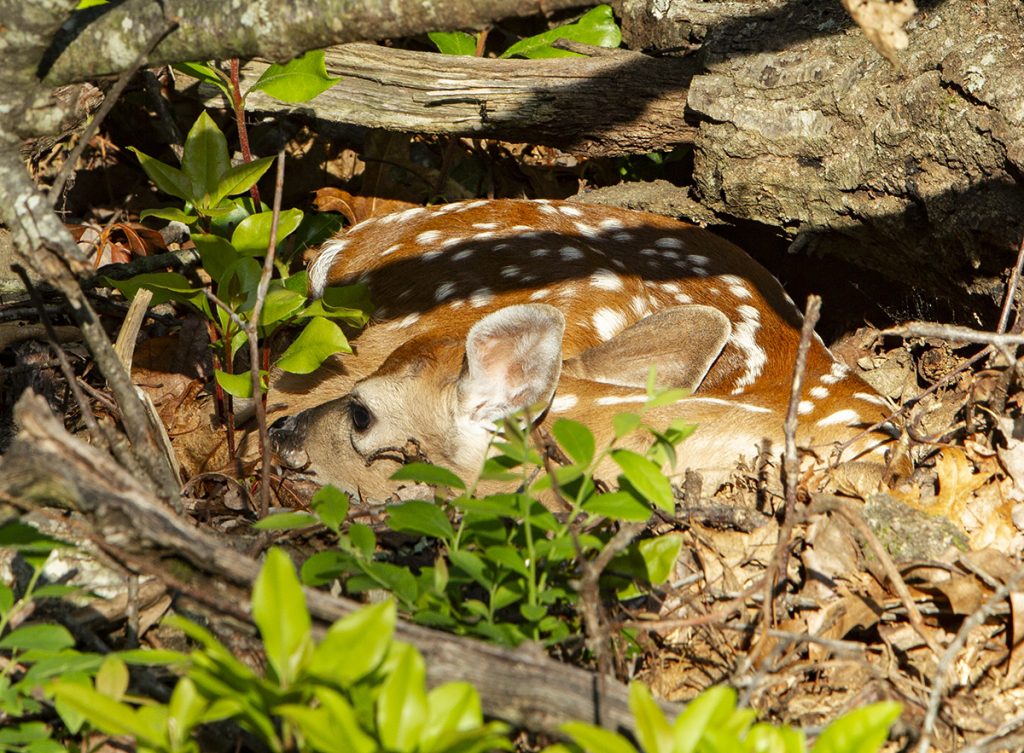
No, a doe has commanded her baby to stay there in the taller grass until she comes back to give it its dinner. Likely its mother is one that hangs around here a lot. There are holes under the fence and a space under the gate where it can get out. She doesn’t leave it in here all the time. Coyotes do come in here occasionally, but I think fawns are safer here than outside the lot.
Well, we’d better head off the mountain. Be on the lookout for more nature treats along the way.
“Oh, there’s a big snake crossing the road ahead!”
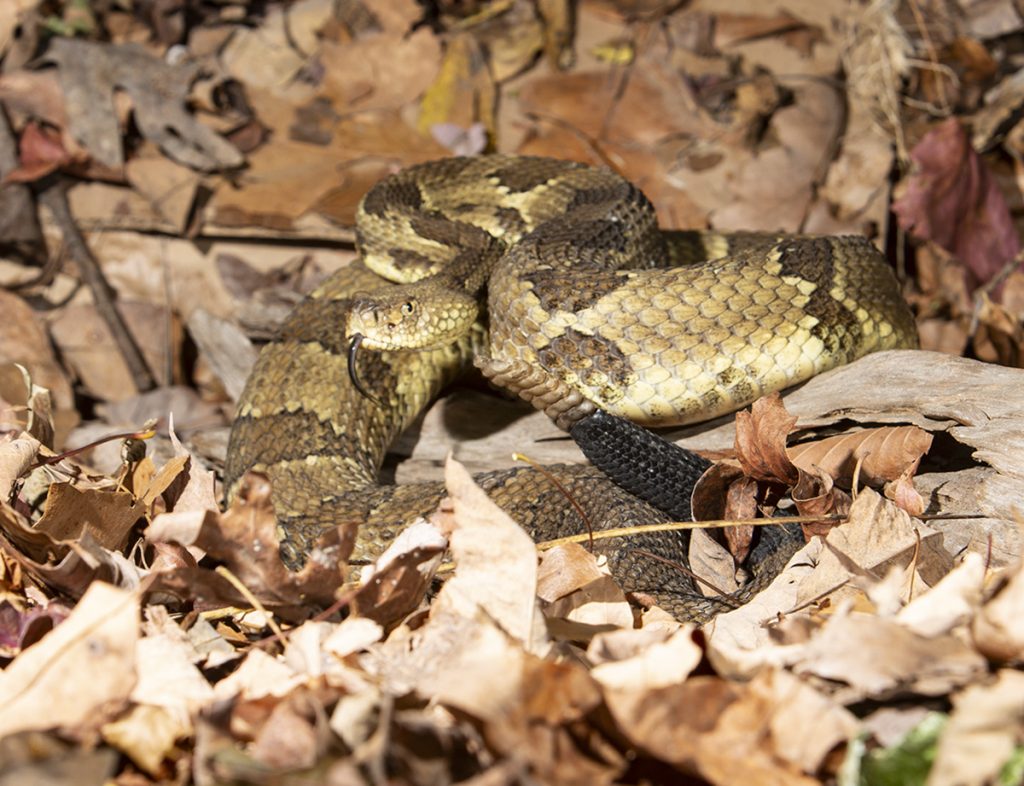
Yes, it’s a timber rattler; let’s get out to get a better look. This is a big one. That thing must be 4 feet (over 1 m) long and big around as a pop can. People say they can strike as far as two-thirds their body length. We’re not going to trust that. We’re not getting any closer than 6 feet (2 m). Don’t worry; it won’t chase us. Look at its geometrically shaped dark brown markings on its brownish yellow skin. See the black near the end of its tail in front of the rattles?
Would you like to watch it spring into a coil and hear it rattle? I’m going to let one of you older fellows pitch a few small gravels on him and see what happens. It sure did! And now you can hear its warning, buzzing sound made by shaking its rattles.
Unlike blacksnakes and garter snakes that lay eggs, rattlesnakes give live birth. They may give birth to as many as twenty snakes every two to six years, but, thankfully, it’s not common to have that many. Babies are about 8 inches (20 cm) long and stay with Mama for only about a week before dispersing. They do have enemies such as birds of prey, raccoons, and bobcats.
I hope you’ve enjoyed this little tour. Let’s close it with a song.
“Summer suns are glowing over land and sea; happy light is flowing bountiful and free. Everything rejoices in the mellow rays. All earth’s thousand voices swell the psalm of praise.”