

At first glance, the Moon looks like a dull gray world, but the closer you look and the longer you observe, the more you’ll notice interesting features. One of the first things you’ll notice is the light and dark variation over the surface. The light areas are highlands and mountains, and the dark areas are typically lowlands called maria (MAR ee uh); that’s the Latin word for seas.
Another noticeable set of features is the bright rays extending out from certain areas on the Moon. These rays can be traced for hundreds of miles across the lunar surface. They often fan out from craters. This gives us a clue as to what caused them. They also extend over the tops of mountains and other craters in the path, giving the impression that they are overlaid across the top of the lunar surface. With close-up observation, they don’t show as cracks in the surface. Instead, they appear to be made of light-colored lunar material strewn across the top of darker areas.
The Sun’s radiation is unhindered by an atmosphere on the Moon. It’s essentially baking the Moon, giving it a sunburn and darkening it. The temperature on the surface can go over 200° F (93° C)—hot enough to fry an egg. You could think of it as a frying pan in the sky! The most likely explanation for these lunar rays is that they were caused by asteroid impacts gouging out huge amounts of light-colored material from below the surface of the Moon and scattering it far and wide.
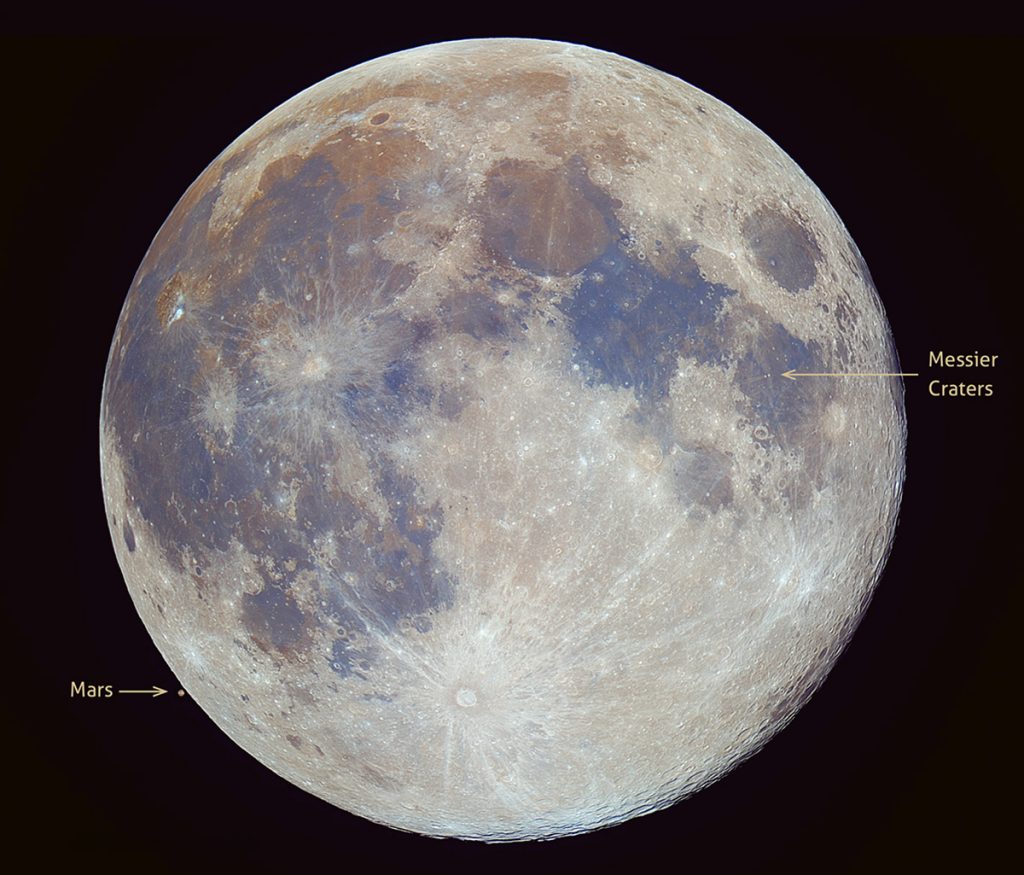
Although the Moon looks like it has a colorless gray surface, it actually has a variety of subtle hues. This photo of the Moon is color enhanced to show the actual color variations across the surface of the Moon. This photo makes it easier to understand how a giant splatter coming from an area could spread noticeably different material across other areas. The rays in this photo can be seen converging at craters.
An interesting point on the right side of the photo is in the dark maria near the 3:00 position on the Moon. There you can see the small Messier craters. There are two rays extending out from those craters in about the same direction, giving the impression that the asteroid causing the rays was coming in at a steep angle when it collided with the Moon.
Another interesting point in this photo is not on the Moon but beside it. The picture was taken during the Moon and Mars’ close approach earlier this year in January. It gives a good impression of how much smaller Mars appears than the Moon. Mars is almost twice the diameter of the Moon, but it’s much farther away. As a result, Mars looks like a bright orange star in the sky when observed without a telescope. This picture, taken with a 10” Newtonian reflecting telescope, shows Mars as a small disc.