

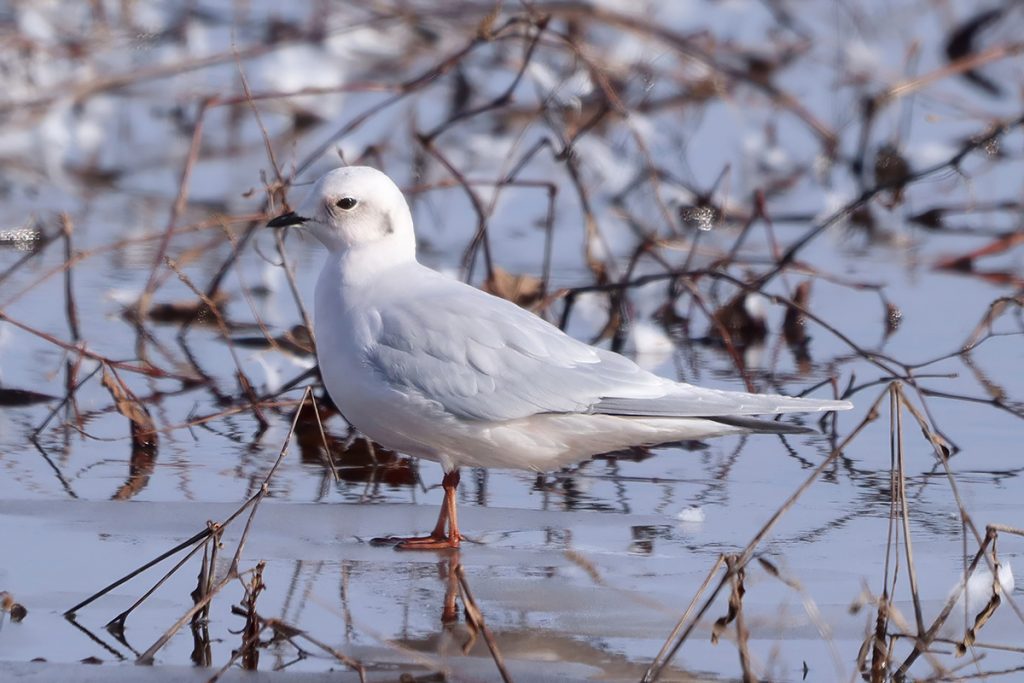
Would it still be there? We were on the road again chasing a rare bird. As always, the closer you get, the more afraid you are it has left.
Our target this time was a Ross’s Gull that flew in at a most unlikely place, Kansas. The seven-hour drive from our home in Missouri raised the stakes quite high.
The Ross’s Gull is a smallish gull of the high arctic that rarely visits the lower forty-eight. The breeding adult is a bird of beauty with a black neck ring and a pinkish wash staining its chest. Its rare visits to accessible land make it one of the least known gulls in North America. It nests mainly in Siberia, though at one point several pairs nested in Churchill, Manitoba. This gull winters in the harsh climate of pack ice far out at sea, presumably in the Labrador Sea between Canada and Greenland. So, if one shows up in the States, it creates a stir!
We were almost there. The flat Kansas farmland with lots of wind farms and an occasional slough full of Northern Pintails and Mallards gave us nothing new to look at.
We rounded the last corner to the marsh where the gull had been reported. Several vehicles were parked on the road shoulder. A white car came our way, so we rolled down the window and asked whether the gull was still there.
“Oh, yes. It’s just off the road feeding on a dead goose,” the lady replied.
Relief! It was still here! Rolling down all the windows, we drove slowly along the road bordering the marsh, our eyes peeled for a gull. We came to the end of the marsh without finding it, even though we stopped several times to scan more thoroughly. So we turned around and drove back the way we had come.
Another load of birders had arrived. We could see them hunched over spotting scopes, looking at something. We got closer, and suddenly there was the gull, twenty yards/meters off the road, standing in marsh grass. We exited quickly. Several seconds later we had our scopes out and zeroed on this lifer. What excellent views we had!
The gull seemed unafraid of the gaggle of excited birders gawking at it. It would feed on the goose for several minutes, then fly a circle around the marsh and come back. We could see its wedge-shaped tail and a faint line where the black neck ring would be in breeding season.

A harrier flashed by and gave it a chase, but the gull easily outmaneuvered the bigger bird. It was the only gull on a marsh full of ducks.
Why was it here? And how did it get here? No one knows. Maybe it had come south for the winter, for a Kansas winter must be warmer than February in the Labrador Sea. And Kansas contains no jaegers to chase it and steal its food. But surely it will feel the pull of the north again and return to the tundra where it is at home.
For the moment, though, the Ross’s Gull fed on goose while we returned to our native territory.