Have you ever had a chance to experience Salamander Night?
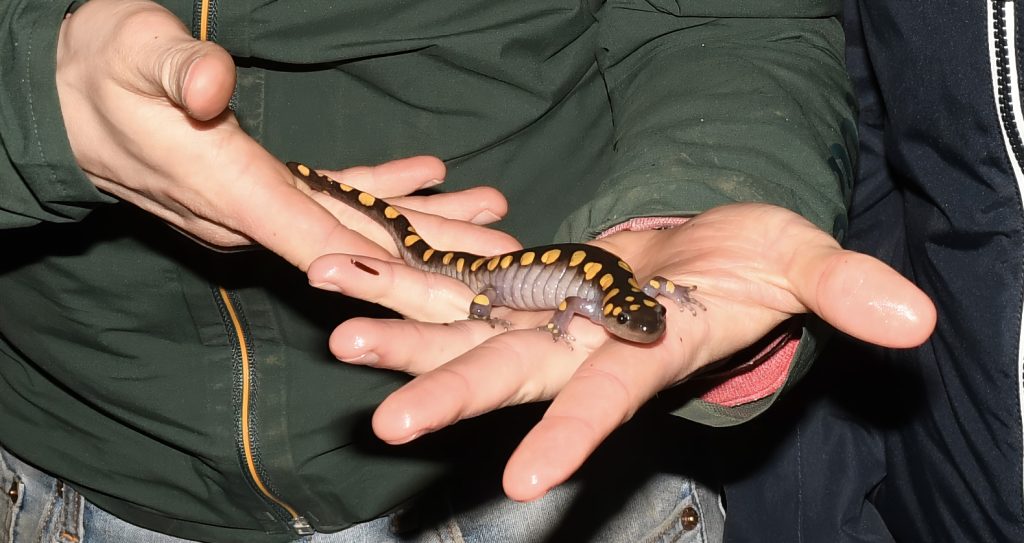
I hope you can get out on that dark, rainy night when the salamanders awaken and come out of the woods to congregate at vernal pools. Prepare to be amazed. Seriously, you should hear the numerous expressions of wonder from the people I’ve taken out in the rain on warmish mid-March nights to see salamanders. I’ve seen many wet, but smiling people holding those large salamanders.
Here are three main things about Salamander Night which amaze folks every time.
- Watching the salamanders cross the road. They seem to come out of nowhere. They are basically invisible the rest of the year even though most of them live within a few hundred yards/meters of the pool.
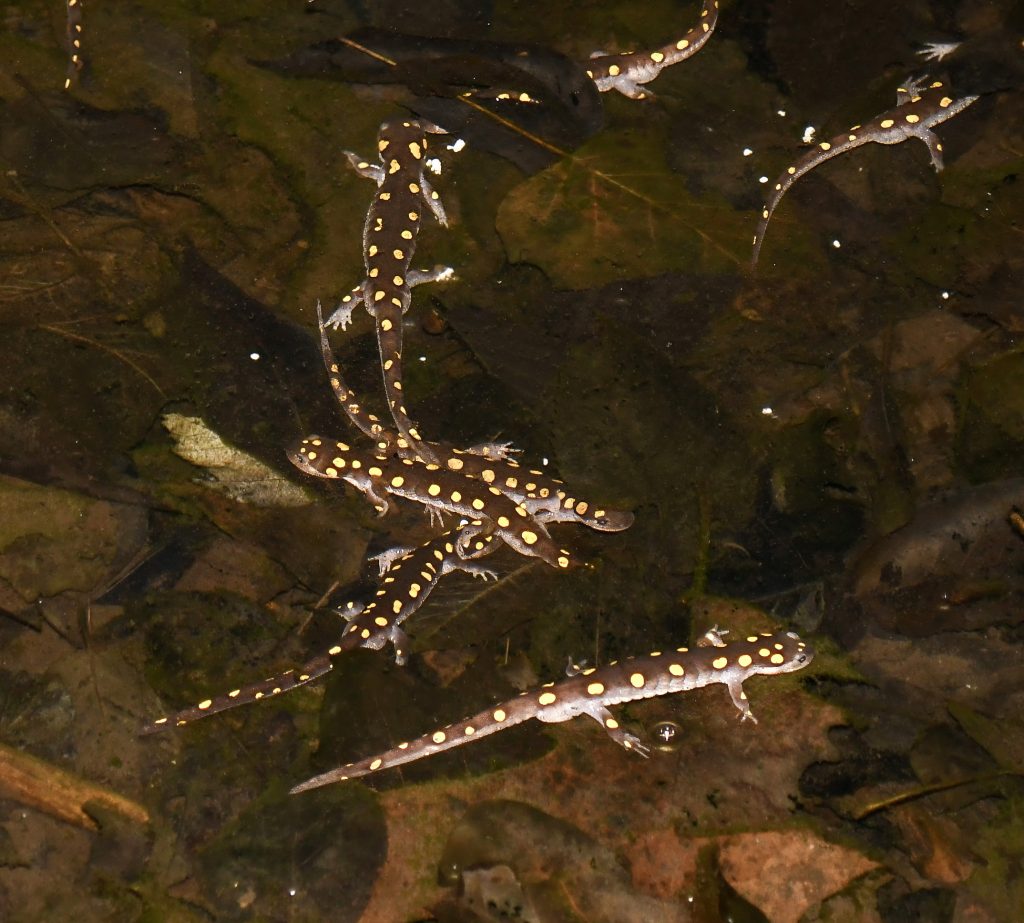
- Seeing “So many salamanders!” milling around in congresses in the vernal pools.
- Pondering how the salamanders are able to find their way to their ancestral pool. Ha! That gives me an idea to do an experiment this Salamander Night. We’ll turn some away from the pool and see if the salamanders head off the wrong direction or turn around. Of course I’ll “fix” the problem if one occurs, but I don’t think one will. I’m expecting they will know right where to go.
Just so you know, I haven’t always hit it right for an epic Salamander Night. For example, last March some of the folks who joined me were disappointed because we didn’t see any salamanders. Turns out we were just an hour or two early, because the second wave of folks who came later got to see the salamanders crossing the road. The vernal pools had no salamanders, but just as we were heading home, we spotted the salamanders beginning to come out of the woods and cross the road. The factors of temperature, the time the rain started, and the timing of our arrival at the pool all have to work out just right for the night to be epic.
Are you interested in going out on a dark, rainy night to be amazed? If so, here are some Salamander Night tips.
Salamander Night usually happens around mid-March in north-central Pennsylvania. It could be earlier or later depending on your area and the weather.
Watch the weather for the first warm, rainy night with a low of around 50°F (10°C).
The salamanders need to stay wet, so that is why it must be a rainy night. The species we see are called yellow-spotted salamanders. They are mole salamanders and spend most of their lives underground within a few hundred yards of their ancestral vernal pool. Vernal pools are usually temporary pools of water without any fish!
You will need boots, rain jackets, and red headlamps. (Salamanders hide in white light.)
If you see lots of egg masses from spring peepers or wood frogs, salamander night might have already happened. If so, the vernal pool is still a very fascinating place, and the salamanders hang around for a week or two, so search for them with a red light.
I hope you have the opportunity to go out on a dark, rainy night and give Salamander Night a try. The vernal pool is a happening place, and you might see things that you’ve never seen before. Plus, you might get to hold a damp, cold mole salamander. You know, now that I’m thinking about it, it would be fun to overhear what you and your friends say about the experience.