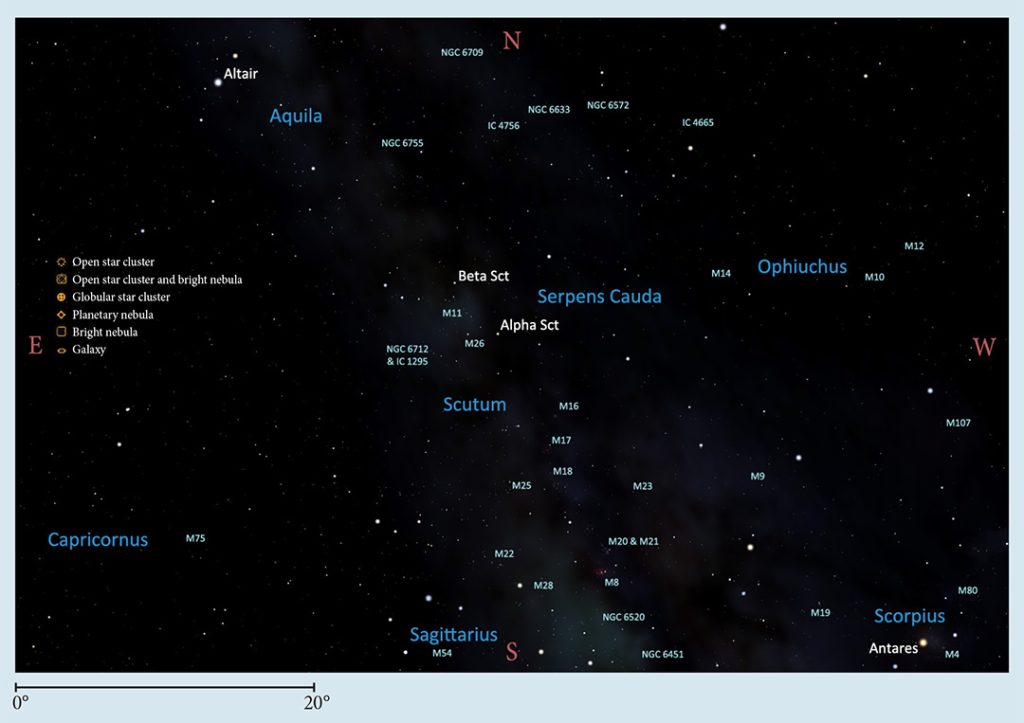
Scutum, the Shield, is a small constellation that lies along the summer Milky Way, just south of the Summer Triangle, and just north of the thick part of the Milky Way around Sagittarius and Scorpius. Scutum itself isn’t much to see—just a foursome of stars, the brightest of which is only about 4th magnitude. However, the constellation contains several good telescopic targets, most of which are star clusters.
M11, the Wild Duck Cluster, is by far the most popular and widely-known deep sky object in Scutum. This object is one of the finest open star clusters in the sky, containing several thousand stars. By comparison, many other open clusters only contain dozens or hundreds of members. M11 lies just under 2° southeast of Beta Scuti in the northern part of Scutum.
M11 is near the limit of naked-eye visibility under dark skies. The cluster is readily visible with binoculars as a hazy spot of light. Most binoculars will also show the brightest star of the cluster as a pinprick of light against the backdrop of the other unresolved stars.
Mid-sized telescopes will resolve the cluster into hundreds of individual stars. The stars of the cluster are distributed in a slight wedge or “V” shape, from which the cluster gets its popular name, the Wild Duck Cluster. Even the slight “V” benefits from a good dose of imagination. I’ve never really seen the resemblance, but the cluster is a breathtaking sight regardless of how active your imagination is.
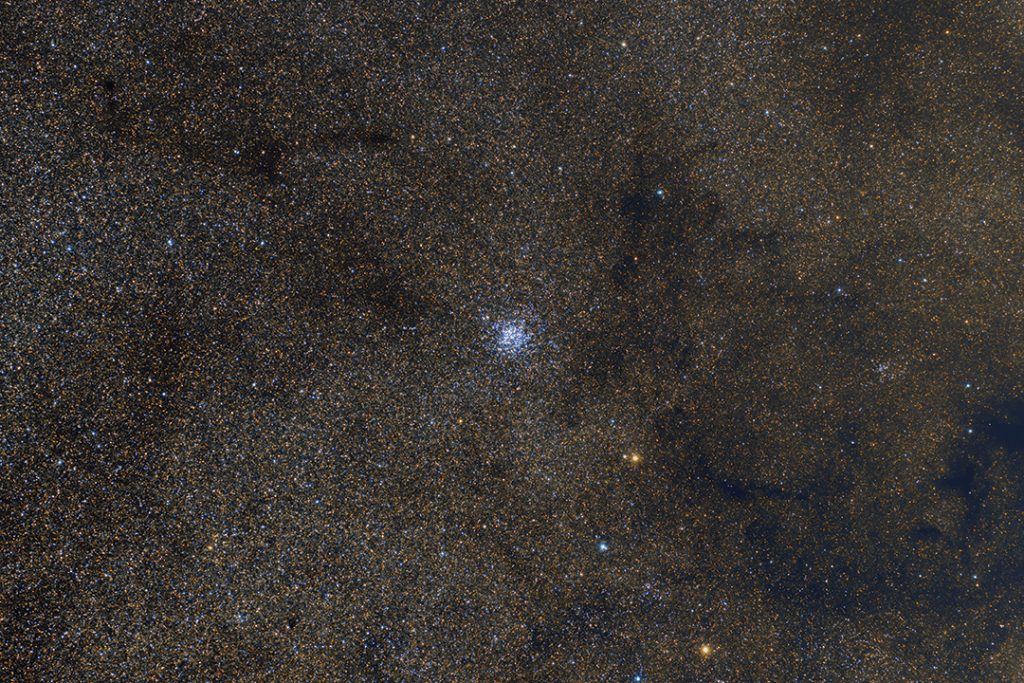
M26 is another beautiful open cluster in Scutum, although it is sometimes overlooked because of its proximity to the brighter M11. Although this cluster is dimmer and contains fewer stars than M11, it is a fun target that is worth finding while you’re in the area. M26 is faintly visible with binoculars, but a telescope at low to moderate magnification is the ideal choice for viewing this cluster. A mid-sized telescope will show M26 as a small group of several dozen stars arranged in an uneven pattern. This appearance is partially caused by interstellar dust that dims or hides some of the stars in the cluster.
These two clusters are the main deep sky targets that Scutum has to offer, and very few stargazers dig any deeper into this constellation. However, if you have a little observing experience and a larger telescope (maybe 10”+), there’s another pair of objects you should hunt down. NGC 6712 and IC 1295 are located just over 4° south-southeast of Beta Scuti and about 4½° east of Alpha Scuti.
NGC 6712 is a globular cluster and IC 1295 is a large planetary nebula. Each of these objects would be quite unimpressive alone, but because they are about ½° apart, they can be seen in the same field of view at moderate magnifications.
NGC 6712 is much smaller and fainter than the well-known globular clusters like M13, but you should be able to see granularity in the cluster, and perhaps resolve a few stars. Without a filter, IC 1295 is very faint and hard to find. However, with an OIII or UHC filter, the nebula becomes much easier to see. The filter will dim the cluster somewhat and will make the two objects look very similar in size and brightness.