

On the front porch post is a bluebird box. The bluebirds raised two broods in that box this summer. Now they are done nesting, and the box serves another purpose.
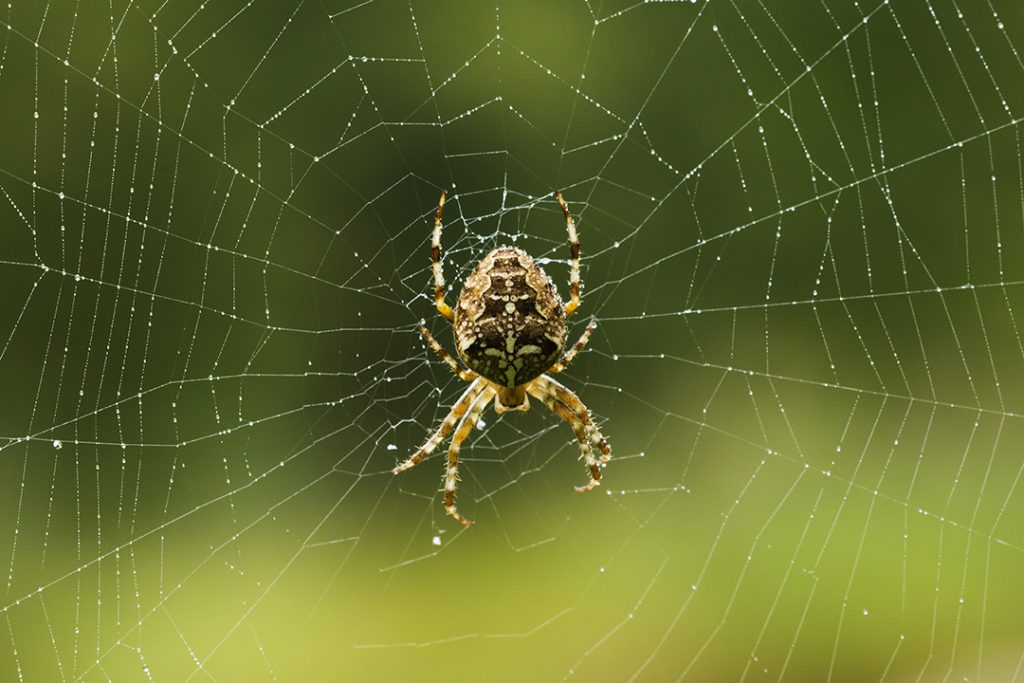
On the bottom of the box, tucked into the corner, is a spider. All day long it sits there waiting. When darkness falls, it will come forth and spin a web. Starting at the bottom of the box, it stretches a line down to the calla lily growing in the flower bed along the porch railing. Then it strings more lines, some to the porch railing, some to the post itself, perhaps to the cardinal climber growing up the post.
It then strings lines from one to the next, forming a crude circle. Now, starting at the top of the circle, it runs a line down through the middle. Halfway down the line is the center. There it deposits some extra silk.
Now it strings lines from the center out to the edge, forming a star. Every time it comes to the center, it walks around, feeling for gaps that need to be filled in. Finding a gap, it promptly fills it and comes back to the center. Around the center it goes again and again, feeling for gaps and filling them in, until finally it is satisfied.
Now it starts on the outer edge and places a line around the perimeter. It keeps going around and around, spacing the lines the width of its reach, which appears to be about a half inch (1.3 cm), not close enough to catch much of anything, yet apparently an important part of web building.
The spider works with feverish haste, blissfully oblivious to the dim flashlight trained on its every move. It is also oblivious to the frequent exclamations of awe and wonder coming from this group of gawking bird-watchers-become-spider-watchers.
Upon reaching the center, it once again goes out to the perimeter and starts around again. This time the lines are spaced close together, close enough that even the smallest of flying insects will be likely to get caught. Around and around it goes until it gets close to the center. Now the spider places itself directly on the center, each of its eight legs touching a different strand. In this way, it can feel everything that hits the web and know instantly where it is.
The spider watchers retire for the night. The next morning, a gaping hole in the web testifies to the events of the night. And there is the spider, firmly clutching a well-earned morsel.
When the first hints of daylight start showing in the east, the spider removes the web. Going around the edge, it severs one strand after the next. The web goes limp and folds together, until it all hangs as one string. Starting at the bottom of the string, the spider gathers it all together and discards it. When the sun comes up, there is no evidence of a spider anywhere.
But look under the bluebird box. There it is, tucked into the corner, waiting…patiently waiting for the daytime activities to cease and night to draw its curtains.