

In the mangrove forests that stretch from India through Southeast Asia to the northern coast of Australia, where tangled tree roots reach down into the brackish water and insects fly (or jump) just above the surface, there lives a small fish that hunts what most fish never think to hunt—the world above the waterline.
The archerfish, which belongs to the family Toxotidae and grows to somewhere between 4 and 12 inches (10-30 cm) long, has a mouth that functions like a precision instrument. Along the roof of the mouth runs a narrow groove. When the fish presses its tongue upward into this groove, the two together form a channel through which the fish can force a jet of water with enough speed and force to knock an insect from a branch several feet above the surface. The fish then catches whatever has fallen. It does this with an accuracy that has occupied researchers for decades and that still raises questions that have not been entirely answered.
The problem the archerfish faces every time it hunts is not a simple one. When light travels from the air down through the water’s surface, it bends, which means that an insect sitting on a branch above the water appears to the fish below to be in a slightly different position than it actually occupies. A physicist calls this refraction, and it is the same phenomenon that makes a stick pushed into water appear to bend at the surface. For the archerfish, this means that aiming at where the insect appears to be will produce a miss; the fish must aim at where the insect actually is, accounting for the degree to which the light has bent. This calculation changes depending on the angle from which the fish is shooting, the height of the target, and the distance across the surface. Research published in the journal Behavioral Ecology and Sociobiology found that archerfish correctly adjust their shooting angle to account for refraction from a wide range of positions, not simply shooting straight upward to sidestep the problem, but managing the full geometry of the shot from various angles.
What makes this more remarkable is the position the fish occupies while it shoots. During the shot, the fish’s mouth just breaks the surface of the water, while its eyes remain completely below. This means the eyes and the mouth are operating in two different environments at the same time. The fish is seeing through water and shooting through air, and it is doing so accurately enough that the jet finds its target rather than the place where the target merely appeared to be.
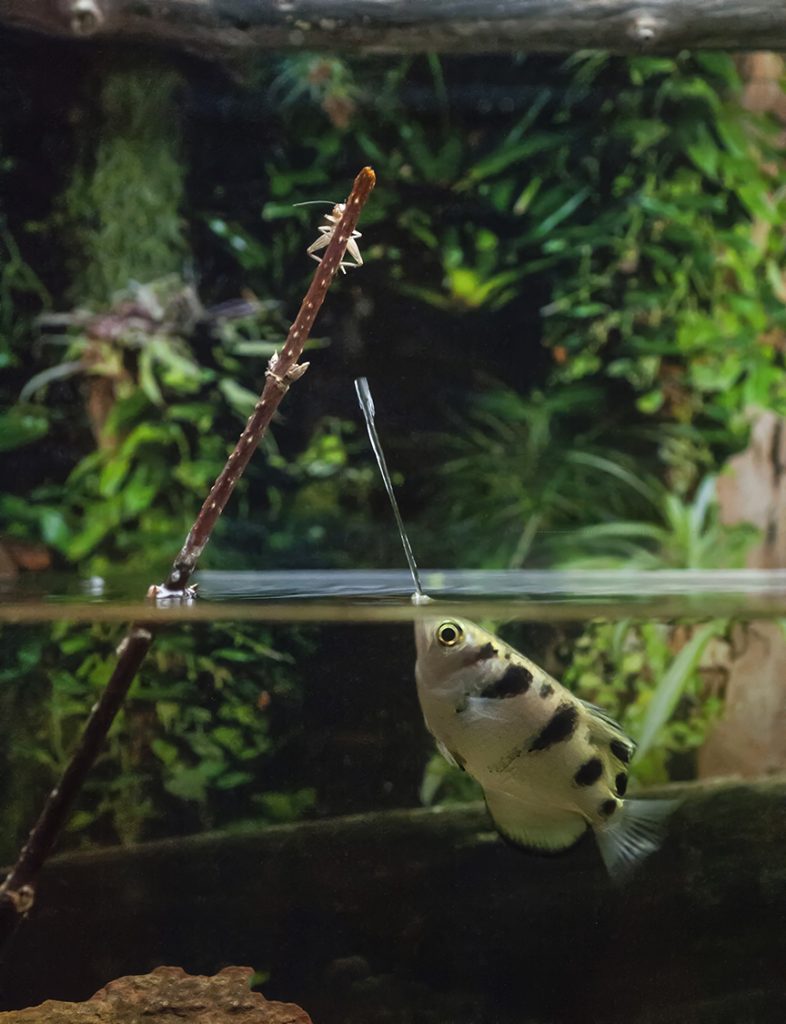
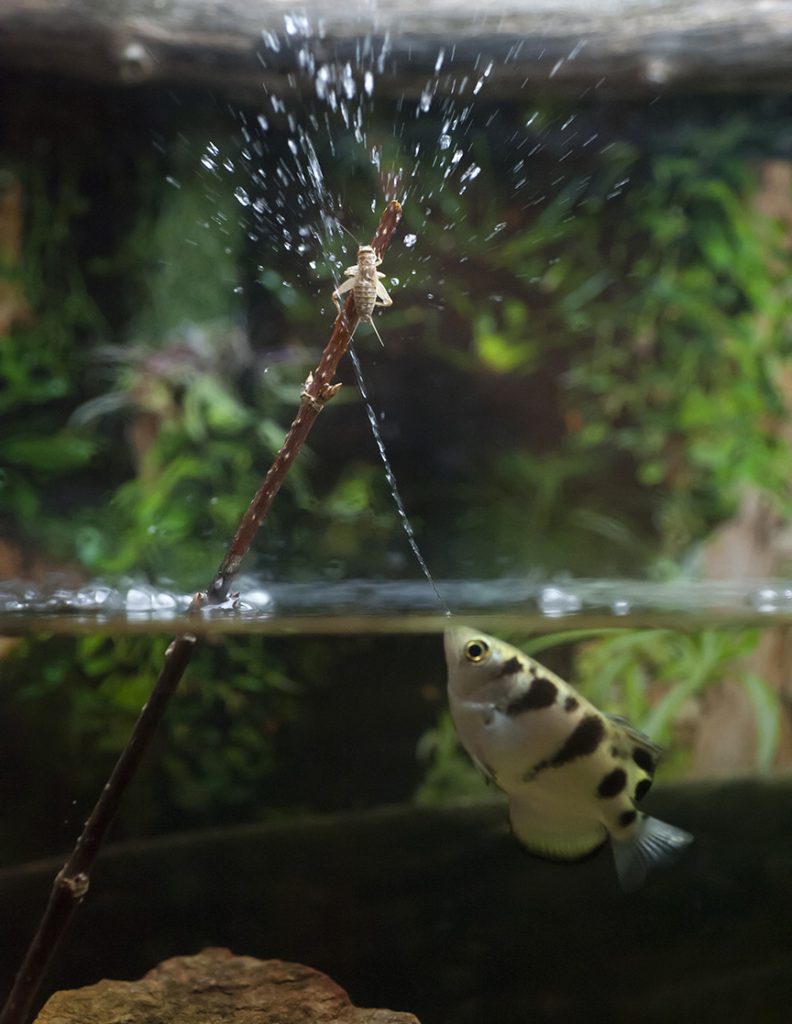
Young archerfish are less accurate than adults. They tend to hunt in groups, which increases the likelihood that at least one shot from the group will connect while each individual fish is still learning to aim. Researchers have also found that archerfish can adjust their shooting in response to changing conditions, correcting their aim when factors like air movement above the water alter the path of the jet, and then correcting back again when those conditions are removed. The fish is not simply repeating the same motion each time, but responding to the actual situation in front of it.
The archerfish also has eyes that are specially built for the work it does. Studies of archerfish vision have found they are specifically suited for seeing clearly across the air-water boundary.
Think about what that means for a moment. The archerfish lives at the edge of two worlds, water and air, and has been given everything it needs to work right at that edge: a mouth shaped into a channel, eyes that see across the surface, and an ability to account for the way light bends every single time it takes aim.
Nothing about this happened by accident. The Creator Who made the archerfish knew exactly what it would need to find its food, and He made sure it had those things, down to the precise angle of a groove along the roof of a small mouth in a mangrove swamp on the other side of the world.