

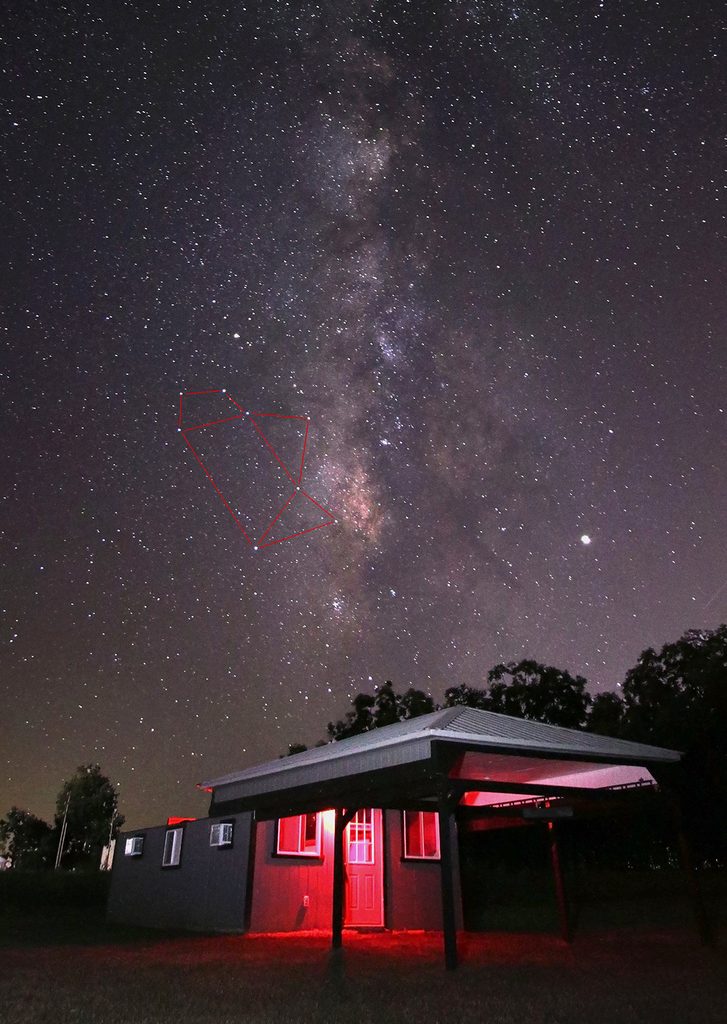
The brightest part of our galaxy is in the direction of the constellation Sagittarius, which has the teapot asterism appearing to brew up something special. It looks almost as if the teapot spout has a cloud of steam coming out of it.
It’s not steaming; it’s teeming with stars! The Large Sagittarius Star Cloud is roughly in the direction of the center of our galaxy. However, seeing the actual center with our backyard telescopes is not possible, because only about twenty percent of the way there, the traffic jam of stars and dust blocks our view.
From a vantage point in the northern hemisphere, the Large Sagittarius Star Cloud is positioned low on the southern horizon. In the southern hemisphere, it can be directly overhead in the darkest part of the sky. There it can appear bright enough against a dark sky to actually cast a subtle shadow.
At the very center of our galaxy is a bright radio source called Sagittarius A*. Photos show it to be a supermassive black hole with stars orbiting around it at tremendous speeds. Going further out into the galaxy, the other stars also orbit around the central black hole, although a revolution takes much longer for the stars further away. A fascinating part of God’s design is that every point of light we see in the night sky is on a steady march around that massive black hole, and the Earth is carried right along with it too, all at a speed of about 500,000 mph. In a conspicuous tribute to orderly design, all of the planets in our solar system march in a tidy line, called the ecliptic, that crosses the plane of our galaxy less than a hand-breadth (at arm’s length) above that galactic center.
If you live too close to city lights and can’t find the bright cloud at the Milky Way center, you can just look at the location of any June full moon to see where the direction of our galactic center is. Interestingly, since the full moon is directly opposite us in the sky from the Sun, that means we have a syzygy—a lineup of astronomical objects. Any June full moon presents an almost perfect syzygy of the Sun, Moon, Earth, Sagittarius A* at the center of the galaxy, and since you are on the Earth observing the spectacle, it includes you too!
For an interesting exercise, you can point your telescope to the Large Sagittarius Star Cloud to see the glow of stars resolve into an overwhelming number of pinpoints of light. While you’re looking through the eyepiece, keep in mind that an average telescope field of view is not much bigger than your thumbnail held at arm’s length. Extend your thumb in the direction your telescope is pointed; then count the number of stars that are blotted out. Compare that to the number of stars you can see in your eyepiece, and it will help you to recognize the power of your telescope. It will also help you to understand the nature of stars shining together to give a milky glow.
If there’s too much light pollution in the Large Sagittarius Star Cloud area, you can look higher up at the Cygnus Star Cloud for a similar view. Turn your attention even higher up to consider the Designer of it all Who has a glory that outshines all the stars.