

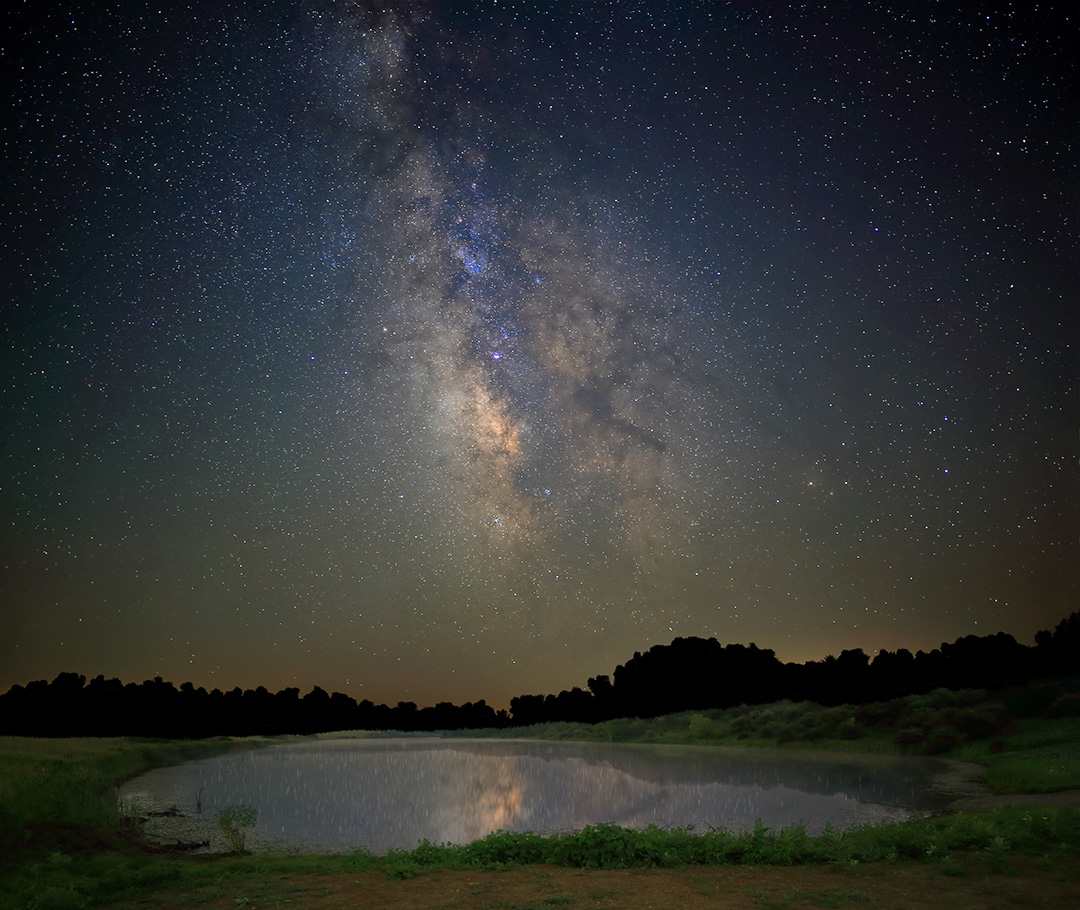
The Milky Way is a very ordinary-sounding name for an extraordinary subject. It describes the hazy band of light crossing the night sky, which shows up especially well in the evening after sunset in late summer. You’ll see its milky glow showcased the best when there’s no moonlight. A long time ago it was named the Milky Way because of its creamy white appearance.
Even the word galaxy has its origins in two Greek words that refer to milk—galaxias, which means “milky,” and galaktose, which means “of milk.” The milky nickname was either from a richness of imagination or from a dimness of contemplation, because, instead of milk, it was actually the shoreline of a vast sea of stars and clouds of gas, all shining together!
The Milky Way is shaped like a flat disc that’s about 100 times wider than thick—as flat as a very flat pancake. In the late springtime just after sunset in the United States, that disc circles around the horizon. When we look up, we are looking straight out of the disc—there is no milky band of light to be seen. A few months later in late summer, the Milky Way disc rears its luminous lanes of light tens of thousands of light years up into the sky, oriented in a mostly north-to-south direction. The stars we see to the right and left of that milky band are all from the same thin disk but are much closer to us, so we can see them in all directions across the sky.
Late summer is a fantastic time to look directly into the milky band—the main street of our galaxy—to find masses of massive things like exploded stars known as supernova remnants, planetary nebulae (gas bubbles thrown off by stars), and diffuse nebulae (gas and dust clouds suspended among the stars).
Looking into the milky lane of light, you’ll notice a mottled pattern of darkness running through it. Instead of nothingness, it’s actually too much of something to be able to see through. Huge clouds of cosmic dust are parked between the nearby stars we see and the distant spiral arms of the galaxy. They totally block our view. Stargazers have bestowed names like The Dark Emu and The Coalsack on even those spaces.
Speaking of space, there’s an astronomical 100,000 light years of it across our galaxy. Regardless, that’s still not enough room for the stars to be spaced out enough to appear to shine individually.
Since there are so many stars and clouds in that glowing disc, the light from distant galaxies is obscured. You’ll have to look to the right and left of that glow to find other galaxies in deep space. There are also dense concentrations of stars called globular star clusters, such as M13 and M22, that are orbiting around the center of the galaxy. There can be from tens of thousands to millions of stars in each cluster. Since they are orbiting the center of the galaxy in orbits separate from the galactic plane, they can be positioned far away from the milky band.
Ultimately, that soft glow isn’t spilled milk; it’s a glorious declaration of the Creator’s majesty.