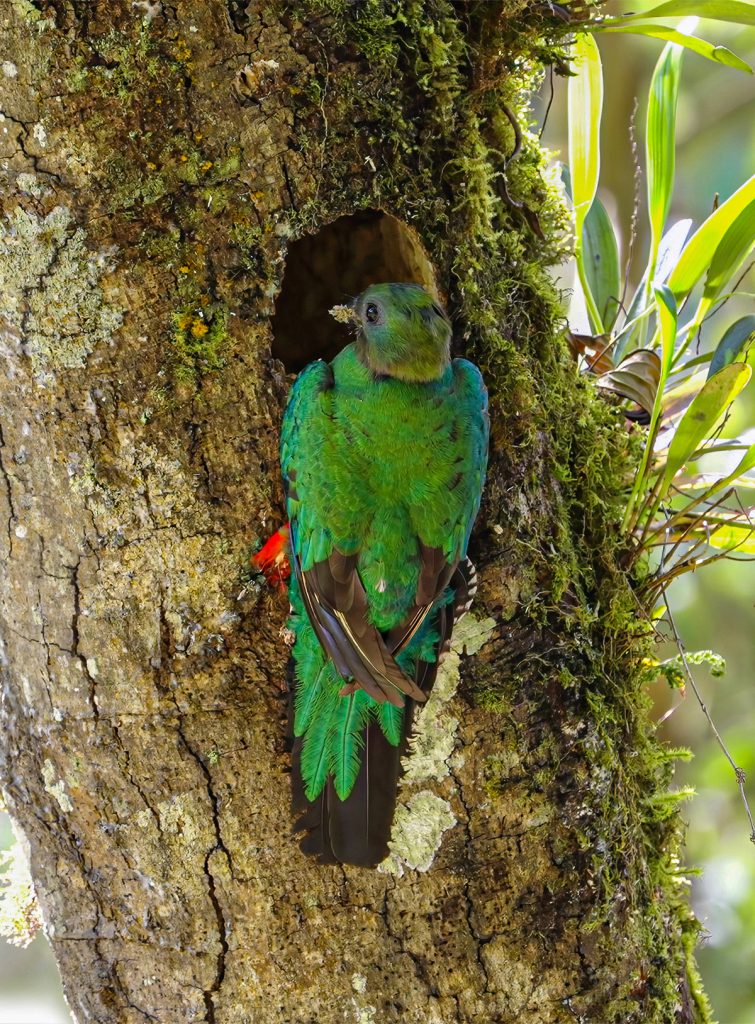
Silhouetted against the setting sun, a tall pine snag pierced the misty Guatemalan cloud forest. Spanish moss and rooster’s foot bromeliads clung gracefully to its barkless branches. The trunk was marked with numerous holes, testimony to the nests and foraging of a score of birds.
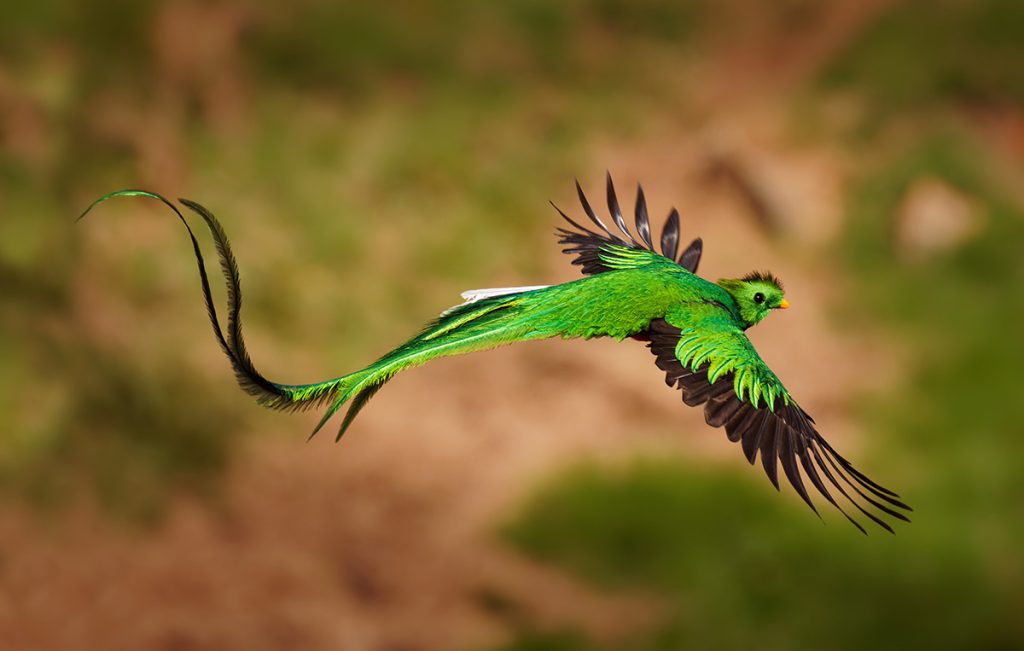
Two emerald plumes drooped from one of these holes, fluttering softly in the breeze. Presently there was a scratching, and a small round head appeared in the hole. It looked about for a minute, contemplatively. Suddenly, silently, he swooped out of the nest and alighted on a nearby branch. He, the Resplendent Quetzal in full regalia.
Shimmering emerald covered his fifteen-inch body above and reached feathery fingers around the scarlet beneath. Over his black and white tail flowed a pair of glistening green plumes some two feet long. Black eyes watched expectantly from an exquisite face as the female flew up to the hole.
She lacked the male’s tail plumes, and soft charcoal brown tempered her greens and reds. In addition, she was nearly one and a half times his size. She “bowed in,” looking from side to side; then she slipped into the hole and settled onto her two blue eggs.
The male flew off into the forest, not wanting to draw the attention of an egg-eating squirrel to his nest. He alighted on a branch overlooking an aguacatillo grove and sat motionless, watching for predators.
A breeze rippled the quetzal’s plumes with the leaves around. Above him, Shining Honeycreepers and Flame-colored Tanagers foraged for insects; a few wood-wrens scuffled in the leaves below. Several Highland Guans flapped into the aguacatillo trees and began feeding on the small green fruit.
The quetzal was on the verge of joining the guans when a streak of brown flashed by through the canopy. He froze, blending into the trees.
A strangled shriek…a moment’s thrashing…the Ornate Hawk-Eagle rose into the air, carrying a hapless guan in his talons. The guans had scattered to the ground, but the eagle was much swifter than they.
Fifteen minutes later, and the forest was calm. Scanning the forest one more time, the quetzal shook out his feathers, perked his golden crown, and swept down into the aguacatillos. Hovering, he snatched a small green fruit and flew to a nearby branch to swallow it.
Soon he regurgitated the seed and dropped it to the ground beneath. After eating a few more wild avocadoes, he flew deeper into the forest for the night.

The eighteenth day after the female laid her eggs, they hatched into tiny featherless chicks, both males. For the first few weeks, both parents worked together to care for the chicks. Even though the parents ate only fruit, they brought their chicks insects, lizards, and other small animals in addition to fruit. Shortly before the chicks fledged, the female stopped feeding them and the male took over all of the parenting.
Nearly a month after birth, the first chick left the nest. He fluttered shakily to a low branch, where the male quetzal rewarded him with an aguacatillo. He continued to feed this chick, ignoring the cries of the one still in the nest. Eventually the second chick’s hunger overcame his fear, and he fluttered out to join the first.
By now the chicks were mostly feathered, but they were still quite brown. In time, they would molt into cute and colorful miniatures of their father, but it would be three years until they would grow their tail plumes. Then, they would grow them each year for nesting season, shedding them afterwards as they became ragged.