

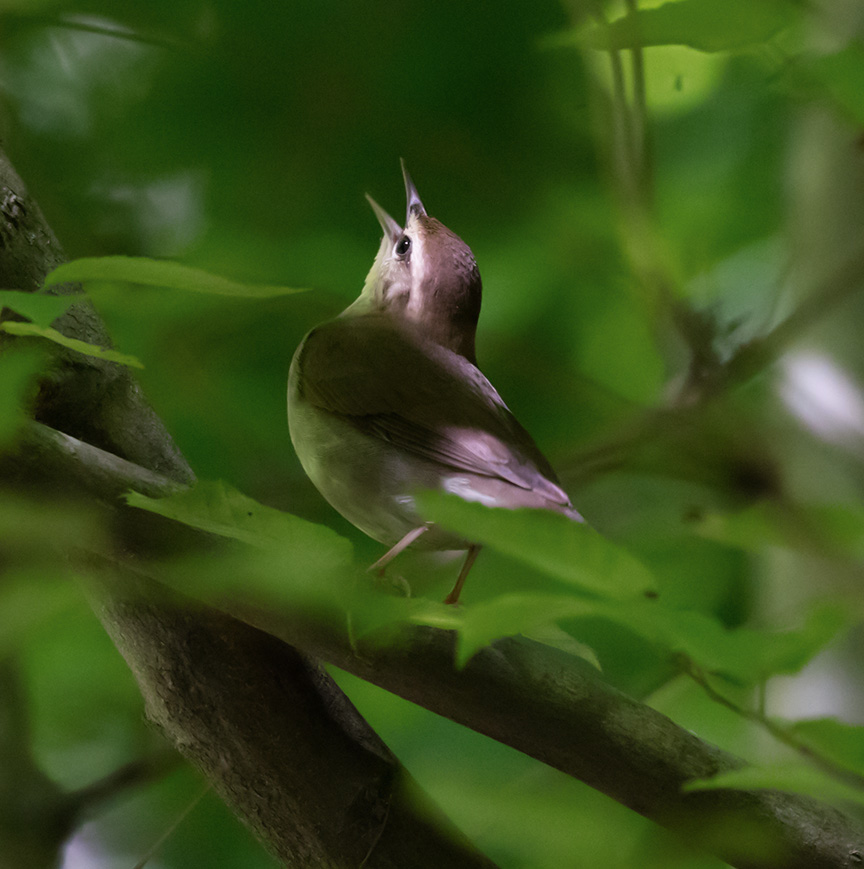
What was Cheryl telling Bethany? We were at a family reunion in Kentucky, and Cheryl was reporting a “find”—a life bird for her.
I followed them out the door and up the hill.
“Do you hear it?” Cheryl asked.
A Cerulean Warbler was singing, but that wasn’t THE BIRD. A Northern Parula was singing also, but he wasn’t THE BIRD either. An American Redstart was singing—not him. The Yellow Warbler? No!
Somewhere in the trees a Swainson’s Warbler sang. They are secretive birds. Their range does not reach our home in Virginia. So, this was the first time Cheryl had encountered a Swainson’s Warbler by either sight or ear.
The next day she identified another first for her, a Yellow-throated Warbler, again by ear, as we traveled the winding road with our windows open, listening.
For too many years I have heard just birds. Real birders, like Cheryl, hear birds by their species. They are the winners. Outdoor excursions—hiking, driving, having a picnic with friends—are much more enjoyable if you know the names of the singers around you.
What are tips for budding birders, to enjoy more of these feathered friends?
Get out early. Birds are especially active at dawn. Later, when the sun is hot, activity quiets down.
Learn bird songs. Even if you do not know songs, begin paying attention to how many syllables are being sung, whether the song has an ascending or descending pattern, and so on. Remembering to listen for these clues in the field will aid you when playing calls later to double-check your suspicions.
When you are hoping for a specific species, learn their preferred habitat and habits. Are they birds of the field or brushy fencerows? Do they live in high elevations or low? Do they like swampy habitat? Do they feed high in trees or on the ground under brush?
When I was a boy, we would see a hummingbird once or twice a year. After Bethany and I moved to the foothills of the Shenandoah Mountains, many hummingbirds came to our feeders—sometimes over a dozen at a time. We have learned they like forest edges, among other habitats, that my childhood home didn’t have.
Provide food and cover. If you have space, plant trees or shrubs that birds enjoy. I have a crabapple and serviceberry outside my office window. When they have fruit, birds come.
Provide water for the birds. They are especially attracted to flowing or dripping water. Birds need water to drink and to bathe. Be sure to have shrubs or cover of some type nearby so birds can make a hasty retreat if a hawk or cat happens through. They are especially vulnerable when they are bathing.
Near cover, provide bird feeders with various seed types. Some species have a distinct preference.
And birdhouses—don’t forget them. Maybe you want to put up bluebird houses and maintain a trail. Folks who did this when I was a boy played a big role in the comeback of this species. In Virginia, the bluebird population had declined by 90% earlier in the century. But by 1999, Eastern Bluebirds were no longer considered endangered, and are now common in many neighborhoods.
One last tip—bluebird houses should typically be no closer than 300 feet (90 m) from each other, as bluebirds are territorial. However, by placing two in the same backyard, you might attract a bluebird family and a Tree Swallow family.