

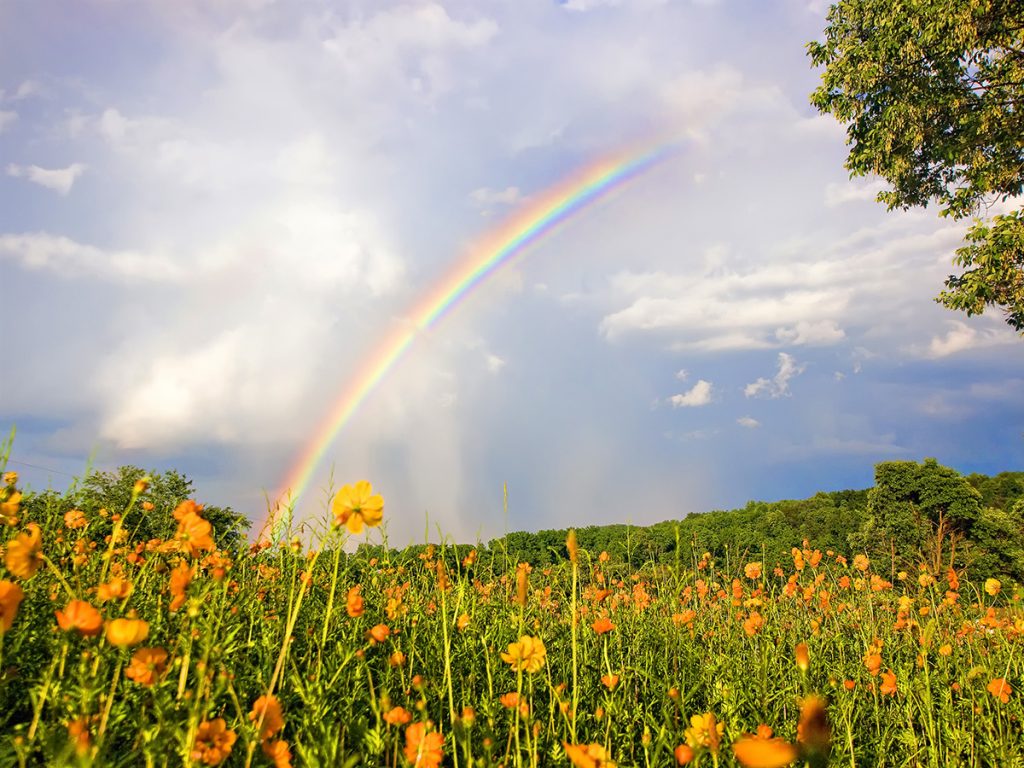
I get excited when I see a rainbow in the sky. I’m sure Noah did too. God told him to take it as a sign of His promise to never destroy the whole earth with a flood again (Genesis 9:13-16). And I am sure as Noah saw rainbows, he was happy to remember he wouldn’t have to get back into that ark and go boating again.
You already know what a rainbow looks like. How would you define it? One encyclopedia says it is an optical phenomenon formed by refraction, reflection, and dispersion of light in water droplets resulting in a continuous spectrum of light in the sky.
So, optical refers to the eyes; your eyes observe a rainbow. A phenomenon is a special, unusual occurrence. Refraction is the bending of light; reflection is light bouncing back to you. You see your reflection in a mirror. Dispersion is sending the light back out of the droplet dividing the colors, and a spectrum is the colors that make up white light arranged in their special order.
You likely have separated the colors of light by moving your watch around to catch sunlight coming in a window, projecting the different colors of light onto a wall or ceiling. Or maybe you set a prism, a triangular glass solid, on a windowsill to bend light rays and see the spectrum.
Normally we think of seven colors in a spectrum. Newton had them arranged as red, orange, yellow, green, blue, indigo, and violet. Red is at the top; it is bent the least and has the longest wavelength. Violet’s wavelength is the shortest and is bent the most.
For you to observe a rainbow, there must be sunlight behind you. You will not see a rainbow when the sun is directly overhead. Rainbows in the morning would be seen in the western sky. Evening rainbows are located in the eastern skies.
Of course there must be raindrops. Clouds have water droplets in them. The sun shines on water droplets, which are spherical in shape. The light bends as it goes into the water droplet. It reflects off the inside wall on the back of the drop and refracts again as it comes out, thus separating sunlight into its different colors.
Sometimes there is a secondary rainbow appearing above the primary one. Secondary bows are made when light is reflected twice in the droplet. It’s interesting that the colors are reversed on these bows because they are refracted upward, while primary bows are refracted downward. Secondary bows appear about 10° above the primary one.
Did I hear you saying you have seen a double rainbow where the colors are not reversed on the top one? You might be right. These are called twin bows and are thought to be formed when a shower has different sizes of water droplets. Sometimes three bows or more appear at the same time.
Do you enjoy riding in an airplane? Then maybe you have seen a full circle rainbow. From the ground we only see rainbows in the shape of an arc or half circle because the horizon interrupts them.
Have you ever seen a moonbow? These are fainter, but droplets sometimes pick up light from the full moon and separate the colors. Of course, the moon is reflecting light from the sun into the droplets.
I’ve already mentioned how you may have separated light with a prism or your watch. But now give it a try using water to make your own rainbow. You may want to give some or all of these experiments a try.
- Go outside on a sunny day when the sun is at approximately a 45-degree angle above the horizon, whether morning or evening. With your back to the sun, spray a mist of water from a hose and create your rainbow.
- You can also put water into a drinking glass and set it on the windowsill; look for the rainbow on the floor.
- Another way to make an indoor rainbow is to place a mirror in a bowl of water where the sun shines on it. Then hold a sheet of heavier white paper, such as card stock or construction paper, above and in front of the bowl to see the rainbow reflected on the paper.
- Did you know you can also use a bright flashlight instead of sunlight to see the spectrum? Use the supplies in Experiment 3. Go into a dark room and shine your light on the underwater part of the mirror. You will likely not need the paper; just reflect the colors onto a white wall.
- If you’d like to see a double spectrum, take a CD and go into a dark room with your flashlight. Shine your light on the back side of the CD. Move it around until you see two spectrums symmetrically arranged on the wall.
Have you heard of rainbows without water droplets? The Apostle John saw a rainbow circling the throne in his vision of Heaven (Revelation 8:3). And why not? God is light; He created light. I am sure the rainbows in Heaven will be more spectacular than any we have seen on earth.
