Does it seem to you that the woods is full of hidden eyes…like, there are things in the woods watching you that you can’t see? I encountered a pair of those hidden eyes one day while I was sitting in a blind hoping to photograph a drumming grouse. Unfortunately, I didn’t get to see the grouse drumming because that day it didn’t visit that particular drumming log. However, I did get to see a woodcock (or Timberdoodle) acting rather wacky.
Here’s the story. I had sat quietly in the blind for a long time. I kept hearing a grouse drumming in other places rather than the drumming log I was watching. Then suddenly right out in front of me I heard a scurrying sound. I zeroed in on the sound and saw a plump smallish creature with a very long bill running furtively away from me. It was a woodcock. It ran a few steps and then froze. Then it ran some more. It seemed to be trying to slip away because, being a pair of those hidden eyes, it had watched me set up my blind and knew I was still there.
Very soon it stopped fleeing, and I could still see it through the brush as it commenced probing the ground for food with its very long bill. While it did that, it walked along doing the timberdoodle. Or maybe it’s called the wacky woodcock waltz. Whatever it’s called, it looks hilarious. Picture this. As the woodcock steps, it places its weight on one foot and gingerly places the other one out in front like it’s testing the ground for quicksand or something. Then it bounces a few times—not really up and down, but halfway between up and down and back-n-forth. All the while the head stays still.
Then it takes another step and continues bobbing/bouncing/doodling with the other foot out front. I should point out that the toes of the forward foot are placed gently on the ground and, as the woodcock doodles, it rocks the heel down…like tapping your heel to a rhythm.
What might the doodle’s purpose be? Maybe the worms, grubs, moth pupae, or whatever else the woodcock is hunting hears the soft, rhythmic sound as rain, and they start wiggling—start moving toward the surface. You’ve probably seen nightcrawlers on the road at night during a rain. If they don’t get to the surface, they drown. Some think the woodcock’s movement imitates rain to cause the creatures underground to give away their location to the hungry woodcock. There does seem to be a relationship between the walking action and locating food.

After the woodcock foraged and timberdoodled its way out of my sight, I went over to where I first saw the woodcock, on a hunch that I might find a woodcock nest. I carefully picked my way through the brush, watching for the nest. I wasn’t sure exactly what it would look like, although I was picturing it to look similar to a killdeer nest.
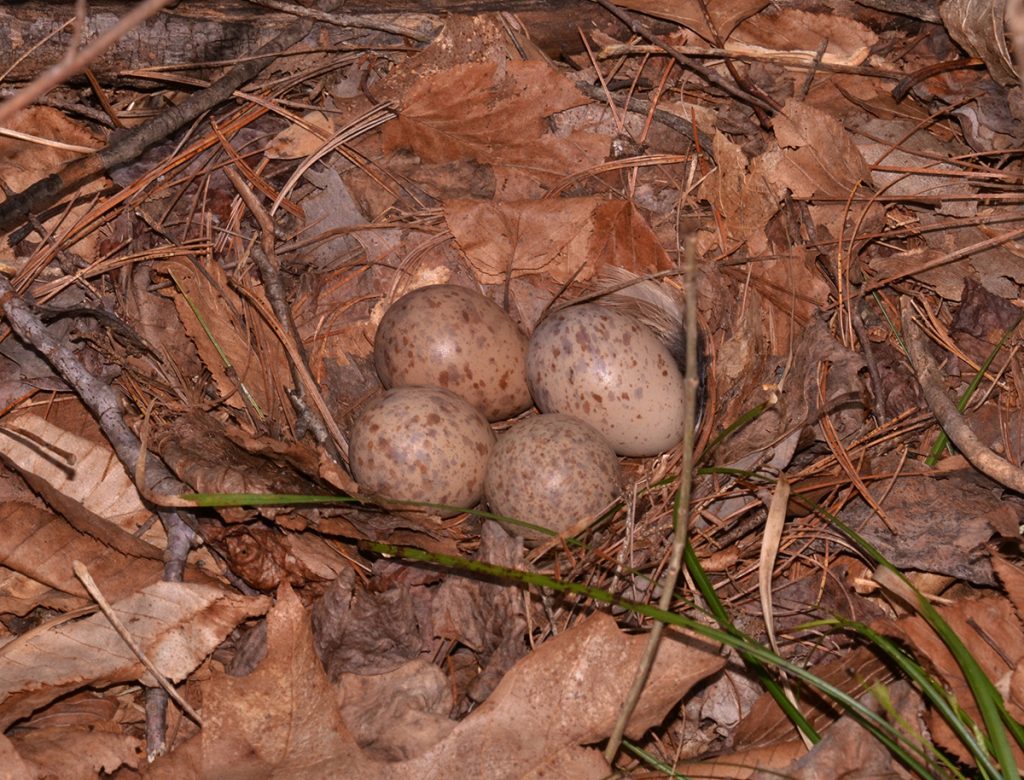
When I spotted the nest, it was right at my feet. I had almost stepped on four incredibly camouflaged woodcock eggs. I marvelled at how the eggs’ splotches of color so closely matched the forest floor—gray spots matched the sticks and maple leaves; reddish-brown spots matched the pine needles, birch leaves, some of the oak leaves; tan matched the beech and other oak leaves. The splotches of color on the eggs not only matched the colors of various leaves, but also the speckles and splotches seen on many of the leaves. Those leaf splotches, I figured, were from the breakdown process the leaves have been undergoing since they fell to the forest floor back in the fall.
I went back another day to watch for the grouse and got the idea to see if the woodcock was sitting on her nest. I carefully picked my way through the brush, watching for either the eggs or the woodcock. When I thought I was very close to the spot, I stopped and looked hard.
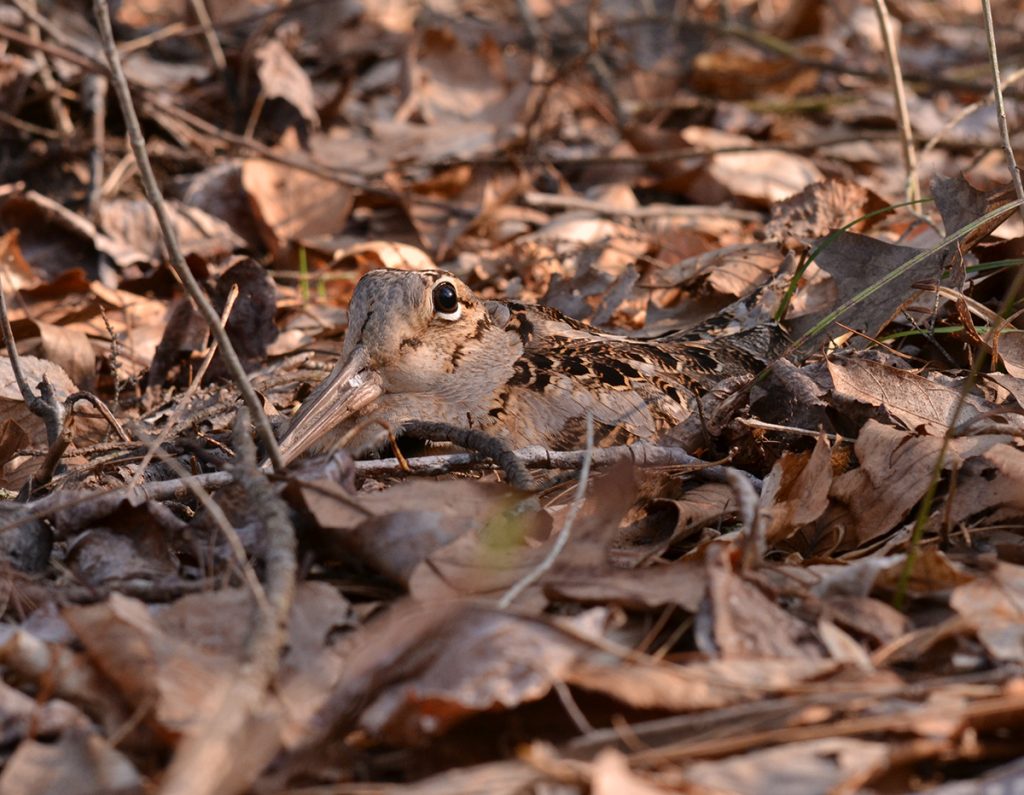
Then I saw an eye. The woodcock was harder to spot than the eggs had been. Even though I was close to stepping on the woodcock, she didn’t move. Did she know she was almost invisible? Was she trusting in her masterfully camouflaged feathers to hide her? Apparently so, because she stayed there perfectly still while I took photos. If she would’ve been a rattlesnake, she would’ve bitten me. If she had been a hornet’s nest, I would’ve been swarmed and stung. If she had been a killdeer, she would have pretended to have a broken wing.
I think it’s amazing how the patterns of the woodcock’s feathers matched the different shades of the leaves. There were even dark spots to mimic the shadows under leaves, and lines to appear like stems and twigs. The woodcock’s masterful camouflage is why she was a pair of those hidden eyes watching me from the woods.
Think about a woodcock’s eyes and how they are set high on its head and very near the back. This location looks very strange, but it gives them almost 360° vision.
Another interesting thing I noticed about my woodcock was the rainbow-colored highlights on the feathers right on top of her head. The structures of those feather barbs bend the light into different wavelengths, similar to the way soap bubbles produce their rainbow colors. This phenomenon is called thin film iridescence.
One more incredible thing I noticed about woodcocks is the bright white spots on the underside of their tail feathers. The intense white of those spots is produced by the thickened, flattened barbs which are arranged in venetian-blind fashion, making them reflect and scatter light. Additionally, the structures, nanostructures, and air pockets within the barbs strongly boost the reflectivity of the feathers. I saw those bright white spots a few times as I observed the woodcock, and sometime I’d like to see them when a woodcock fans its tail to display them. The white spots are reported to “really pop” in dim light.
I’m glad I set up a blind. I got to see a woodcock doing the wacky timberdoodle and learned some incredible things because I happened to see a pair of hidden eyes in the woods.