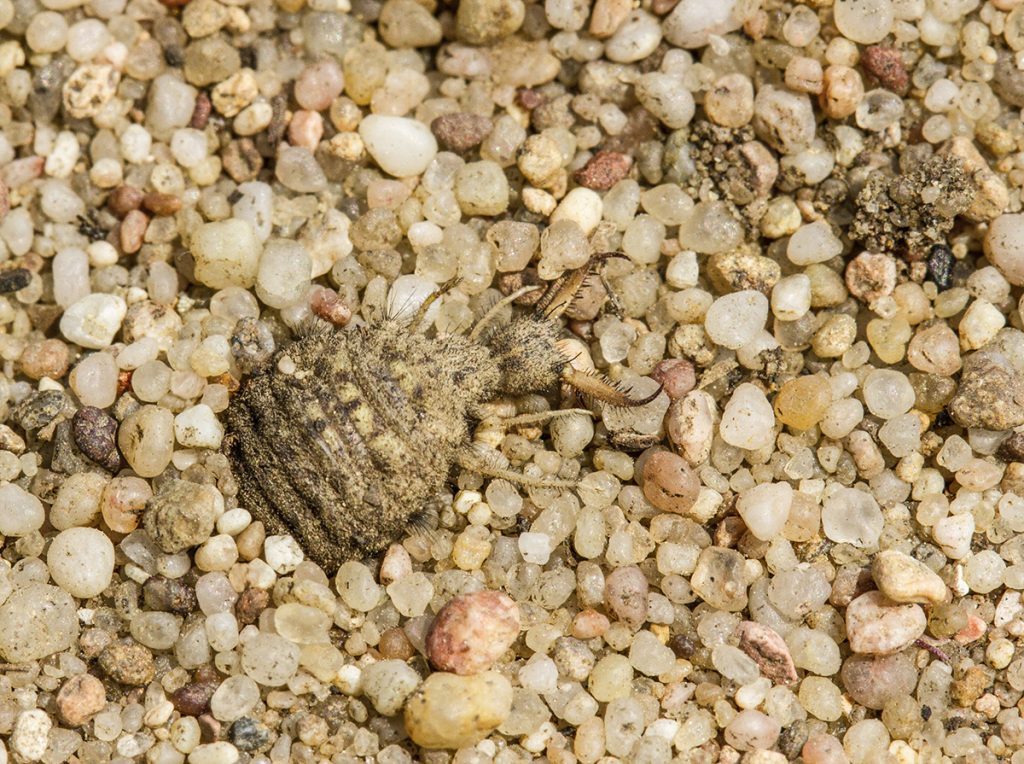
Before we go any farther, I will add another hint for our riddle: the word “lion” is included in this animal’s name.
Does that make you picture some lion-like mammal backing around in the jungle, while keeping watch over its shoulder so as not to collide with other lions or elephants or tigers?
If so, then you are quite far from solving our riddle. Our mystery animal is not a mammal, but an insect. In fact, to be quite accurate, it is only the larval form of a certain insect, and it is not very big at all.
Why, then, was it given a ferocious name like “lion”? It must be because this insect is such an avid hunter. Ants are its favorite food, and its method of catching and eating these ants is really quite entertaining.
No, Wondernose, this is not just a foreign insect that lives in some faraway land. There are about 600 species, and they are found in many countries of the world. Not all the species use this interesting hunting technique, but we will focus on those that do.
Once hatched from the egg, the larva will seek out a dry, sheltered spot where the soil is sandy. Now it begins to fashion its trap by walking around and around in a circle—backwards, of course. The pointed tail shovels up the sand and forces it up over the larva’s back. Every now and then, the larva will flick its head to throw aside the sand. When finished, our little hunter will be sitting at the bottom of a funnel-shaped pit that may be up to two inches deep.
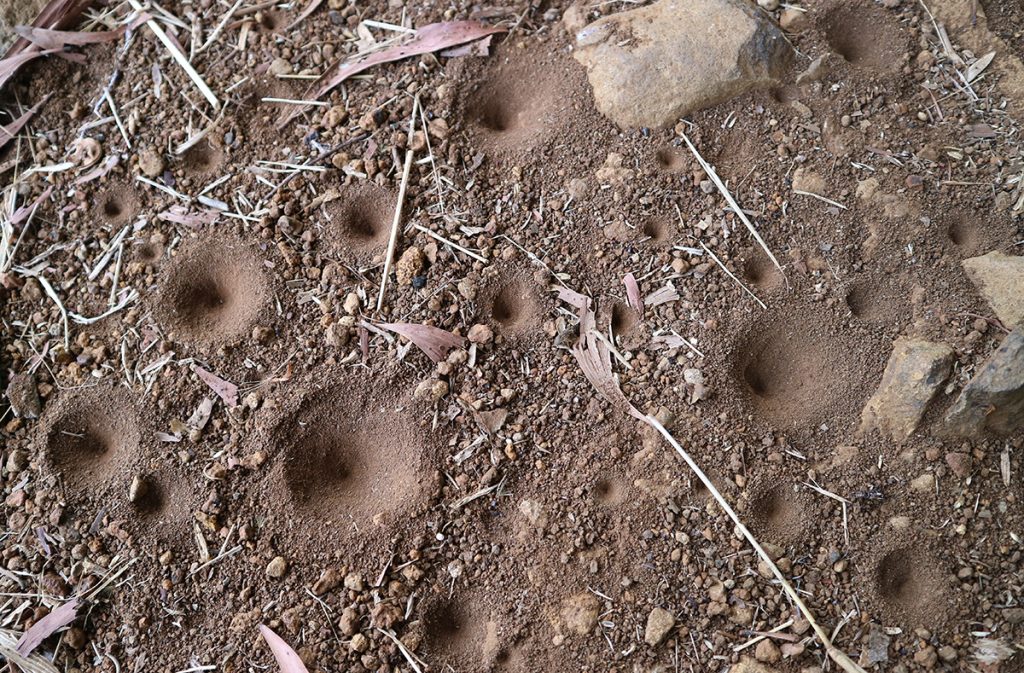
There it hides, beneath the sand. Suddenly it senses that something is walking past the top of the trap, dislodging grains of sand as it goes.
Now the fun begins! Instantly the larva flicks its head, sending an accurate spray of sand in the direction of the newcomer. Down into the pit falls the unfortunate little ant!
I don’t think I’ve mentioned our larva’s weapons. Two big sword-like jaws extend from its small head! The ant is soon caught in a lion-like grip. Poison is injected, and the larva makes short work of its breakfast.
Let me tell you about a common name that’s used for this larva. Ever heard of the doodlebug, Wondernose? The name refers to a habit many of us have. We take a pen or pencil and “doodle” some idle circles onto a paper, much like the backward circles performed by our larva when digging its trap. However, as we have seen, its doodles are anything but idle. It means business!
Of course you want to know the larva’s official name too, Wondernose. Well, it refers to its favorite food. Antlion! That’s it.
Oh, and I must tell you—only some of the species are unable to walk in a forward direction.
And what is the adult form of this antlion? It looks similar to a dragonfly, and, as far as I can tell, most species only have lengthy scientific names that I can’t spell.
Depending on the number of ants it can catch, the larva takes from one to three years to reach the pupal stage. From there, it’s about a month until the adult emerges and flies up to some twig to allow its lacy wings to dry. What a difference between the delicate-looking adult and the well-armed larva!