This is strange. Spring is the time for nest-building, for egg-laying, for bringing worms to hungry little birdies. What bird in its right mind would want to sit on eggs in sub-zero weather, trying to keep both the eggs and itself warm?
That’s a good question, but Wondernose, let me tell you some more strange things about our mystery birds. They don’t build nests. They don’t sit on eggs. In fact, each pair has only one egg to care for. And the male gets to do all the work of incubating! It takes that egg sixty-five to seventy-five days—three-plus months—to hatch. During that time, the female is off to sea, fattening herself upon the fish and crustaceans these birds love so well.
So if the male doesn’t sit on that egg, however does he keep it warm? These birds live in a part of the world that is truly cold. I mean like fifty below zero. And there’s not even a nest to help keep the poor egg warm!
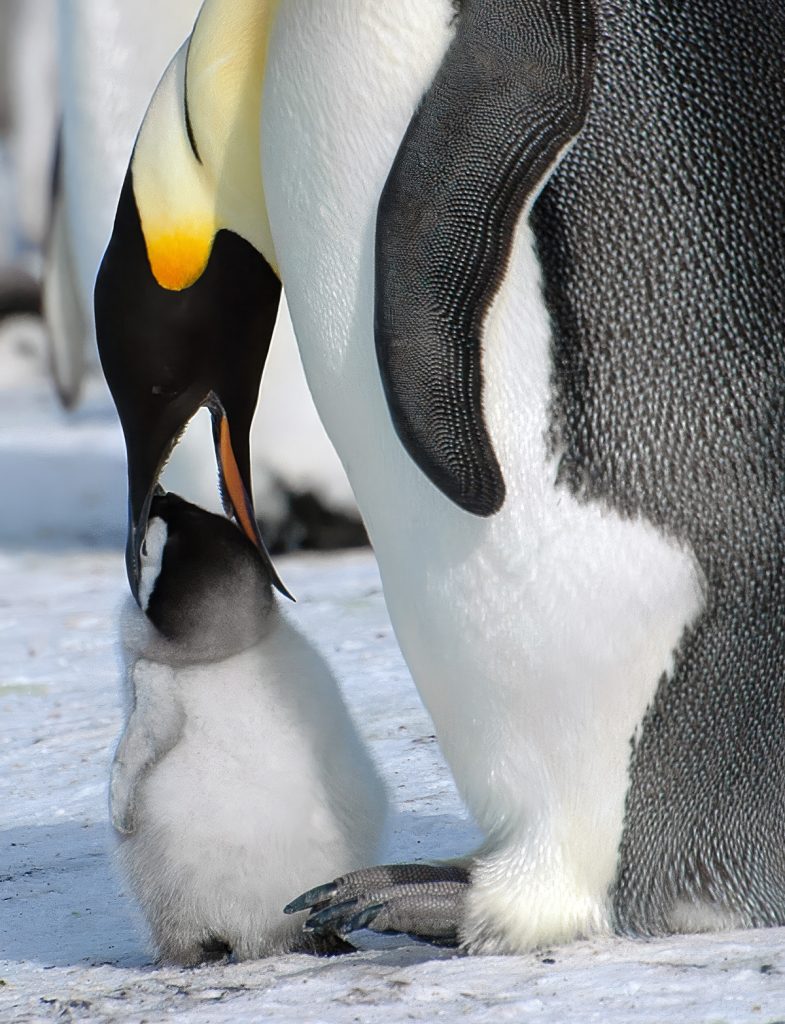
Listen to the marvelous plan God had for these birds. They’re tall birds, you see, 4 feet (1.2 m) tall, and they stand erect on their feet, looking like little men. Their legs are very short. Rolls of fat from their tummies hang right over their feet. There—on top of the feet, tucked beneath those warm, feathered rolls of fat—is where this bird keeps its egg for three long, cold months!
Of course you have guessed by now that our mystery bird is a penguin, and it lives in Antarctica. Now which kind of penguin is it? There are about eighteen species of penguins, living mostly in the world’s southern half. They don’t all live where it’s cold, though. The Galapagos Penguin lives right on the equator.
Two species of penguins live only on Antarctica. Our mystery penguin is definitely not the Adelie, a much smaller bird that’s only 18 inches (46 cm) high and weighs only a few pounds/kilograms, as opposed to the mystery bird’s nearly 100 pounds (40 kg). Furthermore, the Adelie do build nests, and they do it in the spring.
Yes, Wondernose, the answer to our riddle is the Emperor Penguin. They certainly have the right name. These penguins have such a straight, haughty bearing! Even the way they hold their beaks makes them look like proud aristocrats looking down on others. As far as their gait is concerned, it is dignified and sedate. The Adelie has a comical way of scurrying around on land; it would never be labelled as emperor-like!
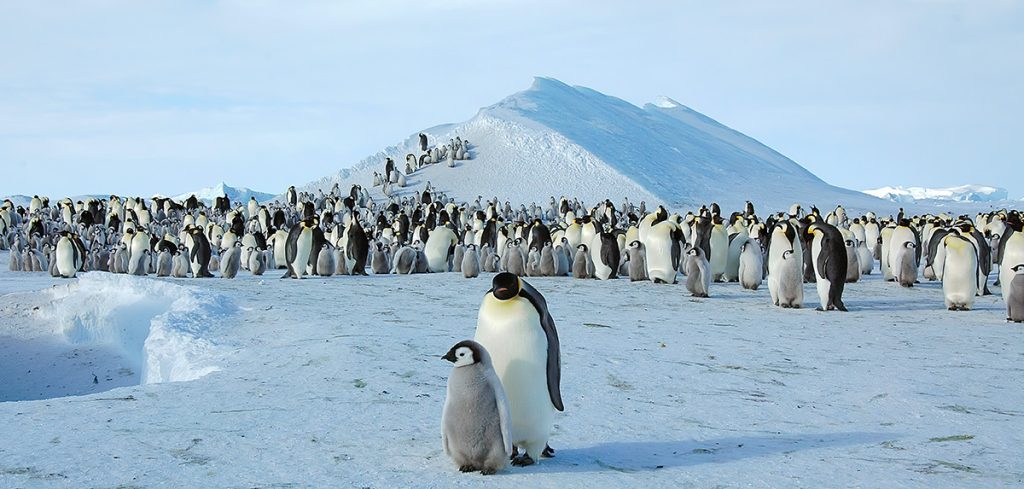
But you’re still feeling sorry for that daddy penguin that has to shuffle around for three months, balancing an egg on his feet. This is a serious matter. If an egg is left lying on the ground for any length of time in this wintry weather, only one thing can be expected. It will freeze. So during those three months, the Emperor doesn’t eat at all. How could he? Nobody is bringing him any food. The female is miles away on the open ocean. So the Emperor lives on his stored-up fat.
Finally it’s time for the egg to hatch. Like seemingly everything else in the development of the Emperor, this is a slow process. It may take three days! And I’m told the daddy can be irritable during the hatching process.
Not that his troubles are over now. He still has to keep that hatchling warm, and he does it by the same means as he incubates the egg. When those long-suffering daddies themselves get cold, they crowd into tight huddles where everyone helps everyone else keep warm.
Fortunately, by this time, the mama penguin has returned, well-fed after months at sea. She now takes her turn at babysitting while the daddy goes off for some much-needed food.
But these babies need a lot of care—far longer than the Adelie’s babies. From the time the egg is laid, it takes up to eight months for an Emperor to mature enough that he’s ready to live on his own. And that answers your question of why these penguins care for eggs in the coldest weather. It’s all timed so that the chicks will be mature at the best time of year—summer!