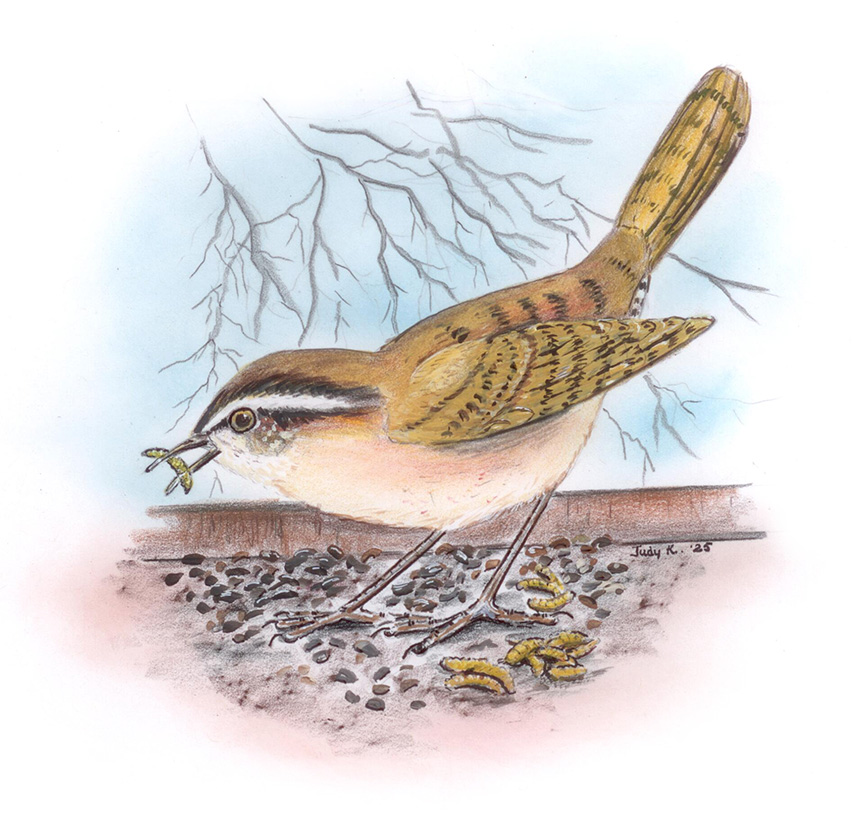
The story of this Carolina Wren began late last summer. We live too far north to have these wrens. But what was I hearing? “Cheat-er, Cheat-er, Cheat-er!” It certainly sounded like the same wren I had heard a number of times in Ohio and Pennsylvania. I stalked through the woodsy horse paddock where that song came from. No success.
Or was it a cardinal? Almost I could imagine it to be singing “Cheer, Cheer, Cheer!” (The bird guide states they can imitate several other birds, almost like a mockingbird.) Yet, something still didn’t sound like a cardinal. The mystery was solved in these last weeks of November when the Carolina Wren couldn’t remain hidden…not when mealworms were being offered at our diner! It has come a number of times, not every day, but never stays more than a few seconds.
You will need:
- Soft-lead pencil colors
- 4 Regular paper
- 4 Cardstock
- 4 Black fine-tip marker
- 4 Pencil
- 4 Foam sheet
- 4 Acrylic paints
- 4 #20 flat brush
- 4 #0 round brush
- 4 10/0 tiny brush
- Paint or pencil colors: Black, dark umber, goldenrod, white, cream
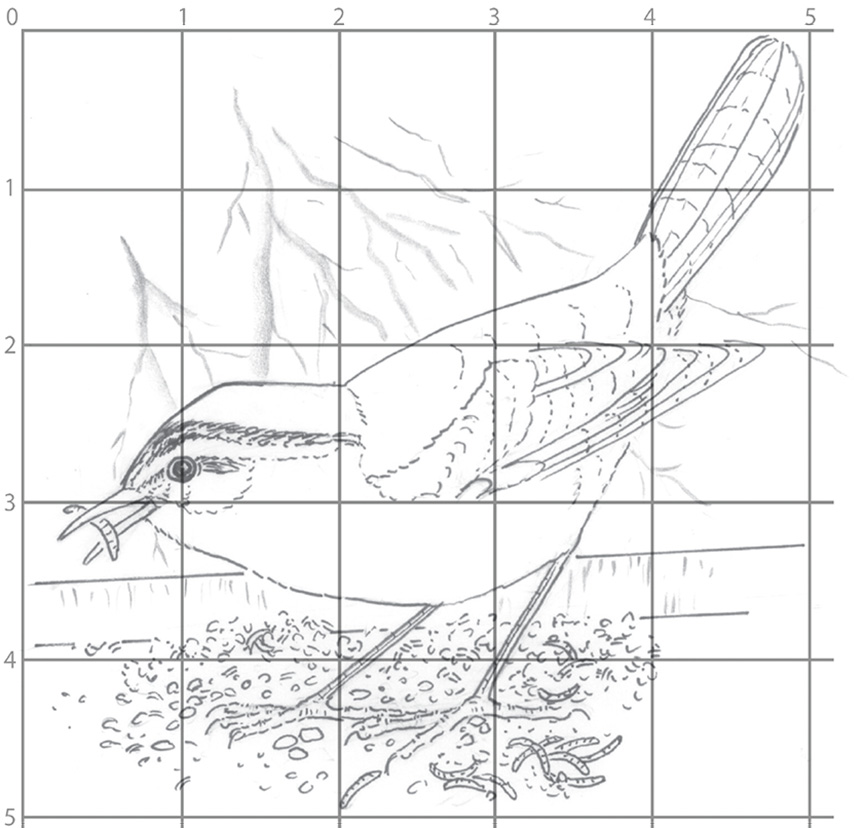
- On a regular paper, lightly draw 1” grid lines, and sketch your bird block by block as the guide picture shows. When you like what you see, trace over your drawing with a fine-tip black marker. Now place your drawing under your cardstock and trace the wren scene with your pencil.
- Your scene is ready for color. Do the eye first, using a fine-tip black marker, outlining the entire eye with black. When doing the pupil, leave a white highlight. Then add a smidgen of yellow to the colored part of the eye. Use that fine-tip marker for the beak as well. Fill in with cream or yellow.
- Use a light shading of dark umber over the back, over the top of the head, on the lower edge of its tail, and on the wings. Now burnish over this all with goldenrod. Add a black-brown streaking above and beside its eye. Note color. A tiny bit of Tuscan red could be tucked under the eye.
- Outline feather divisions with a few markings of black or dark umber. (Use paint here if you wish, with 10/0 brush.) I also added a few white touches to help with feather divisions. Next add the black zig-zag patterns as shown, typical of a wren.
- A goldenrod and tan mix gives color to the lower body. Add a smidgen of black shading under his wing. Also touch in short ‘n quick tiny feather markings with brown. You may need to outline the legs and feet with your fine-tip black marker to help them snap out.
- The feeder is done with sweepings of black and dark umber. Some black and brown paint dabbing with a small round brush works well for the seeds. Highlight some seeds with a bit of white paint. Outline the mealworms with black to help them stand out. Then fill in with goldenrod.
- With blue chalking and the #20 brush, fill in the background sky. Then do black markings for the background branches. Avoid adding too many details.