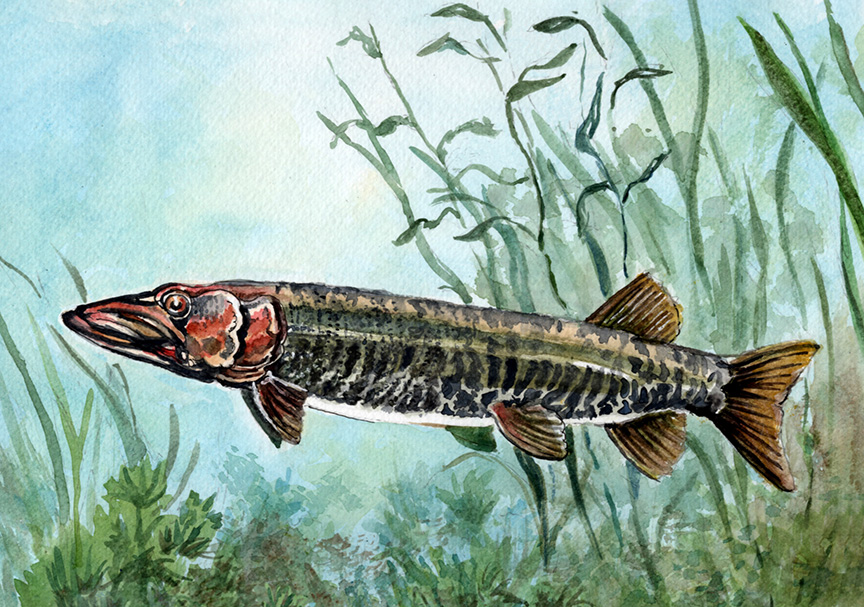
The muskellunge, a member of the pike family, is sometimes called the freshwater shark because of its ferocity. This predator lurks among weeds and surges forward to capture a frog, fish, or duck in its powerful jaws. Sharp teeth facing inward prevent escape as it swallows its victim whole.
The muskellunge has no enemies except cannibalism from it own kind. The fierce fight it puts up when hooked makes it a prized sport fish.
In spring, the female lays as many as 100,000 eggs. Neglected by the mother, the eggs stick to weeds or settle along the lake bottom. In two weeks they hatch. Two months later, after consuming hundreds of small fish, they have grown to 6 inches long. Although the adult range from 15-35 pounds, the world record was estimated to have been 70 pounds.
You will need:
- Sketch paper
- Watercolor paper
- Watercolor brushes: #6, #4, #2
- Watercolors: Red, yellow ochre, yellow, blue, green, Paynes gray, burnt sienna
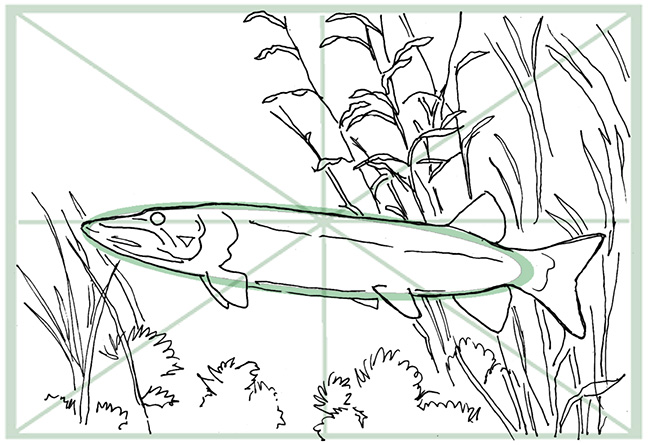
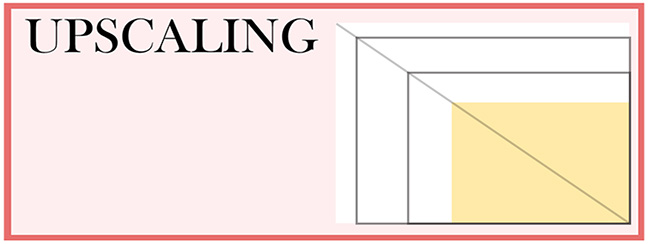
- As a guide for placing your muskellunge, on sketch paper, divide your rectangle diagonally, horizontally, and vertically. Next draw a long oval for the basic shape, and add details. Then trace lightly onto watercolor paper.
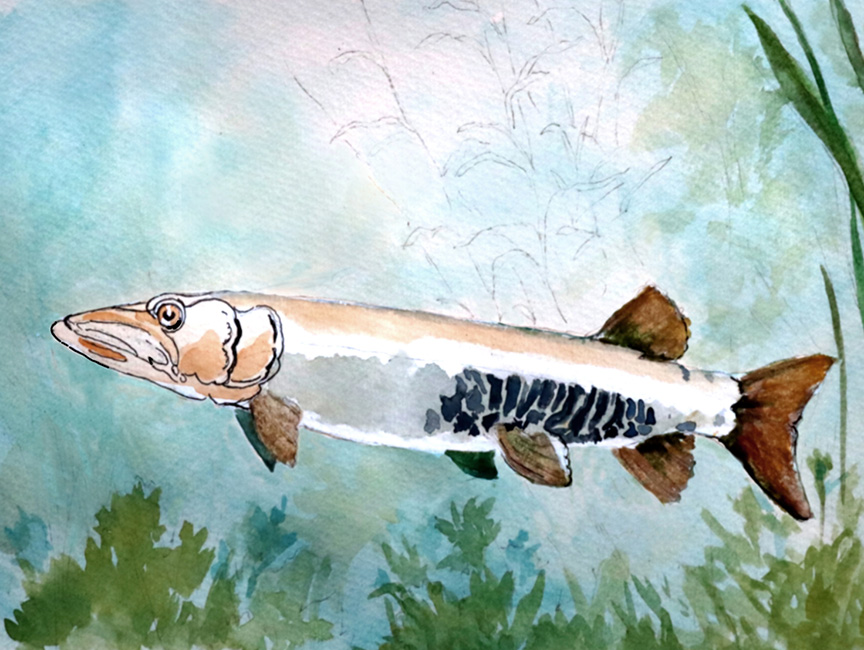
- Before adding color, with your #8 brush lightly wet the entire background, being careful to avoid the fish. (Color will follow the area you dampened.) On your palette, mix a puddle of blue, and drop this color on the dampened paper. Encourage it with your brush as it spreads across the background.
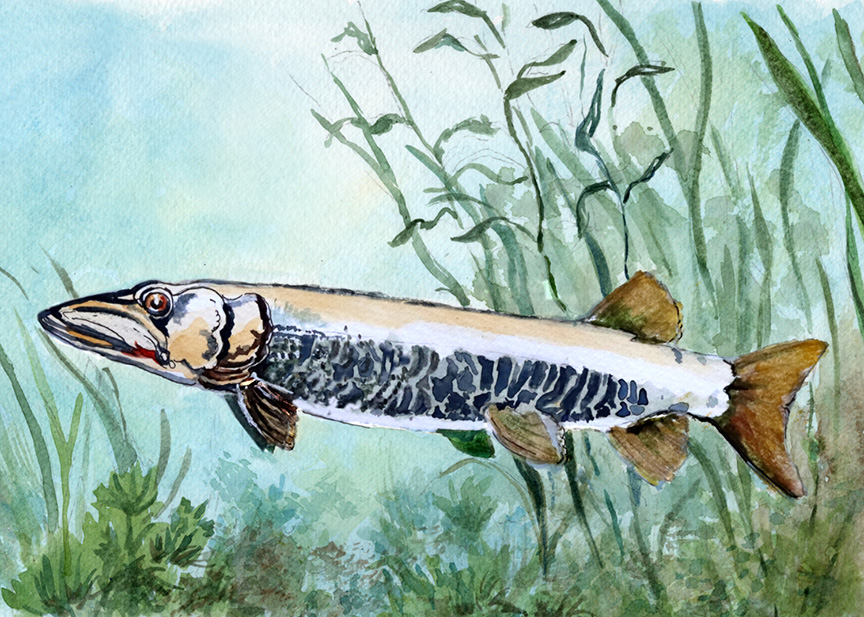
- Switch to the #4 brush for painting yellow ochre on the head and back, burnt sienna on the fins and tail, and Paynes gray on the lower side of the muskellunge. Add dark markings to the head and lower side of the fish.
- Combining some yellow and then some blue with green on your palette will give variety as you begin adding foliage. Start the plants at the bottom of the page and taper off.
- Using your #2 brush, make dark lines on the fins and tail. Paint red markings on the head. With your #4 brush, place a dark green stripe the length of the fish’s body, both below and above the narrower white side stripe. Go over this, putting in dark markings along the top of the muskellunge.